
Warrants Case Vs Summons Case under BNSS
Warrants Case Vs Summons Case under BNSS
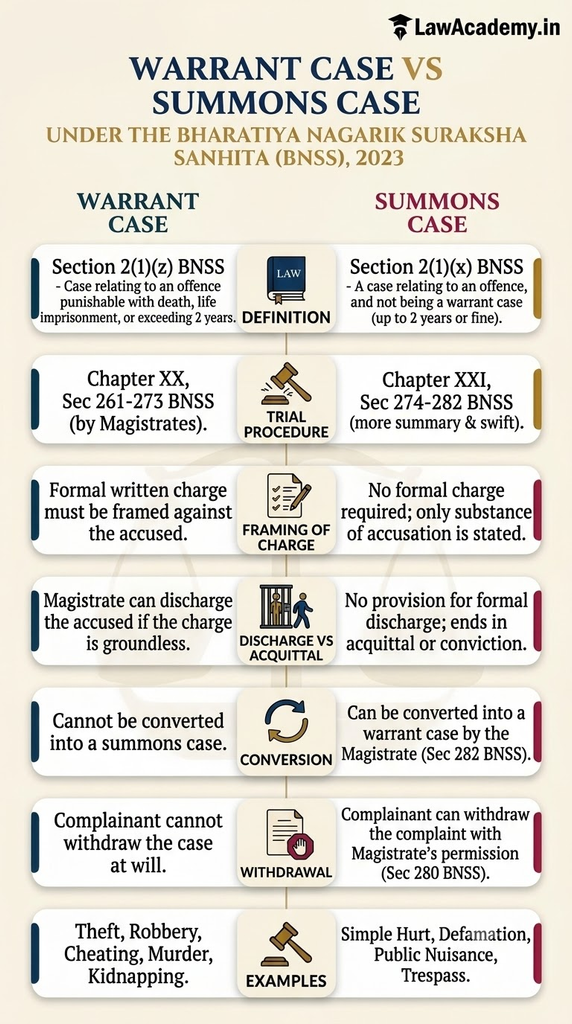
A Warrant Case is a criminal case relating to a serious or grave offence punishable with death, imprisonment for life, or imprisonment for a term exceeding two years.
A Summons Case is a criminal case relating to a relatively minor or petty offence carrying lesser penalties (punishable with imprisonment not exceeding two years).
Under the Bharatiya Nagarik Suraksha Sanhita (BNSS), 2023, these categories determine the trial procedure, framing of formal charges, and the Magistrate’s powers regarding withdrawal or conversion of proceedings.
Distinction Between Warrant Case and Summons Case under BNSS, 2023
| Basis of Distinction | Warrant Case | Summons Case |
| Statutory Definition | Defined under Section 2(1)(x) of BNSS, 2023 as a case relating to an offence punishable with death, imprisonment for life, or imprisonment for a term exceeding 2 years. | Defined under Section 2(1)(w) of BNSS, 2023 as a case relating to an offence, not being a warrant case (i.e., imprisonment up to 2 years or fine only). |
| Severity / Gravity | Serious, heinous, or severe offences. | Minor, petty, or less grave offences. |
| Governing Trial Chapter | Governed by Chapter XIX (Sections 261 to 273 of BNSS, 2023) — Trial of Warrant Cases by Magistrates. | Governed by Chapter XX (Sections 274 to 282 of BNSS, 2023) — Trial of Summons Cases by Magistrates. |
| Framing of Formal Charge | A formal, written charge must be framed against the accused under Section 269 of BNSS, 2023 (or discharge under Section 262/268). | No formal charge needs to be framed; only the substance of the accusation is stated to the accused under Section 274 of BNSS, 2023. |
| Discharge / Dismissal | The Magistrate can formally discharge the accused if the allegations are considered groundless before charges are framed. | There is no concept of formal “discharge”; the Magistrate either convicts or acquits the accused. |
| Conversion of Procedure | A warrant-case procedure cannot be converted into a summons-case procedure. | A summons case can be converted into a warrant case by the Magistrate under Section 282 of BNSS, 2023 if the offence is punishable with imprisonment exceeding 6 months and it is in the interest of justice. |
| Withdrawal of Complaint | A complaint cannot be withdrawn at will without specific statutory permission of the court under Section 360 BNSS. | The complainant may withdraw the complaint with the permission of the Magistrate under Section 280 of BNSS, 2023, resulting in the immediate acquittal of the accused. |
| Absence of Complainant | If the complainant is absent in a complaint case, the Magistrate may discharge the accused only if the offence is non-cognizable or compoundable before charges are framed (Section 272 BNSS). | Non-appearance or death of the complainant generally results in the dismissal of the complaint and the statutory acquittal of the accused under Section 279 of BNSS, 2023. |
| Statutory Examples | Murder (Section 103 BNS), Theft (Section 303 BNS), Rape (Section 64 BNS), Robbery (Section 309 BNS), Cheating (Section 318 BNS). | Simple Hurt (Section 115(2) BNS), Defamation (Section 356 BNS), Public Nuisance, Wrongful Restraint (Section 126 BNS). |