
Various provisions relating to Summary Trial under BNSS
Various provisions relating to Summary Trial under BNSS
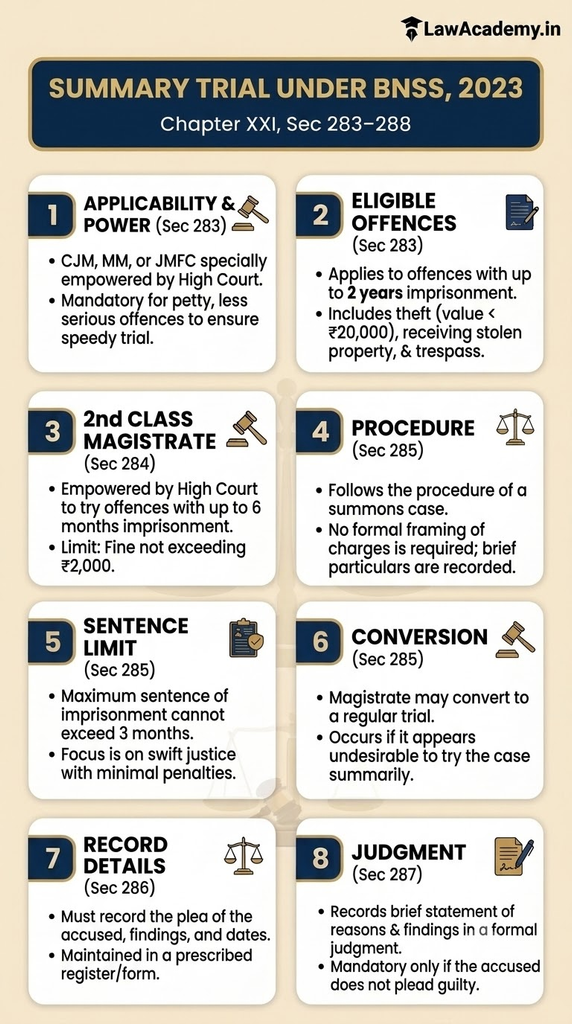
A Summary Trial is an abridged, simplified judicial proceeding designed for the rapid disposal of petty and minor criminal cases without compromising substantive justice. It disposes of cases swiftly by dispensing with the elaborate recording of comprehensive oral evidence, detailed examination-in-chief, or formal framing of charges, recording only the substance of evidence and a concise judgment.
Under the Bharatiya Nagarik Suraksha Sanhita (BNSS), 2023, Summary Trials are governed by Chapter XXI (Sections 283 to 288) (formerly Chapter XXI, Sections 260 to 265 of the CrPC, 1973).
Provisions Relating to Summary Trial under BNSS, 2023
1. Power to Try Summarily (Section 283(1))
- Definition: Specifies the judicial officers vested with the statutory jurisdiction to conduct summary trials.
- Competent Authorities:
- Any Chief Judicial Magistrate (CJM).
- Any Metropolitan Magistrate (MM).
- Any Magistrate of the First Class (JMFC) specially empowered in this behalf by the High Court.
2. Offences Triable Summarily (Section 283(1) & (2))
- Definition: Enumerates the specific categories of minor offences that may be disposed of through the summary procedure.
- Eligible Offences:
- Offences not punishable with death, imprisonment for life, or imprisonment for a term exceeding three years (increased under BNSS from the two-year limit in CrPC).
- Theft under Section 303(2) of the Bharatiya Nyaya Sanhita (BNS), 2023, where the value of stolen property does not exceed ₹20,000 (raised from ₹2,000 under the old code).
- Receiving or retaining stolen property under Section 317(2) BNS, where the value does not exceed ₹20,000.
- Assisting in the concealment or disposal of stolen property under Section 317(5) BNS, where the value does not exceed ₹20,000.
- Lurking house-trespass or house-breaking under Section 329(3) BNS.
- Insult with intent to provoke a breach of the peace under Section 352 BNS.
- Criminal intimidation under Section 351(2) BNS.
- Abetment of or attempt to commit any of the foregoing offences.
- Any offence constituted by an act in respect of which a complaint may be made under Section 20 of the Cattle-trespass Act, 1871.
- Mandatory Summary Trial for Petty Offences (Section 283(2)): BNSS introduces a requirement that the Magistrate shall try all petty offences summarily, unless reasons to the contrary are recorded in writing.
3. Power of Second Class Magistrate (Section 284)
- Definition: Allows the High Court to confer summary trial powers on Judicial Magistrates of the Second Class.
- Scope: The High Court may empower any Magistrate of the Second Class to try summarily any offence punishable only with fine or with imprisonment for a term not exceeding six months (with or without fine), as well as abetment of or attempts to commit such offences.
4. Procedure Applicable to Summary Trials (Section 285)
- Definition: Regulates the basic procedural model adopted during a summary trial.
- Rule: The procedure prescribed for the trial of summons cases (under Chapter XX of BNSS) is followed in all summary trials, except as otherwise provided in Chapter XXI.
- No Formal Charge: No formal written charge is required to be framed; only the substance of the accusation is stated to the accused.
5. Limitation on Quantum of Sentence (Section 285(2))
- Definition: A statutory ceiling on the penal power of the Magistrate when proceeding summarily.
- Restriction: No sentence of imprisonment for a term exceeding three months can be passed in any conviction under this chapter.
6. Switch / Conversion to Regular Trial (Section 285 Proviso)
- Definition: The power of the court to abandon the summary procedure in favor of a regular summons or warrant trial.
- Condition: When, in the course of a summary trial, it appears to the Magistrate that the nature of the case is such that it is undesirable to try it summarily, the Magistrate may recall any witnesses who have been examined and proceed to re-hear the case in accordance with the regular trial procedure.
7. Record in Summary Trials (Section 286)
- Definition: Mandates the maintenance of specific, standardized particulars in the case register rather than recording full depositions.
- Mandatory Particulars:
- Serial number of the case.
- Date of the commission of the offence.
- Date of the report or complaint.
- Name of the complainant (if any).
- Name, parentage, and residence of the accused.
- Offence complained of and the offence (if any) proved.
- Plea of the accused and examination (if any).
- Finding of the court.
- Sentence or other final order.
- Date on which proceedings terminated.
8. Judgment in Cases Tried Summarily (Section 287)
- Definition: Specifies the requirements for drafting the final judgment based on whether the accused pleads guilty or contests the charges.
- Pleads Guilty: The Magistrate records the substance of the admission and passes an order of conviction.
- Contested Case: Where the accused does not plead guilty, the Magistrate must record the substance of the evidence and a brief statement of the reasons for the finding before pronouncing judgment.
9. Language of Record and Judgment (Section 288)
- Definition: Dictates the official linguistic form and authentication of summary trial records.
- Rule: Every record maintained under Section 286 and every judgment delivered under Section 287 must be prepared in the language of the court and signed by the presiding Magistrate.