
Cognizable Vs Non-Cognizable offences under BNSS
Cognizable Vs Non-Cognizable offences under BNSS
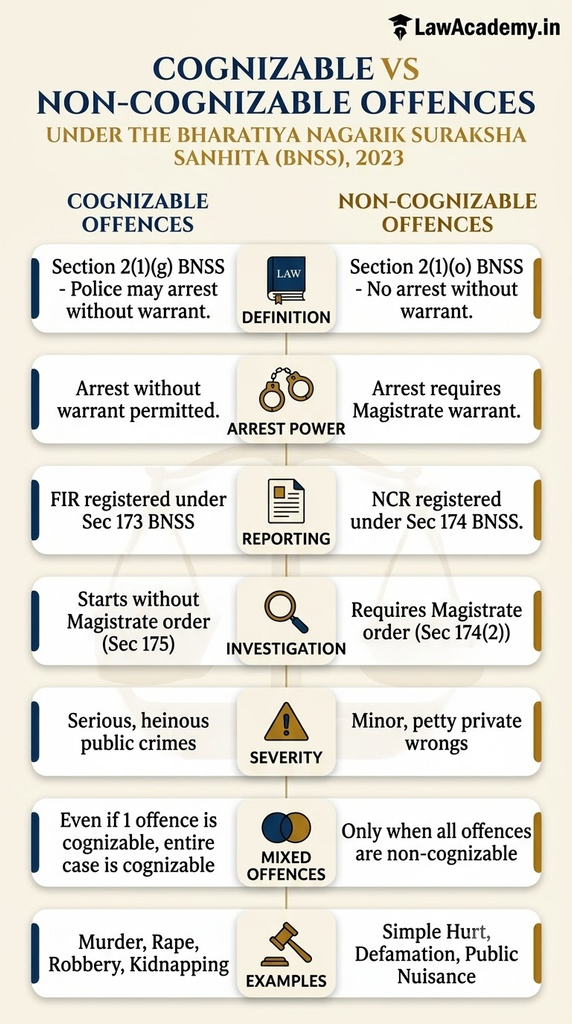
A Cognizable Offence is a serious category of criminal offence where a police officer has the statutory authority to arrest the accused without a warrant from a Magistrate and can initiate an investigation without requiring prior magisterial permission.
A Non-Cognizable Offence is a less serious crime where a police officer has no authority to arrest the accused without an arrest warrant issued by a competent Magistrate and cannot investigate the case without the specific direction and sanction of a Magistrate.
Under the Bharatiya Nagarik Suraksha Sanhita (BNSS), 2023, these classifications are codified under Section 2, governing police procedures, FIR registrations, and investigative protocols.
Distinction Between Cognizable and Non-Cognizable Offences under BNSS, 2023
| Basis of Distinction | Cognizable Offence | Non-Cognizable Offence |
| Statutory Definition | Defined under Section 2(1)(g) of BNSS, 2023 as an offence for which a police officer may arrest without a warrant in accordance with the First Schedule or any other law. | Defined under Section 2(1)(o) of BNSS, 2023 as an offence for which a police officer has no authority to arrest without a warrant. |
| Power of Arrest | Police can arrest the accused without a warrant issued by a Magistrate. | Police cannot arrest the accused without a valid warrant issued by a competent Magistrate. |
| Initiation of Information | Information given to police is registered as a First Information Report (FIR) under Section 173 of BNSS, 2023 (formerly Section 154 CrPC). | Information is recorded as a Non-Cognizable Report (NCR) in the station diary under Section 174 of BNSS, 2023 (formerly Section 155 CrPC). |
| Investigation Authority | Police have the statutory power and duty to investigate without an order of a Magistrate (Section 175 BNSS). | Police cannot investigate without the specific order/sanction of a Magistrate having jurisdiction (Section 174(2) BNSS). |
| Nature & Gravity | Relates to grave, heinous, and public wrongs that pose a direct threat to societal peace and safety. | Relates to minor, less grave private wrongs or petty disputes between individuals. |
| Submission of Final Report | Upon concluding investigation, the police submit a Police Report / Chargesheet to the Magistrate under Section 193 of BNSS, 2023. | If investigated under a Magistrate’s order, the police report is submitted, which is treated as a complaint under Section 2(1)(h) BNSS. |
| Combined Offences (Section 174(4) BNSS) | Where a case involves two or more offences, of which at least one is cognizable, the case is deemed to be a cognizable case, notwithstanding that the other offences are non-cognizable. | Applies only when all alleged offences are purely non-cognizable in nature. |
| Statutory Examples | Murder (Section 103 BNS), Rape (Section 64 BNS), Robbery (Section 309 BNS), Kidnapping, Dowry Death. | Simple Hurt (Section 115(2) BNS), Defamation (Section 356 BNS), Public Nuisance, Criminal Intimidation (Section 351(2) BNS). |