
Salient features of Juvenile Justice (Care and Protection) Act, 2015
Salient features of Juvenile Justice (Care and Protection) Act, 2015
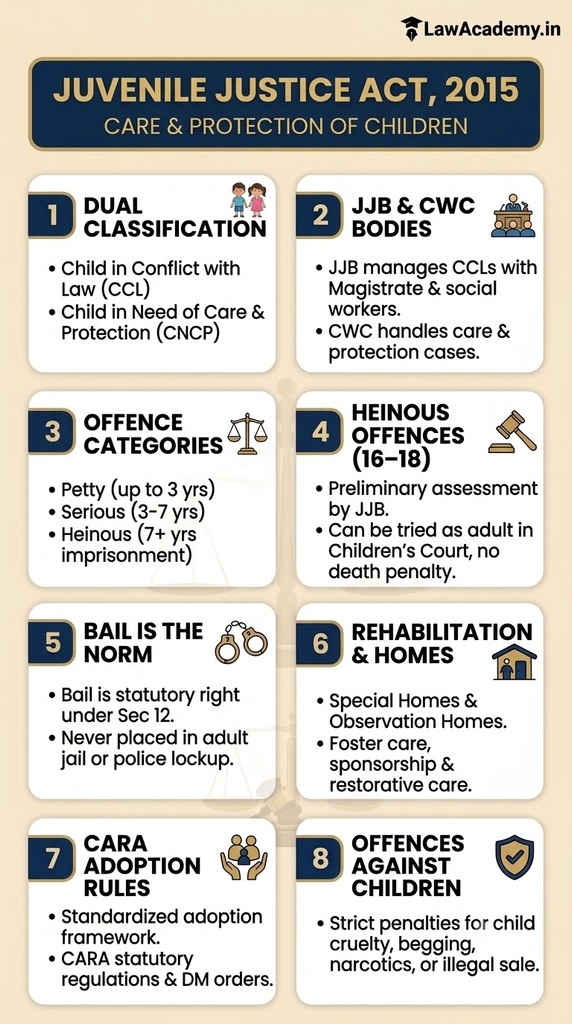
The Juvenile Justice (Care and Protection of Children) Act, 2015 (replacing the earlier 2000 Act) is India’s principal comprehensive statute governing the rights, care, protection, and rehabilitation of children. It aligns domestic law with the UN Convention on the Rights of the Child (UNCRC) and shifts the overarching approach from punitive retribution to reformative and restorative justice.
1. Dual Classification of Children
The Act distinctly bifurcates children under 18 years into two categories to deliver tailored institutional mechanisms:
- Child in Conflict with Law (CCL) [Sec. 2(13)]: A child who is alleged or found to have committed an offence and has not completed 18 years of age on the date of commission.
- Child in Need of Care and Protection (CNCP) [Sec. 2(14)]: Children facing vulnerability, abuse, abandonment, homelessness, exploitation, child labour, or lack of fit guardians.
2. General Principles of Child Care (Section 3)
The statute codifies 16 fundamental principles that bind all courts, boards, and institutions, including:
- Principle of presumption of innocence.
- Principle of best interest of the child.
- Principle of non-stigmatising semantics (e.g., terms like “arrest”, “jail”, “conviction”, or “accused” are strictly barred; “apprehension” and “inquiry” are used).
- Principle of right to privacy, dignity, and confidentiality.
3. Classification of Offences
To eliminate ambiguity in procedures and sentencing, offences committed by juveniles are classified into three categories:
- Petty Offences: Offences punishable with imprisonment up to 3 years.
- Serious Offences: Offences punishable with imprisonment between 3 and 7 years.
- Heinous Offences: Offences punishable with a minimum imprisonment of 7 years or more under substantive penal laws.
4. Trial of Juveniles Aged 16–18 for Heinous Offences (Sections 15 & 18)
- Where a child aged between 16 and 18 years is alleged to have committed a heinous offence, the Juvenile Justice Board (JJB) conducts a preliminary assessment regarding their mental and physical capacity to commit the crime, ability to understand the consequences, and circumstances of the act.
- If the JJB concludes that the child should be tried as an adult, the case is transferred to the Children’s Court (Sessions Court).
- Absolute Protection: Even if tried by the Children’s Court, no child can be awarded the death penalty or life imprisonment without the possibility of release (Section 21).
5. Dedicated Adjudicatory Bodies
- Juvenile Justice Board (JJB) [Section 4]: Handles CCLs in every district. Comprises a Principal Magistrate (Metropolitan/Judicial Magistrate First Class) and two social workers (at least one being a woman).
- Child Welfare Committee (CWC) [Section 27]: Exercises Magisterial powers for CNCPs. Comprises a Chairperson and four members with child welfare expertise (at least one being a woman).
6. Child-Friendly Procedures & Bail as a Norm (Section 12)
- Bail as a General Rule: When a juvenile is apprehended, bail is a statutory norm irrespective of whether the offence is bailable or non-bailable, unless release brings them into association with known criminals or exposes them to moral, physical, or psychological danger.
- Prohibition of Police Lockups: Under no circumstances can a child be lodged in a regular police lockup or adult prison; they must be kept in an Observation Home or Place of Safety.
- Children cannot be handcuffed or chained.
7. Child Care Institutions & Non-Institutional Options
- Institutional Infrastructure: Mandates the establishment and registration of Observation Homes (during inquiry), Special Homes (for rehabilitation post-inquiry), Places of Safety, and Children’s Homes. All childcare institutions must be registered with the State Government under Section 41.
- Non-Institutional Care: Explicit provisions prioritizing family restoration, foster care, sponsorship, and fit persons/facilities.
8. Streamlined Adoption Framework (Chapter VIII)
- Standardizes and codifies inter-country and in-country adoption procedures for orphaned, abandoned, and surrendered children.
- Recognizes the Central Adoption Resource Authority (CARA) as a statutory body to regulate transparent and swift adoption protocols.
- (Note: Post-2021 amendment, the power to issue adoption orders was shifted from civil courts to District Magistrates/Additional District Magistrates to expedite timelines).
9. New and Stringent Offences Against Children (Chapter IX)
The Act creates specific criminal liabilities with strict penal provisions for acts committed by adults against children:
- Sale and procurement of children (Sec. 81).
- Giving intoxicating liquor, narcotics, or psychotropic substances to a child (Sec. 77).
- Employing children for begging (Sec. 76) or using them for illegal/smuggling activities.
- Cruelty and corporal punishment against children (Sec. 75).
10. Protection of Identity & Confidentiality (Section 74)
Strict prohibition on print, electronic, or social media from disclosing the name, address, school, photograph, or any details that could reveal the identity of any child involved in JJ proceedings, punishable with fine and imprisonment up to 6 months.