
Various provisions of Plea Bargaining under BNSS.
Various provisions of Plea Bargaining under BNSS.
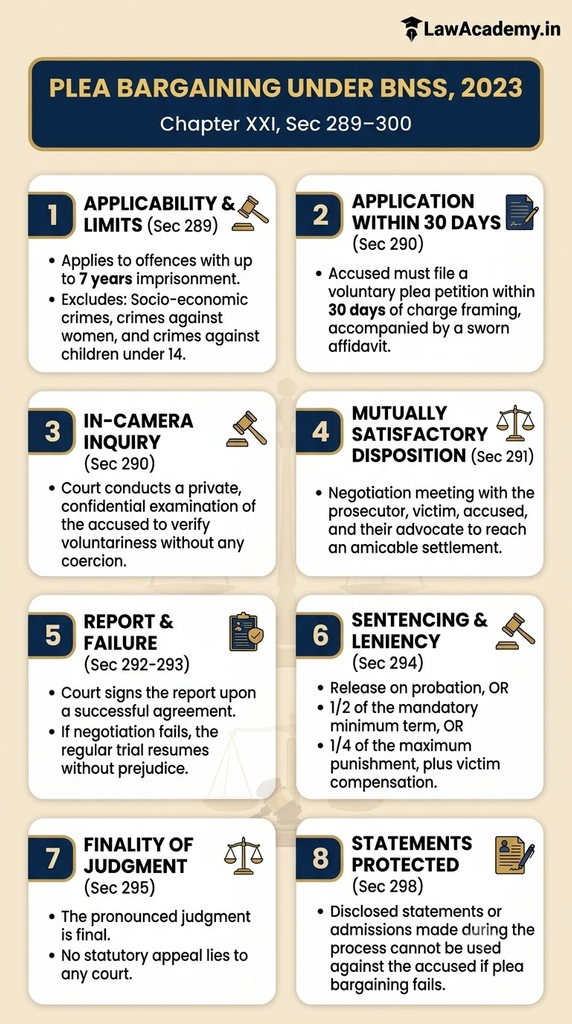
Plea Bargaining is a pre-trial negotiation process between the prosecution and the accused, overseen by the court, wherein the accused agrees to plead guilty to the charged offence or a lesser offence in exchange for certain concessions, such as a reduced sentence, a lesser charge, or an agreement on victim compensation.
Under the Bharatiya Nagarik Suraksha Sanhita (BNSS), 2023, Plea Bargaining is codified under Chapter XXI (Sections 289 to 300).
Key Provisions of Plea Bargaining under BNSS, 2023
1. Scope and Applicability (Section 289)
- Definition: Outlines the specific categories of criminal cases where an accused can seek plea bargaining, and sets statutory exclusions based on punishment and nature of the crime.
- Scope:
- Applicable to offences where the maximum punishment prescribed by law does not exceed imprisonment for seven years.
- Initiated either upon a police report under Section 193 BNSS or upon taking cognizance of an offence on a private complaint.
- Exclusions:
- Offences affecting the socio-economic conditions of the country (as notified by the Central Government).
- Offences committed against women or children below the age of fourteen years.
- Not available to previous convicts (habitual offenders) convicted of the same offence.
2. Application for Plea Bargaining & Time Limit (Section 290)
- Definition: The procedural mechanism and statutory deadline by which the accused formally petitions the court to initiate the plea-bargaining process.
- Timeframe: The application must be filed within 30 days from the date of framing of charges by the court.
- Contents: Must contain a brief description of the case, supported by an affidavit sworn by the accused stating that the application is voluntary and that the applicant has not previously been convicted of the same offence.
3. In-Camera Examination of Voluntariness (Section 290(2) & (3))
- Definition: The preliminary judicial inquiry to guarantee that the accused’s decision to plead guilty is genuine and devoid of external pressure or coercion.
- Procedure: The court issues notice to the Public Prosecutor, investigating officer, and victim. The Magistrate/Judge examines the accused in camera (in private, without the presence of the opposite party) to ensure the plea was made voluntarily.
4. Mutually Satisfactory Disposition (MSD) Guidelines (Section 291)
- Definition: The structured negotiation process facilitated by the court to reach an agreed settlement between the parties.
- Participants:
- In Police Cases: Public Prosecutor, investigating officer, victim, and the accused (assisted by their advocate).
- In Complaint Cases: The complainant/victim and the accused (assisted by their advocate).
- Objective: Arrive at a mutually satisfactory disposition of the case, which may include compensation and other expenses to be paid by the accused to the victim.
5. Report of the Settlement (Sections 292 & 293)
- Definition: The formal documentation of the outcome of the negotiation process.
- Successful Settlement (Sec 292): If a mutually satisfactory disposition is reached, the court prepares a report signed by the presiding officer and all participating parties.
- Failure to Settle (Sec 293): If no agreeable resolution is reached, the court records the failure and directs the case to proceed with regular trial from the stage where the application was originally made.
6. Disposal of the Case and Sentencing Rules (Section 294)
- Definition: The statutory sentencing framework applied by the court once a mutually satisfactory disposition is approved.
- Sentencing Framework:
- Compensation Award: The court awards compensation to the victim as agreed in the settlement.
- Release on Probation: The court may release the accused on probation of good conduct or after admonition under Section 401 BNSS / Probation of Offenders Act, 1958, where eligible.
- Minimum Sentence Offence: If the law prescribes a mandatory minimum punishment, the court may sentence the accused to half of such minimum imprisonment.
- Non-Minimum Sentence Offence: In any other case, the court may sentence the accused to one-fourth (one-fourth of the term) of the maximum punishment provided for the offence.
7. Finality of Judgment (Section 295)
- Definition: The statutory bar against appeals to ensure closure and prevent endless litigation.
- Rule: The judgment pronounced by the court in a plea bargaining proceeding is final. No appeal lies against such a judgment to any superior court, except through a Special Leave Petition (SLP) under Article 136 of the Constitution of India or a writ petition under Articles 226/227 before the High Court.
8. Protection Against Self-Incrimination / Statements Not to Be Used (Section 298)
- Definition: The legal safeguard protecting the accused if the negotiations collapse.
- Rule: Statements, admissions, or facts disclosed by an accused in a plea bargaining application cannot be used as evidence against them for any other purpose or in any ongoing or subsequent trial if the settlement fails.