
Viewing Child Abuse Material Is an Offence Under POCSO and IT Act
Viewing Child Abuse Material Is an Offence Under POCSO and IT Act
Zero Tolerance: Supreme Court Rules Storing and Viewing Child Abuse Material Is an Offence Under POCSO and IT Act
By LawAcademy Editorial Team
Published on October 4, 2026
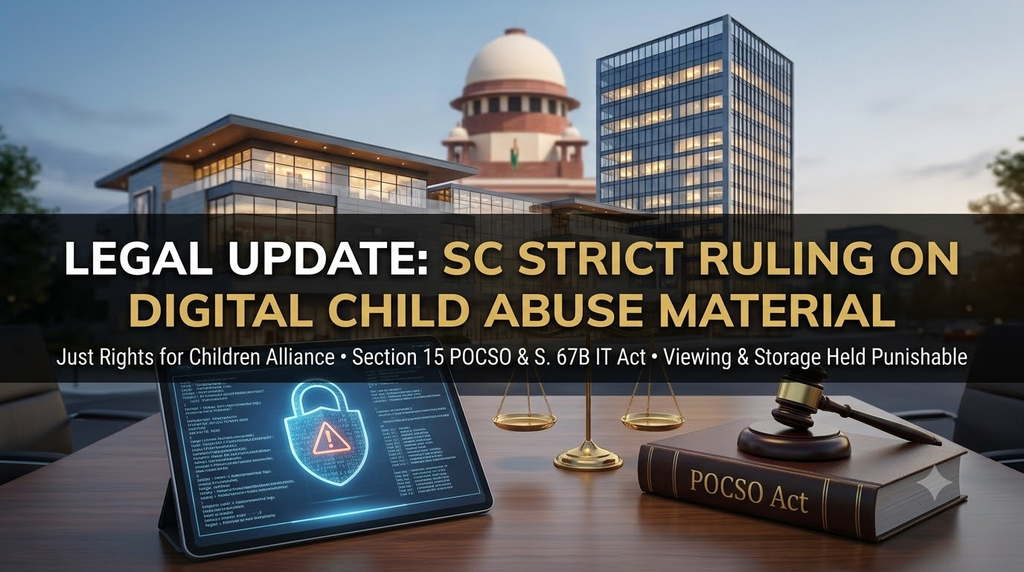
In an authoritative ruling aimed at safeguarding children in the digital ecosystem, the Supreme Court of India held that the downloading, viewing, and storing of Child Sexual Abuse Material (CSAM) constitutes a punishable offence under Indian law, even in the absence of an intention to circulate or transmit such content.
Overruling an order of the Madras High Court that had quashed criminal proceedings against an individual for merely downloading such media onto a mobile phone, a bench comprising Chief Justice D.Y. Chandrachud and Justice J.B. Pardiwala clarified the scope of Section 15 of the Protection of Children from Sexual Offences (POCSO) Act, 2012 and Section 67B of the Information Technology (IT) Act, 2000.
Core Legal Issue & The High Court’s Error
The Madras High Court had previously taken the view that simple downloading or private viewing of child abuse material, without secondary distribution, publication, or commercial exploitation, did not attract penal consequences under Section 15 of the POCSO Act.
The Supreme Court rejected this narrow interpretation, holding that it ignored the legislative amendments introduced in 2019 and defeated the fundamental objective of the statute:
- Consumption Fuels Creation: The Court observed that viewing and storing child sexual abuse media is not a victimless private act; consumer demand directly fuels the sexual exploitation, coercion, and abuse of vulnerable minors.
- Interpretation of Section 15 POCSO: Following the 2019 legislative amendment, Section 15 penalizes the storage or possession of child sexual abuse material unless it is retained for legitimate evidentiary, reporting, or statutory defense purposes.
- Mandatory Reporting Duty: Under Section 19 and Section 21 of the POCSO Act, any person who comes into possession or knowledge of child abuse media is legally mandated to report or surrender it to child protection agencies or law enforcement, rather than retain it in private custody.
Key Directives Laid Down by the Court
- Harmonizing POCSO and IT Act Provisions: The bench clarified that Section 67B of the IT Act (penalizing facilitation and collection of child pornography) and Section 15 of the POCSO Act must be read in tandem to prevent enforcement gaps.
- Guidance on Terminology: The Court urged legislative and judicial bodies to officially replace the phrase “child pornography” with “Child Sexual Abuse Material” (CSAM) or “Child Sexual Exploitation and Abuse Material” (CSEAM), underscoring that the word “pornography” inappropriately normalizes acts of non-consensual violence against minors.
- Preventive Tech Responsibilities: Directed social media intermediaries, internet service providers (ISPs), and tech platforms to aggressively deploy hashing technology and reporting mechanisms to flag and takedown illicit content proactively.
Impact on Cyber Law and Child Rights Jurisprudence
The verdict closes a critical legal loophole that offenders previously exploited to avoid liability by claiming personal, non-commercial use. It establishes an absolute legal duty on digital citizens to flag and delete illicit content immediately, shifting legal liability from outward circulation to possessory intake.
Reference & Source
- Case Title: Just Rights for Children Alliance & Anr. v. S. Harish & Ors. (Criminal Appeal No. 3922 of 2024)
- Bench: Dr. D.Y. Chandrachud (CJI) and J.B. Pardiwala, J.
- Date of Judgment: September 23
- Statutory Focus: Section 15, Section 19, Section 21 of the POCSO Act, 2012 (as amended in 2019); Section 67B of the Information Technology Act, 2000.