
Supreme Court Formulates Comprehensive Child Protection Directives
Supreme Court Formulates Comprehensive Child Protection Directives
Digital Safety and Sex Education in Schools: Supreme Court Formulates Comprehensive Child Protection Directives
By LawAcademy Editorial Team
Published on October 23, 2026
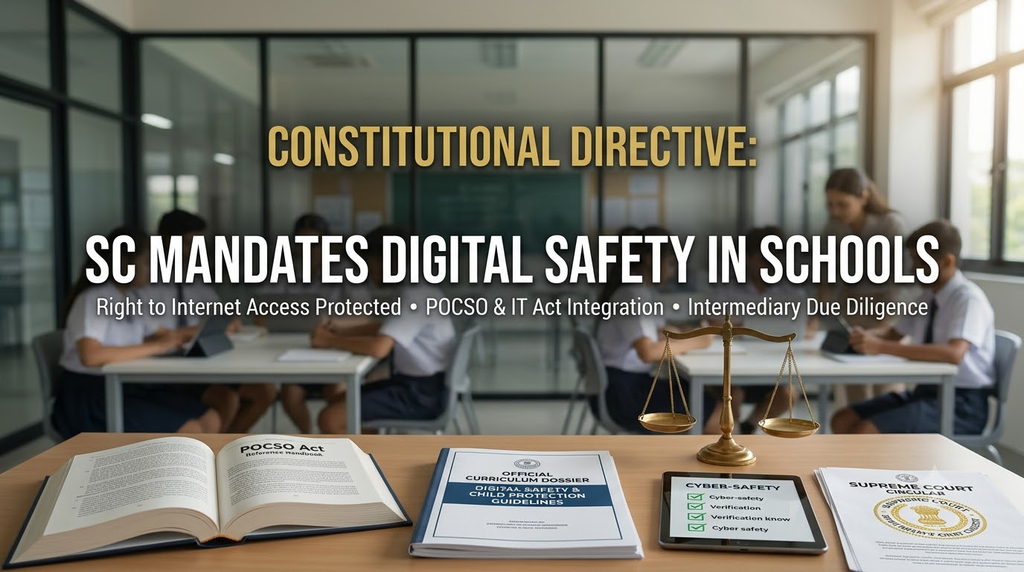
Delivering a landmark ruling at the intersection of constitutional liberty and child protection, the Supreme Court of India held that digital safety and age-appropriate sex education are two sides of the same coin and must be integrated into school curricula from the primary level.
In Just Rights for Children Alliance & Anr. v. S. Harish & Ors. (2026 INSC 1149), a division bench comprising Justice J.B. Pardiwala and Justice K. Vinod Chandran addressed the escalating circulation of Child Sexual Exploitation and Abuse Material (CSEAM). The Court rejected calls for a blanket prohibition on children accessing the internet, ruling that access to the digital ecosystem is an extension of fundamental rights under Articles 19(1)(a), 21, and 21A, while formulating binding operational directives for educational boards, social media intermediaries, and law enforcement agencies.
Core Directives Laid Down by the Apex Court
- Curriculum Integration via NCERT & SCERTs: The National Council of Educational Research and Training (NCERT) and State Councils (SCERTs) are directed to formulate age-appropriate modules on bodily boundaries, good and bad touch, personal consent, peer privacy, and digital literacy in consultation with child psychologists and education experts.
- Awareness on Non-Consensual Peer Media: The Court specifically noted the phenomenon where adolescents photograph, record, or circulate private images of peers. Curricula must clearly apprise students of the penal consequences under the POCSO Act and the Information Technology Act, 2000, emphasizing that possessing, viewing, or distributing non-consensual sexually explicit content is a serious criminal offense.
- Institutional Firewalls and Helpline Displays: All educational institutions, residential hostels, and coaching hubs must install content filters on digital networks and prominently display national emergency numbers—such as the Child Helpline (1098), the Cyber Crime Helpline (1930), and links to the National Cyber Crime Reporting Portal—across classrooms, computer labs, and portals.
- Intermediary Due Diligence & Two-Hour Reporting Rule: Social media platforms and online intermediaries must maintain accessible CSEAM reporting workflows, execute immediate removal of known abuse material, and report unknown-origin abuse files to the national cybercrime authorities within two hours of detection or complaint confirmation.
- Free Psychological and Rehabilitative Support: Underlining the State’s restorative obligations, the bench directed governments to guarantee continuous, free-of-cost trauma counseling, psychological therapy, and follow-up care to minor survivors of digital abuse and exploitation.
Constitutional Synthesis: Protection Without Disproportionate Bans
The bench emphasized that children cannot be insulated from online harms by cutting off their connection to modern education, creative development, and research. Blanket bans disproportionately injure underprivileged children dependent on digital public goods. The constitutional solution lies in systemic accountability: training children to navigate online spaces, holding tech intermediaries accountable for automated algorithmic grooming, and enforcing the mandatory reporting requirements under Sections 19 and 21 of the POCSO Act.
Reference & Source Links
- Case Title: Just Rights for Children Alliance & Anr. v. S. Harish & Ors.
- Neutral Citation: 2026 INSC 1149
- Date of Judgment/Directions: October 15–21, 2026
- Bench: Hon’ble Justice J.B. Pardiwala and Hon’ble Justice K. Vinod Chandran
- Statutory Bedrock: Protection of Children from Sexual Offences (POCSO) Act, 2012 (Sections 19, 21); Information Technology Act, 2000 (Section 67B); Articles 19(1)(a), 21, and 21A of the Constitution.
- Official Judgment Source: Supreme Court of India Official Judgments Portal (sci.gov.in)
- National Reporting Framework: National Cyber Crime Reporting Portal (cybercrime.gov.in)