
Dignity Within Prison Walls
Dignity Within Prison Walls
Dignity Within Prison Walls: Supreme Court Strikes Down Caste Discrimination and Segregation in State Prison Manuals
By LawAcademy Editorial Team
Published on October 4, 2026
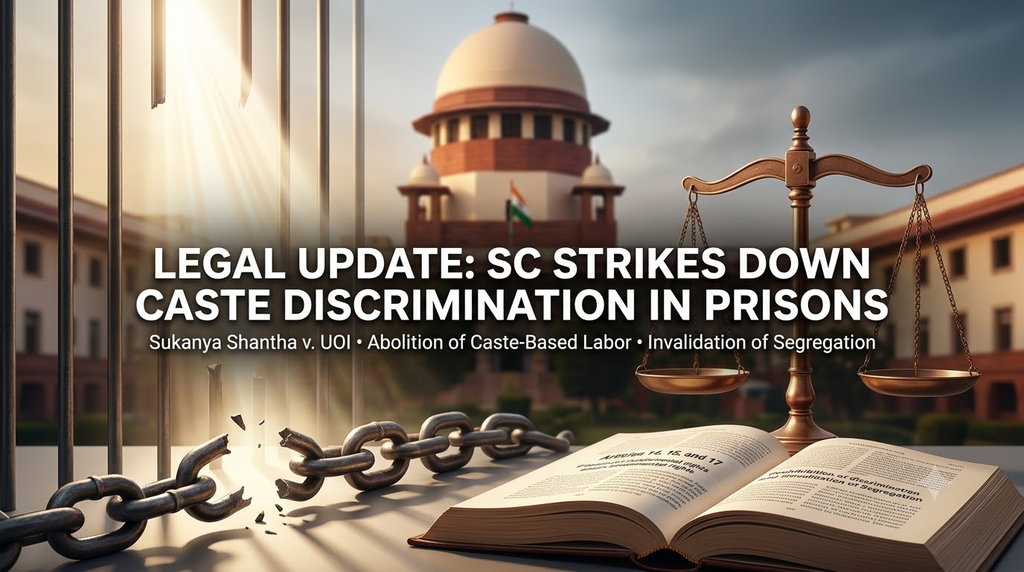
In a landmark verdict championing constitutional morality within correctional institutions, a three-judge bench of the Supreme Court of India struck down discriminatory provisions in state prison manuals that enforced division of labor and segregation of barracks based on caste.
Delivering the judgment in Sukanya Shantha v. Union of India & Ors., the Court held that the fundamental rights of equality, dignity, and freedom from discrimination do not halt at prison gates, declaring all institutional caste practices violative of Articles 14, 15, 17, 21, and 23 of the Constitution.
Key Highlights of the Judgment
- Abolition of Caste-Based Labor: The apex court invalidated archaic colonial-era rules that assigned kitchen and cooking duties exclusively to “upper caste” inmates while relegating sweeping, latrine cleaning, and manual scavenging duties to marginalized castes.
- Prohibition of Barrack Segregation: The bench held that segregating prisoners into specific wards or barracks based on caste purity, lineage, or customary untouchability violates constitutional anti-discrimination guarantees.
- Deletion of Caste Columns in Records: The Court ordered the Union and all State/UT governments to remove the “caste” entry column from prisoner registers, intake dockets, and correctional databases.
- Overhaul of “Habitual Offender” Definitions: Struck down discriminatory references that targeted members of Denotified Tribes (DNTs) and nomadic communities under the guise of “habitual offenders” or “criminal classes.”
- Continuous Judicial Oversight: The Court initiated a suo motu writ petition titled In Re: Discrimination Inside Prisons in India to monitor compliance, requiring all States and Union Territories to submit revised manuals within three months.
Breaking the Colonial-Feudal Carceral Architecture
The petition stemmed from investigative reporting by journalist Sukanya Shantha, exposing that jail manuals across states—including Uttar Pradesh, Rajasthan, Madhya Pradesh, Punjab, and West Bengal—retained century-old rules mandating caste-based roles.
Chief Justice D.Y. Chandrachud, authoring the judgment, observed that assigning menial sanitation work to marginalized communities under the guise of them being “accustomed to such work” directly perpetuates the outlawed evil of untouchability:
“To assign menial work like sweeping and cleaning latrines to marginalized castes while allowing upper castes to cook is an egregious violation of Article 15. The Constitution does not permit the State to institutionalize caste prejudices under the veil of administrative convenience or religious customs.”
The Court emphasized that rehabilitation—not the reproduction of societal hierarchies—must form the sole objective of penal incarceration.
Mandates for Correctional and Legal Aid Authorities
To ensure that the ruling translates into structural reform on the ground, the Court issued binding guidelines:
- State Revisions: All States and Union Territories must align their prison rules with the Model Prison Manual, 2016, and the Model Prisons and Correctional Services Act, 2023, eliminating every remnant of caste distinction.
- Duty of DLSAs: District Legal Services Authorities (DLSAs) and Board of Visitors are mandated to conduct surprise inspections in prisons to verify that kitchen, cleaning, and maintenance tasks are allotted transparently without caste bias.
- No Coerced Scavenging: The bench reiterated that compelling prisoners from specific castes to clean septic tanks or sewers violates the Prohibition of Employment as Manual Scavengers and their Rehabilitation Act, 2013 and amounts to forced labor under Article 23.
Reference & Source
- Case Title: Sukanya Shantha v. Union of India & Ors. (Writ Petition (Civil) No. 1404 of 2023)
- Bench: Dr. D.Y. Chandrachud (CJI), J.B. Pardiwala, and Manoj Misra, JJ.
- Date of Judgment: October 3
- Constitutional Provisions: Articles 14, 15, 17, 21, and 23 of the Constitution of India.