
Core Pillars of National e-Courts Phase III
Core Pillars of National e-Courts Phase III
Transforming Justice Delivery: Core Pillars of National e-Courts Phase III
By [LawAcademy Editorial Team]
Published on [15-09-2026]
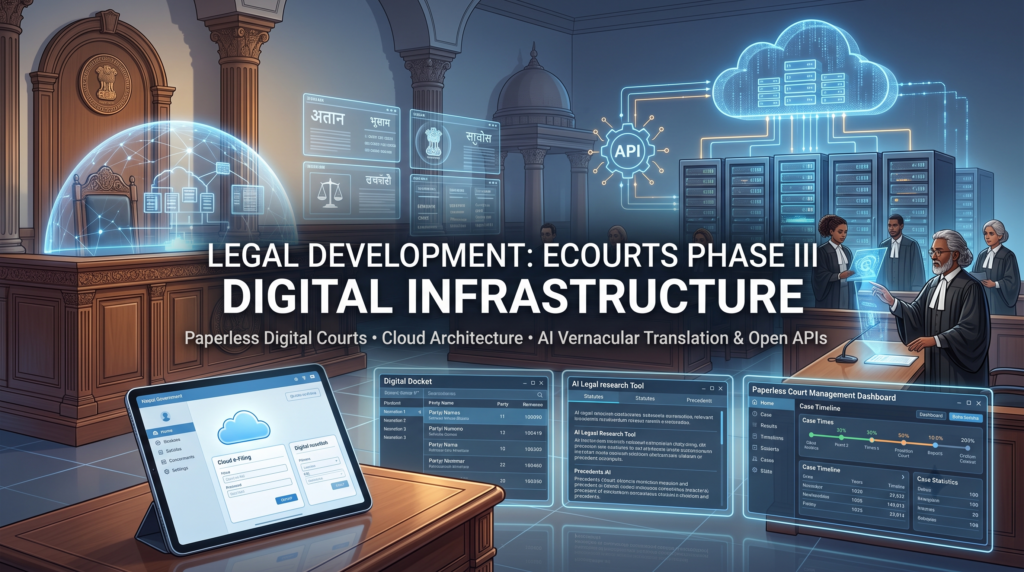
The rollout of the e-Courts Project Phase III represents an evolutionary leap in India’s judicial administration. Moving past the digitisation of paper records, Phase III creates a unified, cloud-native, and intelligent digital justice delivery platform.
Approved with a central outlay of ₹7,210 crore under the guidance of the Supreme Court e-Committee and the Department of Justice, Phase III transitions the justice system toward completely paperless, digital-first courts.
Core Pillars of the Phase III Digital Architecture
- Cloud-First, Interoperable Infrastructure: Replaces localized court servers with scalable cloud infrastructure, linking district judiciaries, high courts, the Supreme Court, and key law-enforcement registries via the Interoperable Criminal Justice System (ICJS).
- Paperless Courts & Digital Case Registries: Establishes end-to-end digital case management where e-filings, verified pleadings, digital summonses, and judicial orders reside inside tamper-evident digital dockets, minimizing manual handling and procedural physical movement.
- Universal Vernacular Judgments via AI Tools: Integrates AI-powered legal translation engines (such as SUVAS) to systematically translate English appellate and apex court rulings into scheduled Indian languages, making judicial precedents accessible to non-English-speaking litigants.
- Virtual and Hybrid Hearings as a Standard: Modernizes video conferencing setups across courtrooms and custodial institutions, standardizing virtual remand hearings, expert witness examinations, and online proceedings to cut transport costs and administrative overheads.
- Open Digital Platforms & Legal APIs: Creates open-standard APIs allowing citizen portals, institutional litigants, and research bodies to access anonymized case status dockets, court causes lists, and judgments programmatically.
Key System Advancements: Phase II vs. Phase III
| Structural Dimension | Phase II Infrastructure | Phase III Transformation |
| Court Functionality | Computerized court halls & scan-and-store methods | Fully paperless courts and dynamic digital workflows |
| Data Hosting | Fragmented district/state data centres | Unified cloud architecture with central backups |
| Citizen Touchpoints | Basic web case search & manual e-filing | Open APIs, mobile apps, citizen service centres, and automated notifications |
| Intelligence Layer | Simple text search systems | AI-driven search, automated translation, and scheduling analytics |
Strategic Significance for the Legal Community
For advocates, legal tech founders, and litigants, Phase III shifts the litigation practice from regional court registries into integrated digital hubs. By eliminating paper waste, standardizing digital summonses, and cutting down on-site processing delays, the initiative provides the structural foundation for faster dispute resolution across India’s subordinate judiciaries.
Reference & Statutory Source
- Initiative: e-Courts Mission Mode Project (Phase III).
- Nodal Agencies: e-Committee, Supreme Court of India & Department of Justice, Ministry of Law and Justice, Government of India.
- Outlay & Tenor: Central Sector Scheme (₹7,210 Crore).