
Constitution Bench Rules Courts Cannot Re-Write Decisions
Constitution Bench Rules Courts Cannot Re-Write Decisions
Arbitral Award Finality: Constitution Bench Rules Courts Cannot Re-Write Decisions
By [LawAcademy Editorial Team]
Published on [14-09-2026]
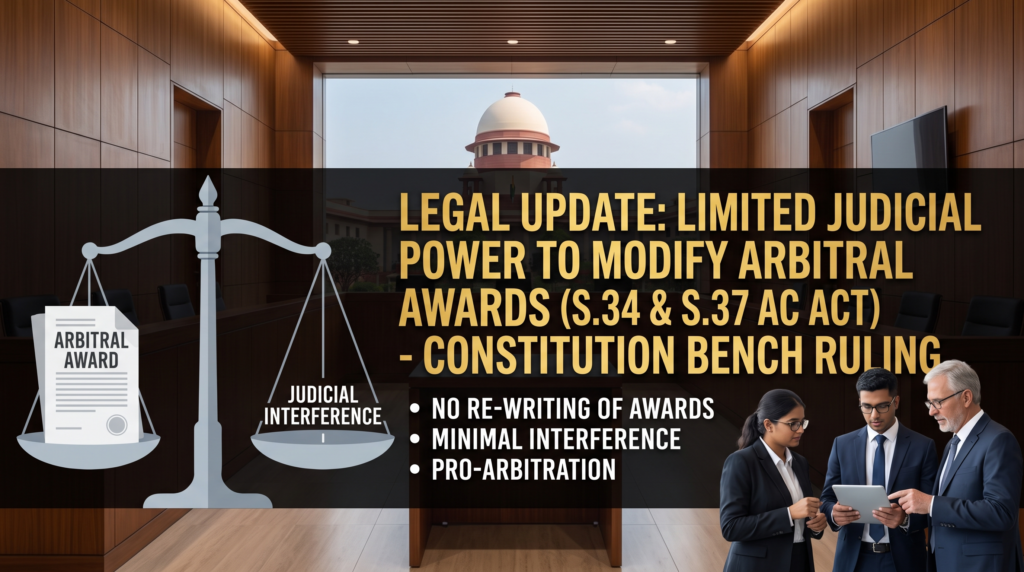
In a significant reinforcement of India’s pro-arbitration stance, a five-judge Constitution Bench of the Supreme Court has unequivocally ruled that courts exercising jurisdiction under Sections 34 and 37 of the Arbitration and Conciliation Act, 1996, possess no inherent power to modify or vary an arbitral award.
The landmark judgment clarifies the boundaries of judicial intervention, establishing that the power of a court is limited to either upholding the award or setting it aside in its entirety if specific, narrow grounds are met.
Core Legal Issue and Controversy
The primary dispute concerned conflicting interpretations from various High Courts and smaller benches of the Supreme Court regarding whether the judiciary could “modify” an award to correct errors, recalculate damages, or substitute its own logic for that of the arbitral tribunal. Proponents of a wider power argued that setting aside a complex award entirely often forces parties back to square one, leading to excessive delays and costs.
However, the Constitution Bench held that the legislative intent behind the 1996 Act was minimal judicial interference to ensure speed and finality. Allowing courts to modify awards would empower them to effectively “re-write” the commercial bargain struck between parties and the decision made by their chosen adjudicator, thus undermining the core premise of arbitration.
Key Rulings and Implications
- No Power to Modify: The Supreme Court definitively held that Section 34 (Setting aside) and Section 37 (Appeals) do not include the authority to “vary” or “modify” an award.
- Minimal Judicial Interference: Courts must respect the arbitrator’s decision unless it is found to be patently illegal, perverse, or contrary to the fundamental policy of Indian law.
- Protecting Arbitral Finality: The ruling prevents courts from delving into the merits of the dispute or substituting their own view on questions of fact or law, provided the arbitrator’s interpretation was a “possible” view.
- Clarity for Practitioners: The judgment resolves decades of procedural ambiguity, establishing that a Section 34 application is not a full appeal but a limited review.
Institutional Impact
This ruling is a major boost for the development of institutional arbitration in India. It signals to commercial entities—both domestic and international—that Indian courts will respect the finality of awards, making arbitration a more attractive and reliable method for dispute resolution in the country.
Reference & Citation
- Case Name: S.V. Samudram v. State of Karnataka and Ors. (Note: This is the definitive case name, even as it settled broader interpretation for Balasamy 2026/GMR/NHAI matters).
- Bench / Authority: Supreme Court of India, Constitution Bench
- Relevant Statutes: Sections 34, 37 of the Arbitration and Conciliation Act, 1996.