
BCI Revises All India Bar Examination (AIBE) Eligibility Norms
BCI Revises All India Bar Examination (AIBE) Eligibility Norms
Unlocking Early Entry: BCI Revises All India Bar Examination (AIBE) Eligibility Norms
By [LawAcademy Editorial Team]
Published on [15-09-2026]
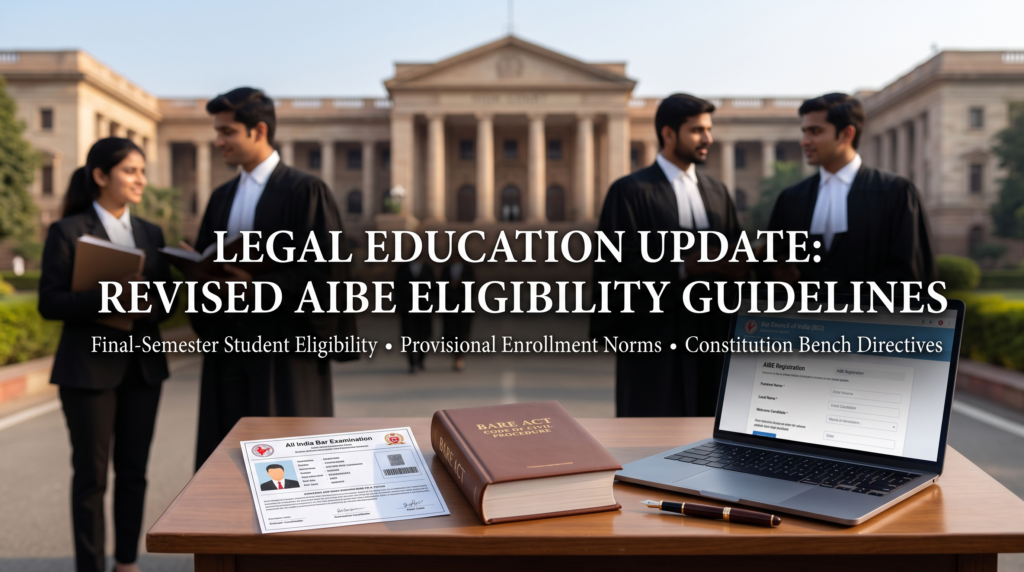
In adherence to directions issued by the Supreme Court of India, the Bar Council of India (BCI) updated its operational and eligibility guidelines for the All India Bar Examination (AIBE). The revised framework eliminates procedural bottlenecks that previously delayed entry into the profession for recent law graduates.
Most notably, the updated rules formalize pathways allowing final-semester law students to appear for the national qualifying examination without waiting for official degree conferral ceremonies or long-delayed provisional state enrollments.
Context: Overcoming Post-Graduation Administrative Delays
Under the historic AIBE framework, candidates were strictly mandated to possess a provisional enrollment certificate from a State Bar Council before applying to sit for the examination. Because universities often experience protracted turnaround times in issuing mark sheets, provisional degrees, and migration certificates, thousands of graduating law students routinely lost six to twelve months waiting to clear the exam, during which their ability to practice or appear in court remained stalled.
The Supreme Court Constitution Bench in Bar Council of India v. Bonnie FOI Law College & Ors. addressed this systemic hardship, holding that the primary objective of AIBE is to test practical legal aptitude, not create arbitrary administrative hurdles for aspiring advocates.
Core Highlights of the Revised Framework
- Inclusion of Final-Semester Students: Final-year or final-semester law students registered in 3-year or 5-year LL.B programs from BCI-recognized institutions can register for the AIBE upon submitting a bonafide certification from their university or law college principal confirming that they have no pending academic backlogs.
- Provisional Enrollment Window Harmonization: Candidates who clear the exam prior to formal enrollment retain their qualified status, provided they furnish their passing marksheet and secure enrollment with a State Bar Council within the prescribed post-result compliance window.
- Strict Adherence to Bare Acts Policy: Reaffirming standardized testing conditions, the Council maintained that candidates may carry only clean, bare acts without notes, commentary, or extensive handwritten annotations into the examination hall, preserving objective statutory assessment.
- Uniform Passing Thresholds: The revised syllabus and pattern preserve the updated qualifying benchmarks: a minimum passing score of 45% for General/OBC candidates and 40% for SC/ST and benchmark disability candidates, calculated against evaluated questions after answer-key challenge reconciliations.
- Streamlined Verification Workflows: Integration of digitized verification channels with universities ensures that fabricated degree certificates and unapproved campus submissions are screened automatically during registration.
Professional Impact on Law Graduates
This structural reform shortens the career ramp-up period for young lawyers entering trial advocacy, litigation chambers, and judicial clerkships. By decoupling the examination schedule from state council processing delays, law graduates can enter the courtroom with their full Certificate of Practice (COP) significantly faster after graduation.
Reference & Statutory Citations
- Issuing Body: Bar Council of India (BCI).
- Direct Judicial Authority: Bar Council of India v. Bonnie FOI Law College & Ors. (Supreme Court Constitution Bench ruling on AIBE administration and pre-enrollment timelines).
- Statutory Source: All India Bar Examination Rules; Section 49(1)(ah) of the Advocates Act, 1961.