
BCI Mandates Student Grievance Redressal Committees (SGRC) Across All Law Colleges
BCI Mandates Student Grievance Redressal Committees (SGRC) Across All Law Colleges
Institutional Accountability: BCI Mandates Student Grievance Redressal Committees (SGRC) Across All Law Colleges
By LawAcademy Editorial Team
Published on October 5, 2026
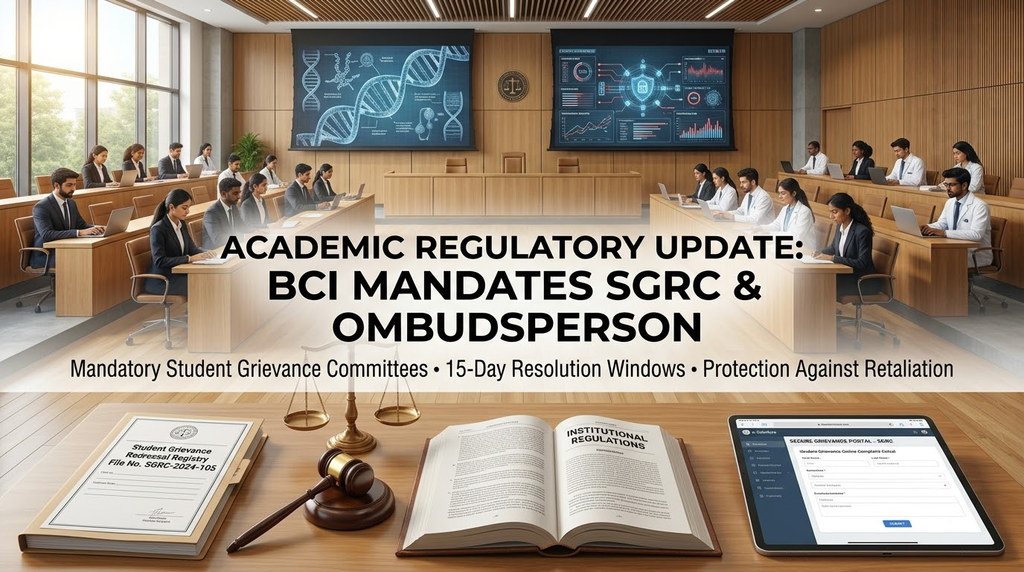
To institutionalize student welfare, eliminate campus arbitrariness, and provide accessible dispute-resolution mechanisms within legal academia, the Bar Council of India (BCI) issued a binding circular directing all affiliating universities and Centres of Legal Education (CLEs) to establish functional Student Grievance Redressal Committees (SGRCs) backed by an independent Ombudsperson.
Issued pursuant to the UGC (Redressal of Grievances of Students) Regulations and directives of the Supreme Court of India in student welfare petitions, the mandate penalizes non-compliant institutions with the immediate withdrawal of approval to conduct law admissions.
Key Operational Mandates of the Circular
- Mandatory SGRC Constitution: Every recognized law college and university department must notify a permanent SGRC comprising a senior Professor/Director as Chairperson, senior faculty members, and a nominated student representative (selected on academic or co-curricular merit as a special invitee).
- Affirmative Representation: The committee composition must mandatorily include at least one woman member and one member representing Scheduled Castes (SC), Scheduled Tribes (ST), or Other Backward Classes (OBC) to ensure balanced, impartial adjudication.
- Strict Redressal Timelines:
- The SGRC must initiate inquiries within 5 working days of receiving a grievance.
- The committee is obligated to issue its final report and binding recommendations within 15 working days, strictly adhering to the principles of natural justice (audi alteram partem).
- Two-Tier Appellate Structure (The Ombudsperson): Students dissatisfied with an SGRC ruling can prefer an appeal within 15 days to an Ombudsperson appointed by the affiliating university—mandated to be a former District Judge or a retired Professor with over ten years of collegiate standing.
- Online Filing Portals & Confidentiality: Law schools must host a dedicated, tamper-proof digital grievance submission portal and physical grievance boxes, with strict whistleblower protections to safeguard students against academic or attendance victimization.
Scope of Cognizable Student Grievances
The circular explicitly identifies actionable issues within SGRC jurisdiction:
- Admissions & Documentation: Withholding degrees, migration certificates, or original documents deposited during admission.
- Fee Transparency: Non-refund of fees upon lawful withdrawal, arbitrary levy of unnotified charges, or delays in disbursing government/institutional scholarships.
- Academic Evaluation & Attendance: Irregularities in internal continuous evaluations, retaliatory attendance shortfalls, or denial of access to examinations without due process.
- Campus Environment & Discrimination: Systemic mistreatment, caste or linguistic prejudice, or failure to maintain essential campus safety and library standards (with sexual harassment complaints routed strictly to the statutory Internal Complaints Committee under the POSH Act).
Significance for Law Students and Campus Governance
Historically, law students raising concerns over arbitrary detention, internal assessment tampering, or administrative overreach faced unchecked executive authority from college administrations. By establishing structured, time-bound quasi-judicial panels subject to external Ombudsperson review, the BCI ensures that rule of law principles are practiced directly within the institutions that teach them.
Reference & Statutory Authority
- Issuing Body: Bar Council of India (BCI Circular on SGRC Implementation).
- Statutory Foundation: Advocates Act, 1961; Rules of Legal Education, 2008; UGC (Redressal of Grievances of Students) Regulations.
- Judicial Bedrock: Amit Kumar & Ors. v. Union of India & Ors. (Supreme Court directives on institutional support and student welfare).