
BCI Mandates Forensic Science and Scientific Investigation in Criminal Law Curricula
BCI Mandates Forensic Science and Scientific Investigation in Criminal Law Curricula
Modernizing Legal Pedagogy: BCI Mandates Forensic Science and Scientific Investigation in Criminal Law Curricula
By LawAcademy Editorial Team
Published on October 5, 2026
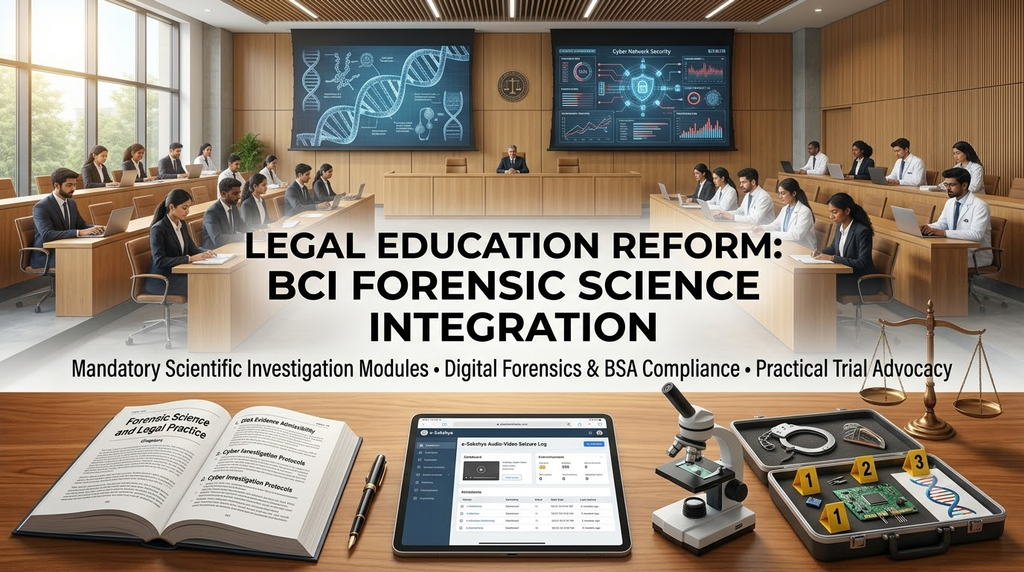
To bridge the gap between classroom legal theory and courtroom forensic realities, the Bar Council of India (BCI) issued a binding curriculum reform circular to all affiliating universities and Centres of Legal Education (CLEs) across the country.
The directive mandates the integration of practical Forensic Science, Digital Forensics, and Scientific Investigation Techniques into the criminal law syllabi of both 3-year and 5-year LL.B degree programmes. The reform operationalizes statutory shifts under the Bharatiya Nagarik Suraksha Sanhita (BNSS) and the Bharatiya Sakshya Adhiniyam (BSA) into academic legal training.
Context: Moving Criminal Law Beyond Textbook Theory
Under India’s criminal codes, forensic evidence has shifted from an occasional investigative aid to a mandatory statutory requirement:
- Section 176(3) BNSS makes forensic expert visits and crime scene videography mandatory for offences punishable with seven years or more of imprisonment.
- Section 105 BNSS requires mandatory audio-video recording of search and seizure operations.
- Sections 61 to 63 BSA place electronic and digital records on an equal footing with primary documentary evidence, subject to chain-of-custody and hash verification standards.
Because traditional law school curricula focused heavily on conceptual penal codes while treating forensics as an optional elective, graduates often enter trial practice unprepared to assess ballistics, examine digital evidence, or cross-examine forensic analysts.
Key Curricular Mandates for Law Universities
- Compulsory Integration in Criminal Procedure & Evidence: Forensic science can no longer be relegated to an isolated optional seminar. Core criminal law and evidence modules must include practical units covering crime-scene reconstruction, chain of custody protocols, toxicology, fingerprint analysis, and DNA profiling.
- Hands-on Cyber Forensics & Hash Integrity: Syllabi must train law students in the mechanics of digital forensics, covering mobile device extractions, server logs, metadata preservation, electronic seizure certificates, and cloud-stored data admissibility.
- Practical Clinical Training & Mock Crime Scenes: Law institutions are instructed to establish forensic workstations or tie up with forensic science laboratories (FSLs) and medical colleges. Moot court exercises must incorporate disputed scientific reports, ballistic discrepancies, and forensic cross-examination drills.
- Case-Study-Based Pedagogy: Faculty must replace rote section memorization with problem-based clinical instruction, testing students’ ability to identify procedural lapses in evidence collection under the BNSS and BSA framework.
Professional Impact on Legal Practice
By upgrading academic standards, the BCI ensures that upcoming generations of defense attorneys, public prosecutors, and prospective judicial officers can evaluate scientific evidence with rigor. Integrating forensic fluency into foundational legal studies protects fair trial guarantees and strengthens the administration of criminal justice.
Reference & Regulatory Source
- Issuing Body: Bar Council of India (BCI) / Legal Education Committee.
- Statutory Authority: Advocates Act, 1961 (Section 7(1)(h)); Rules of Legal Education.
- Statutory Linkages: Bharatiya Nagarik Suraksha Sanhita (BNSS, Sections 105 & 176); Bharatiya Sakshya Adhiniyam (BSA, Sections 61–63).