
BCI Mandates Automated University Verification to Weed Out Fake Law Degrees
BCI Mandates Automated University Verification to Weed Out Fake Law Degrees
Safeguarding the Rolls: BCI Mandates Automated University Verification to Weed Out Fake Law Degrees
By LawAcademy Editorial Team
Published on October 5, 2026
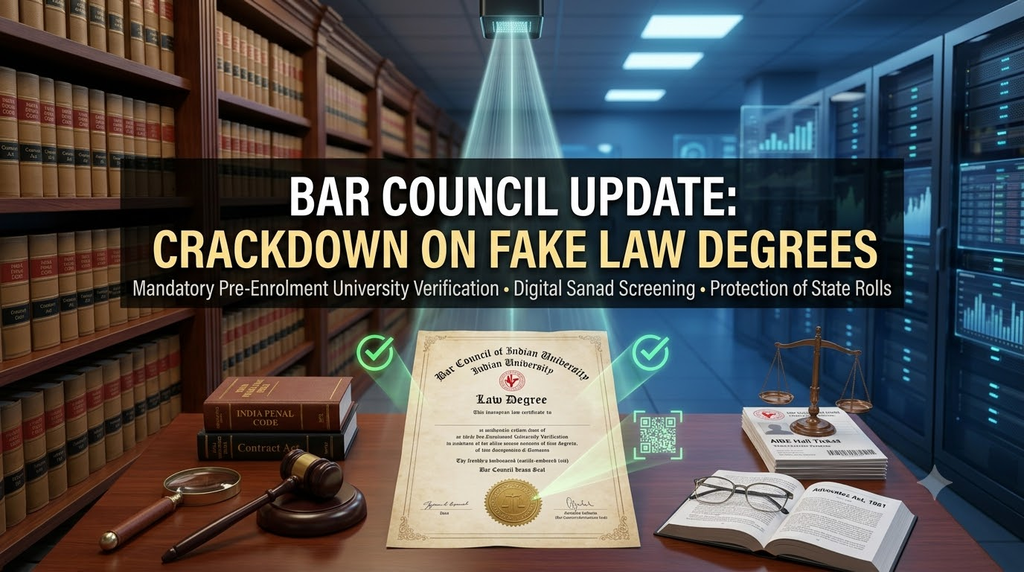
In a concerted drive to preserve the integrity of the bar and prevent unqualified individuals from entering the courts, the Bar Council of India (BCI) issued a comprehensive compliance directive to all State Bar Councils (SBCs) across the country.
The circular establishes a mandatory, automated pre-enrolment verification mechanism, requiring State Bar Councils to validate graduation marksheets and LL.B degree certificates directly with conferring universities before issuing provisional Sanads or enrolling candidates onto the official State Rolls.
Context: Addressing Systemic Fraud in Professional Enrolment
The directive stems from proceedings before the Supreme Court of India in matters concerning fake degree rackets, alongside high-level committee findings revealing that thousands of individuals across various jurisdictions were practicing on forged academic certificates.
Historically, applicants submitted photocopies or notarized duplicates of graduation and law degrees during enrolment, with post-enrolment verification often dragging on for years. The BCI made it clear that provisional enrolment can no longer precede verification, making direct authentication a condition precedent to joining the Bar.
Core Directives for State Bar Councils
- End-to-End Digital Verification: State Bar Councils must integrate their enrolment portals with university exam databases and the National Academic Depository (NAD / DigiLocker) to verify marks, roll numbers, and passing credentials electronically.
- Zero Verification Fees for Students: Reaffirming Supreme Court rulings (including Ajay Shankar Srivastava v. BCI), universities and examining boards are barred from charging exorbitant fees or causing procedural delays when responding to verification requests from Bar Councils.
- Strict Scrutiny of Distance & Non-Recognized Centers: Councils must cross-check whether the applicant’s degree was obtained from an institution holding active BCI approval during the relevant academic session. Degrees obtained through correspondence, distance formats, or unapproved satellite campuses must be rejected summarily.
- Police Action & Criminal Liability: If an uploaded certificate is found to be forged or counterfeit, State Bar Councils are instructed to register an immediate FIR with local law enforcement, report the individual to the BCI vigilance cell, and initiate debarment proceedings.
- Periodic Cleansing of Existing Rolls: State Bar Councils must accelerate the High-Powered Committee verification process under the BCI Certificate and Place of Practice (Verification) Rules to identify and remove existing enrolled advocates practicing on fraudulent documents.
Impact on Judicial Administration and Litigant Trust
Allowing non-lawyers to represent clients jeopardizes litigants’ liberty, undermines judicial administration, and dilutes professional ethics. Establishing rigorous pre-enrolment screening ensures that every advocate stepping into a courtroom possesses legitimate academic qualifications, bolstering public faith in the justice system.
Reference & Statutory Authority
- Issuing Body: Bar Council of India (BCI).
- Statutory Framework: Section 24 & Section 49(1)(ag) of the Advocates Act, 1961; Bar Council of India Certificate and Place of Practice (Verification) Rules.
- Judicial Directives: Ajay Shankar Srivastava v. Bar Council of India & Anr. (Supreme Court directives on degree verification).