
What is Conciliation? Explain the Procedure, Powers and Functions of a Conciliator.
What is Conciliation? Explain the Procedure, Powers and Functions of a Conciliator.
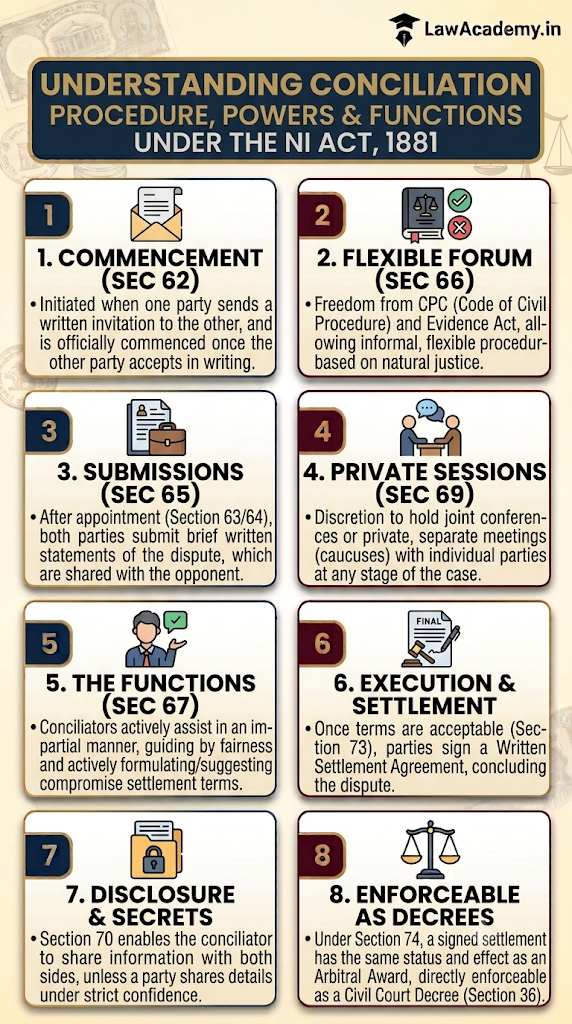
Conciliation is an Alternative Dispute Resolution (ADR) process where disputing parties enlist the assistance of an impartial, neutral third person—the Conciliator—who actively works with them to resolve differences, improve communication, and reach an amicable settlement.
In India, statutory conciliation is governed by Part III (Sections 61 to 81) of the Arbitration and Conciliation Act, 1996, modeled on the UNCITRAL Conciliation Rules (1980).
I. Procedure of Conciliation
The statutory procedure under Part III of the 1996 Act follows a structured sequence:
1. Commencement of Proceedings (Section 62)
- The party initiating conciliation sends a written invitation to the other party, identifying the subject matter of the dispute.
- Conciliation proceedings commence only when the other party accepts the invitation in writing.
- If the other party rejects the invitation or fails to reply within 30 days (or within the time specified in the invitation), the initiating party may treat it as a rejection and elect not to proceed.
2. Number and Appointment of Conciliators (Sections 63 & 64)
- Number: By default, there is one conciliator, unless the parties agree on two or three. Where there are three conciliators, the third acts as the Presiding Conciliator.
- Appointment: Parties may enlist institutional assistance (e.g., an arbitral or mediation institution) or mutually agree on individual appointments.
3. Submission of Statements (Section 65)
- The conciliator may request each party to submit a brief written statement describing the general nature of the dispute and points at issue.
- Further written statements, documentary evidence, and supplementary materials may be required as the proceedings develop. Copies of all submissions must be shared with the opposing party.
4. Conduct of Sessions (Sections 67 & 69)
- The conciliator determines the place and time of meetings, consulting the convenience of both parties.
- The conciliator is entitled to meet or communicate with the parties jointly or individually (private caucuses).
5. Formulation and Execution of Settlement (Section 73)
- If the conciliator perceives elements of a settlement acceptable to the parties, they formulate the terms of a possible settlement and submit them to the parties for observation.
- After incorporating party feedback, the conciliator reformulates the terms.
- When the parties draw up and sign the Written Settlement Agreement, the dispute is concluded. The agreement becomes final and binding on both parties and persons claiming under them.
6. Termination of Proceedings (Section 76)
Conciliation proceedings terminate upon:
- The signing of the settlement agreement by the parties (on the date of the agreement).
- A written declaration of the conciliator that further efforts are no longer justified.
- A written declaration of the parties addressed to the conciliator to the effect that the proceedings are terminated.
- A written declaration of one party to the other and to the conciliator terminating the proceedings.
II. Functions of a Conciliator
The conciliator acts as an active, evaluative neutral rather than a passive observer or a binding judge.
- Assisting in an Independent and Impartial Manner (Section 67(1)): The conciliator must remain neutral and objective, helping the parties to understand each other’s perspectives without taking sides.
- Guiding by Principles of Fairness and Justice (Section 67(2)): The conciliator is guided by principles of objectivity, fairness, and justice, giving consideration to the rights and obligations of the parties, commercial practices, and the circumstances surrounding the dispute.
- Formulating Terms of Settlement (Section 67(4) & 73): Unlike a pure mediator (who typically only facilitates conversation), the conciliator actively formulates, suggests, and reformulates settlement terms, proposing compromise formulas at any stage.
- Bridging Communication Gaps: Clarifying misconceptions, neutralizing hostility, and assisting parties in identifying mutual priorities beyond their rigid legal positions.
III. Powers of a Conciliator
Under the 1996 Act, the conciliator exercises broad, flexible statutory powers:
1. Freedom from Technical Procedural Codes (Section 66)
- The conciliator is not bound by the Code of Civil Procedure, 1908 (CPC) or the Indian Evidence Act, 1872 (now Bharatiya Sakshya Adhiniyam, 2023).
- The conciliator has full discretion to conduct proceedings in an informal, flexible manner best suited to the case.
2. Power to Conduct Private and Joint Meetings (Section 69)
- The conciliator has the power to invite parties to joint sessions or hold separate, private caucuses with each party individually at any location.
3. Power to Request Information and Evidence (Section 65)
- Can direct parties to furnish detailed statements of claim, defense, and supporting documentation or evidence.
4. Discretion on Disclosure vs. Confidentiality (Section 70)
- When the conciliator receives factual information concerning the dispute from one party, they may disclose the substance of it to the other party to allow them an opportunity to respond.
- Limitation: If a party provides information subject to a specific condition that it be kept confidential, the conciliator has no power to disclose that information to the opposing party.
5. Power to Propose Settlement Terms (Section 67(4))
- The conciliator may make proposals for a settlement of the dispute at any stage. These proposals need not be accompanied by formal reasons.
6. Power to Request Financial Deposits (Section 78)
- The conciliator may direct each party to deposit an equal amount as an advance for the costs of conciliation (including conciliator fees, travel, and administrative expenses).
- If a party fails to pay their share, the conciliator can suspend or terminate the proceedings.
IV. Key Safeguards & Legal Status
- Status of Settlement Agreement (Section 74): The signed settlement agreement has the same status and effect as an arbitral award on agreed terms (Section 30), making it directly enforceable as a decree of a civil court under Section 36.
- Confidentiality (Section 75): The conciliator and parties must keep all matters relating to the conciliation proceedings confidential.
- Admissibility of Evidence in Other Proceedings (Section 81): Parties are legally barred from relying on views, admissions, proposals, or the willingness of either party expressed during conciliation in any subsequent arbitral or judicial proceeding.
- Role Restrictions (Section 80): Unless agreed otherwise, the conciliator cannot act as an arbitrator, representative, or counsel in any judicial or arbitral proceedings regarding the same dispute, nor can they be called as a witness.