
Rights and Obligations of a Bankers
Rights and Obligations of a Bankers
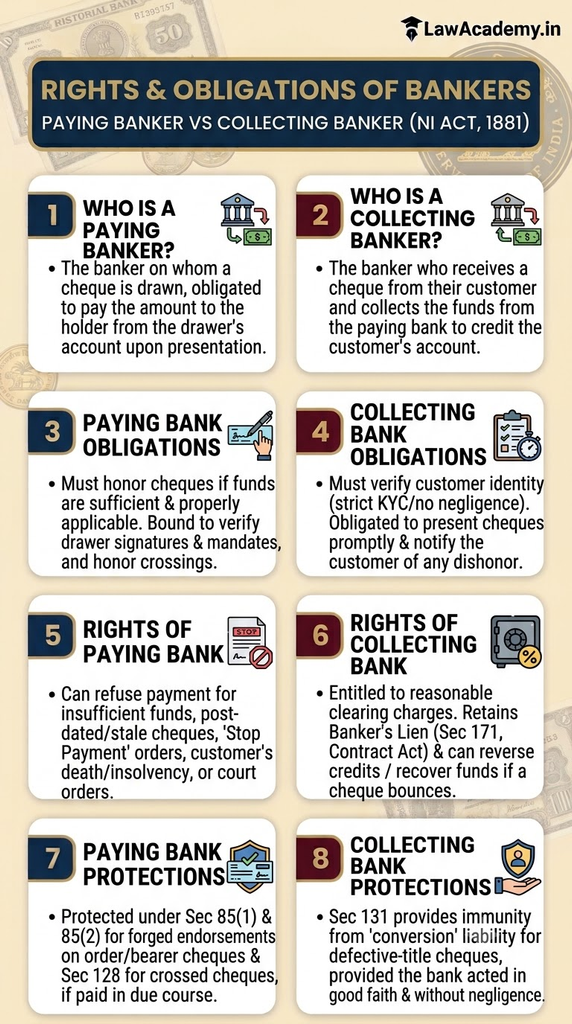
To explore the rights, duties, and statutory protections of bankers in India, let’s first clarify that under the Negotiable Instruments Act, 1881 (NI Act), a bank’s liabilities are heavily determined by whether they are acting as the Paying Banker (debting their customer’s account to pay a cheque) or the Collecting Banker (receiving a cheque and collecting the funds on behalf of their customer).
Both positions come with unique statutory obligations, rights, and critical legal protections that protect banks from fraud or conversion when they act in good faith.
Part 1: The Paying Banker
The Paying Banker is the bank on whom a cheque is drawn (the drawee bank) that is obligated to pay the amount of the cheque to the holder from the drawer’s account.
A. Obligations (Duties) of a Paying Banker
- Duty to Honor Cheques (Section 31, NI Act): The banker is bound to honor the cheques of its customer, provided there are sufficient funds in the customer’s account, the funds are properly applicable (not locked by an court or garnishee order), and the cheque is properly drawn and presented within banking hours.
- Duty to Verify Signatures & Mandates: The banker must ensure the drawer’s signature matches the specimen on record. A paid cheque with a forged drawer’s signature is a nullity, and the bank cannot debit the customer’s account.
- Duty to Pay in Due Course (Section 10): Must pay in good faith, without negligence, and to a person in possession of the instrument under circumstances that don’t raise suspicion.
- Compliance with Endorsements: The paying banker must examine all endorsements on order cheques to ensure they appear regular and continuous on the face of it.
- Honor Crossings (Section 126): If a cheque is crossed generally, it must be paid only to a banker. If crossed specially, it must be paid only to the specified banker. Failing to adhere to crossings makes the bank liable to the true owner.
B. Rights of a Paying Banker
- Right to Refuse Payment: The banker can (and must) dishonor a cheque in cases of:
- Insufficient funds.
- Signature mismatch or altered/mutilated cheque.
- Post-dated, stale (over 3 months old), or undated cheques.
- A “Stop Payment” mandate from the drawer.
- Notice of the customer’s death, insanity, or insolvency.
- Receipt of a Garnishee Order / Attachment Order.
- Right to Debit Customer’s Account: Upon “payment in due course,” the bank has an absolute right to debit the drawer’s account for the paid amount.
C. Statutory Protection for Paying Bankers
Paying bankers are highly vulnerable to forged endorsements. The law provides shield protections under:
- Section 85(1) (Order Cheques): Protects the paying banker if an “order” cheque contains a forged endorsement, provided the bank pays it in due course and the endorsement appears regular.
- Section 85(2) (Bearer Cheques): A bearer cheque remains a bearer cheque. If it is paid to the bearer in due course, the bank is discharged, regardless of any forged endorsements.
- Section 128 (Crossed Cheques): Protects the bank if it pays a crossed cheque in due course to a banker (for general crossing) or the specified banker (for special crossing), treating it as if it were paid to the true owner.
Part 2: The Collecting Banker
The Collecting Banker is the bank that receives a cheque from its customer (the holder) and collects the funds from the paying bank to credit the customer’s account.
A. Obligations (Duties) of a Collecting Banker
- Duty to Verify the Customer (KYC): Since the bank collects money for another, it must verify the identity and integrity of its customers. Negligence in opening an account (lack of KYC) strips the bank of statutory protection if the customer deposits stolen cheques.
- Duty to Present Instruments Promptly: Must present cheques for clearing or collection within a reasonable time. Any delay causing financial loss to the customer (e.g., if the drawer goes insolvent or the paying bank fails during the delay) makes the collecting bank liable.
- Duty to Notice Dishonor: If a cheque is dishonored, the collecting banker must promptly inform its customer and return the dishonored instrument.
- Duty of Care as an Agent: Must act with reasonable skill and diligence as the customer’s agent, ensuring the endorsements on deposit slips and cheques match the customer’s identity.
B. Rights of a Collecting Banker
- Right to Charges/Commission: The bank has the right to charge reasonable fees, commissions, or processing costs for its clearing and collection services.
- Right of Banker’s Lien (Section 171, Indian Contract Act): Has a general lien on the collected funds or securities if the customer owes money or has an overdrawn account, allowing the bank to retain the funds to settle the debit.
- Right to Recover Paid Money: If the bank credit’s a customer’s account in anticipation of collection, and the cheque ultimately bounces, the bank can reverse the credit or recover the money from the customer.
C. Statutory Protection for Collecting Bankers
If a customer deposits a stolen or altered cheque, the true owner can sue the collecting bank for the civil tort of “conversion” (wrongfully handling their money). The law provides a vital shield:
- Section 131 (Crossed Cheques): A collecting banker does not incur liability to the true owner of a crossed cheque simply because the customer’s title was defective, provided the banker acted in good faith and without negligence.
- Critical condition for protection: The cheque must be crossed before it reaches the collecting banker, and the bank must show it was not negligent (e.g., it verified signatures, examined endorsements, and followed standard KYC protocols).