
Provisions relating to Suit by Indigent
Provisions relating to Suit by Indigent
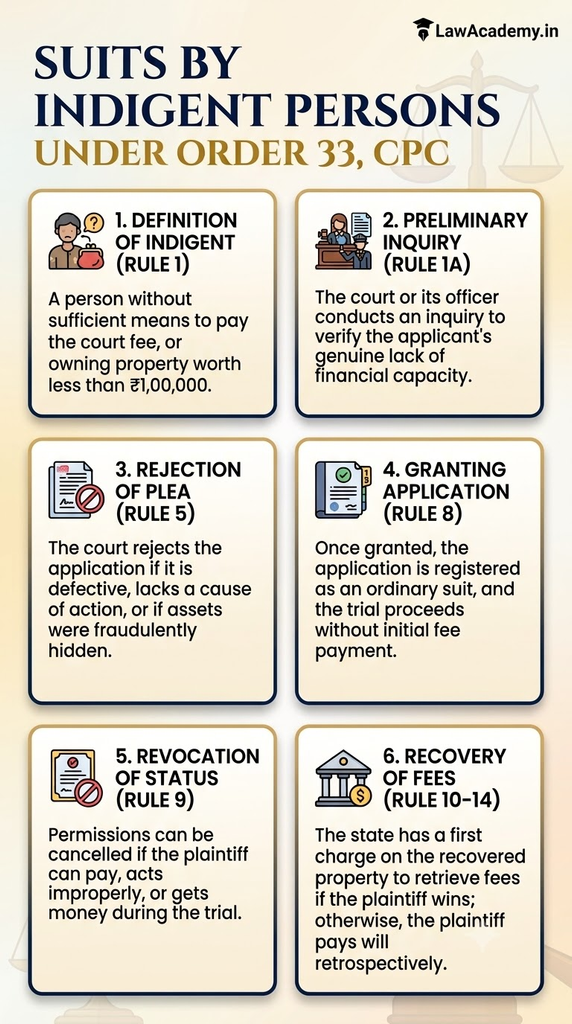
Suits by Indigent Persons (Order 33, CPC)
A Suit by an Indigent Person (historically called a pauper suit) is a special civil proceeding enabling an impoverished litigant without sufficient means to institute a suit and pursue justice without the prepayment of court fees or process charges at the initial stage.
Definition of Indigent Person (Order 33, Rule 1)
- Definition: A person who does not possess sufficient means (excluding assets exempt from attachment in execution of a decree and the suit’s subject matter) to pay the prescribed court fee, or where no fee is prescribed, does not own property worth ₹1,000.
- Example: A daily-wage laborer whose ancestral homestead was encroached upon, owning no attachable assets or savings, applying to sue the encroacher for recovery of possession without paying ₹25,000 in upfront court fees.
Inquiry into Means of Indigent Person (Order 33, Rule 1A & Rule 6)
- Definition: A preliminary inquiry conducted by the Chief Ministerial Officer of the court or the court itself, after issuing notice to the government pleader and the opposite party, to verify the genuine lack of financial capacity of the applicant.
- Example: The court’s registry examining an applicant’s bank records and issuing notice to the District Collector and the defendant to verify if the applicant owns undisclosed land before granting indigent status.
Rejection of Application (Order 33, Rule 5)
- Definition: The mandatory refusal by the court to grant leave to sue as an indigent person if the application is defectively filed, reveals no cause of action, is barred by law, the applicant is financially capable, or entered into a champertous agreement to finance the litigation.
- Example: Rejecting an application where the applicant fraudulently transferred a commercial vehicle to their brother two weeks prior to filing simply to appear assetless before the court.
Effect of Granting Application (Order 33, Rule 8)
- Definition: Once the application seeking permission is granted, it is numbered and registered as an ordinary plaint, and the suit proceeds in the conventional trial manner without initial fee payment.
- Example: The court accepts the applicant’s plea of poverty, assigning an original suit (OS) number to the petition, requiring the defendant to file their written statement without demanding court fee stamps from the plaintiff.
Revocation / Withdrawal of Permission (Order 33, Rule 9)
- Definition: The cancellation of indigent status upon application by the defendant or government pleader if the plaintiff engages in improper or vexatious conduct, ceases to be indigent during the trial, or enters an agreement giving a third party an interest in the suit property.
- Example: The defendant proving during the trial that the plaintiff inherited ₹15,00,000 from a relative, prompting the court to revoke the indigent status and order payment of regular court fees.
Recovery of Court Fees and First Charge (Order 33, Rules 10–14)
- Definition: If the indigent plaintiff succeeds, the state government has a first charge over the subject matter recovered to realize the calculated court fees; if the plaintiff fails, the court directs the plaintiff to pay the court fees retrospectively.
- Example: An indigent plaintiff wins a decree for recovery of ₹10,00,000; the executing court directs the debtor to pay the outstanding ₹50,000 court fees directly to the state revenue before releasing the balance to the plaintiff.