
Parties to a suit under CPC
Parties to a suit under CPC
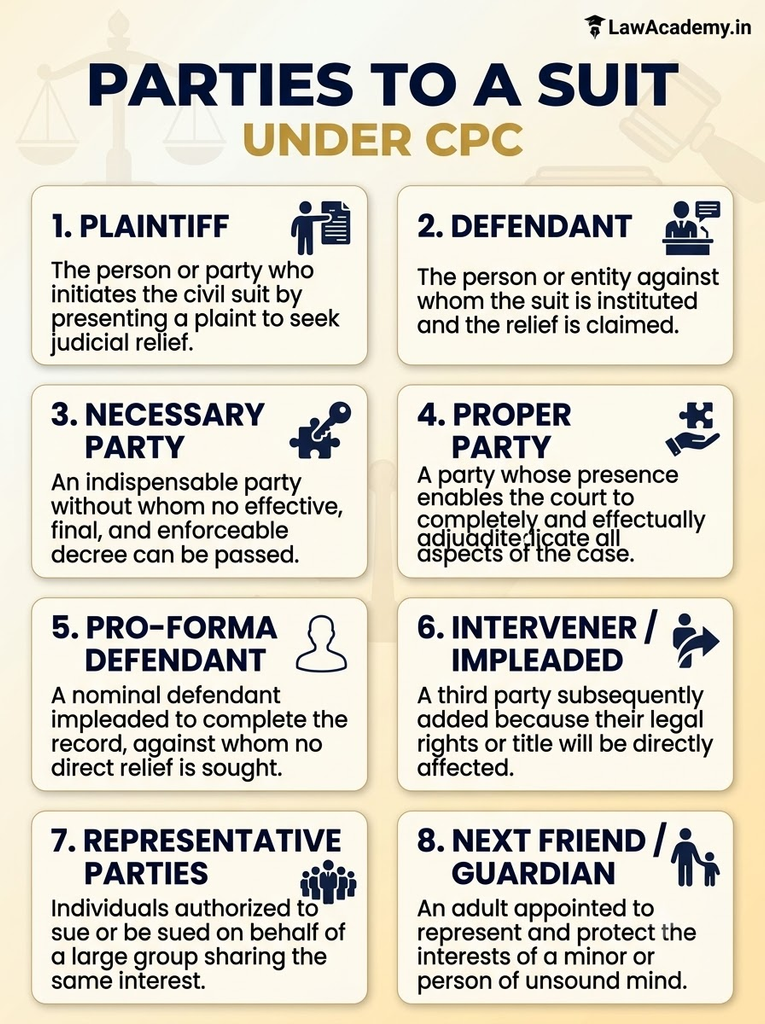
A suit is a civil proceeding instituted by the presentation of a plaint in a court of competent jurisdiction to enforce, establish, or redress a civil legal right against another person or entity (governed by Section 26 and Order 4 of the Code of Civil Procedure, 1908).
Plaintiff
- Definition: The person or party who initiates the civil suit by presenting a plaint to seek judicial relief against the alleged violation of their legal rights (Order 1, Rule 1).
- Example: A creditor filing a civil suit seeking recovery of an unpaid loan amount of ₹10,00,000 from a borrower.
Defendant
- Definition: The person or entity against whom the suit is instituted and against whom the plaintiff claims relief, damages, or remedies (Order 1, Rule 3).
- Example: A tenant who fails to pay rent and is sued by the landlord for eviction and recovery of arrears.
Necessary Party
- Definition: A party whose presence before the court is indispensable, without whom no effective, final, and enforceable decree can be passed at all.
- Example: In a suit for partition of ancestral joint family property, every coparcener or legal co-heir having a lawful share is a necessary party; failure to implead them causes non-joinder.
Proper Party
- Definition: A party who has an interest in the dispute and whose presence enables the court to completely, effectually, and comprehensively adjudicate all aspects of the case, though an effective decree could technically be passed in their absence.
- Example: In an eviction suit brought by a landlord against a chief tenant, a sub-tenant residing in the premises is a proper party so that their rights, if any, can be settled in the same proceedings.
Pro-Forma Defendant
- Definition: A nominal defendant impleaded merely to complete the formal record of the suit and avoid technical objections, against whom the plaintiff seeks no direct or substantive relief.
- Example: One of several co-owners who declines to join as a co-plaintiff in an ejectment suit against an encroacher, impleaded formally as a defendant so all title-holders are before the court.
Intervener / Impleaded Party
- Definition: A third party who was not an original litigant but is subsequently added to the suit by the court’s leave or on their own application under Order 1, Rule 10 because their legal rights or title would be directly affected by the outcome.
- Example: A purchaser who bought a portion of disputed agricultural land under a prior registered agreement, applying to intervene in a fresh partition suit between rival family members.
Representative Parties
- Definition: One or more individuals authorized by the court under Order 1, Rule 8 to sue or be sued on behalf of, and for the benefit of, a large group of persons sharing an identical community of interest.
- Example: Three residents filing a suit on behalf of an entire residential layout to prevent a developer from constructing a commercial mall over designated community parkland.
Next Friend / Guardian ad Litem
- Definition: A qualified adult recognized by the court to represent and protect the legal interests of a person suffering from a legal disability (such as a minor or a person of unsound mind) during the litigation (Order 32).
- Example: A mother acting as the “Next Friend” of her 10-year-old child to sue for the minor’s rightful share in an inherited property, or appointed as “Guardian ad Litem” to defend the child if sued.