
General principles of Limitation Act
General principles of Limitation Act
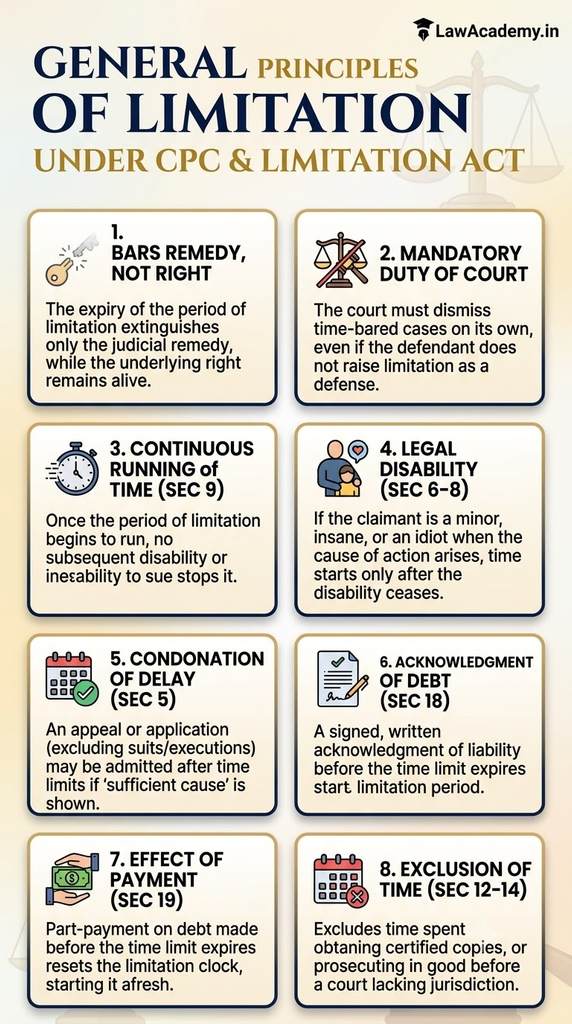
Limitation is the legally prescribed statutory timeframe within which an aggrieved party must initiate legal proceedings (such as a suit, appeal, or application) to enforce a civil right or seek judicial redress. In India, substantive rules of limitation are codified under the Limitation Act, 1963, which operates in close procedural harmony with the Code of Civil Procedure, 1908 (CPC).
General Principles of Limitation
Bars Remedy, Does Not Extinguish Right
- Definition: The expiry of the period of limitation extinguishes only the litigant’s judicial remedy to enforce the claim in a court of law; the underlying substantive right itself remains alive (except in cases governed by Section 27 of the Limitation Act regarding property rights).
- Example: If a loan debt becomes time-barred after three years, the lender cannot file a civil suit for recovery, but if the debtor voluntarily repays the money later, the lender is legally entitled to retain it because the debt was never extinguished.
Mandatory Duty of the Court (Section 3, Limitation Act read with Order 7, Rule 11(d), CPC)
- Definition: Every suit, appeal, or application instituted after the prescribed period must be dismissed by the court as a matter of law, even if the defendant has not set up limitation as a specific defense.
- Example: If the trial court finds on the face of the plaint that a suit for money recovery was filed four years after default, the court must reject the plaint under Order 7, Rule 11(d) of CPC on its own motion, even if the defendant fails to appear or plead the bar of limitation.
Continuous Running of Time (Section 9, Limitation Act)
- Definition: Once the period of limitation begins to run from the date the cause of action accrues, no subsequent disability or inability to institute a suit or make an application stops it.
- Example: If the limitation period for filing a breach of contract suit begins to run on 1st January and the creditor falls seriously ill or suffers an accident two months later, the running clock of limitation does not pause.
Exclusion of Legal Disability (Sections 6, 7 & 8, Limitation Act)
- Definition: If a person entitled to institute a suit or make an application is a minor, insane, or an idiot at the time the cause of action arises, the period of limitation is calculated only after that disability has ceased.
- Example: A 15-year-old minor whose land is unlawfully usurped can institute a suit through a Next Friend during minority, or file the suit in their own name within three years after attaining the age of 18 (subject to Section 8).
Condonation of Delay (Section 5, Limitation Act)
- Definition: An appeal or application (excluding suits and execution petitions under Order 21) may be admitted after the prescribed limitation period if the applicant satisfies the court that they had “sufficient cause” for not preferring it within time.
- Example: An appellant filing a first appeal 20 days late under Order 41 of CPC submits hospital records demonstrating sudden, severe medical incapacitation; the appellate court condones the delay upon finding sufficient cause.
Effect of Written Acknowledgment of Debt (Section 18, Limitation Act)
- Definition: If, before the expiration of the prescribed period of limitation, an acknowledgment of liability regarding any property or right is made in writing and signed by the debtor, a fresh period of limitation begins to run from the date of the acknowledgment.
- Example: A borrower signs an email or promissory acknowledgment confirming an outstanding balance of ₹3,00,000 on the 2nd year and 11th month of a 3-year limitation cycle; a completely fresh 3-year limitation window begins from that date.
Effect of Payment on Account of Debt (Section 19, Limitation Act)
- Definition: Where payment on account of a debt or of interest on a legacy is made before the expiration of the prescribed period by the debtor or their authorized agent, a fresh period of limitation is computed from the time the payment was made.
- Example: A borrower transfers ₹10,000 via bank transfer specifically referencing the loan account before the original 3-year term lapses; the clock resets, extending the limitation period for another three years from that payment date.
Exclusion of Time Spent in Obtaining Certified Copies (Section 12, Limitation Act read with Order 41, CPC)
- Definition: In computing the period of limitation for any appeal, application for leave to appeal, or application for review/revision, the day the judgment was pronounced and the time requisite for obtaining a certified copy of the decree, sentence, or order appealed against is excluded.
- Example: If the limitation to file a first appeal is 30 days and the court registry takes 18 days to furnish the certified copy after application, those 18 days are completely excluded from the 30-day calculation.
Exclusion of Time in Bona Fide Proceedings in Court Without Jurisdiction (Section 14, Limitation Act)
- Definition: The time during which a plaintiff has been prosecuting with due diligence another civil proceeding in good faith before a court which, from defect of jurisdiction or other cause of a like nature, is unable to entertain it, is excluded.
- Example: A plaintiff mistakenly files a recovery suit in Court A lacking territorial jurisdiction; after litigating for 10 months, Court A returns the plaint under Order 7, Rule 10 of CPC. Those 10 months are excluded when filing before the competent Court B.