
Explain the role of Lokayukta, and its Composition, Powers and Functions.
Explain the role of Lokayukta, and its Composition, Powers and Functions.
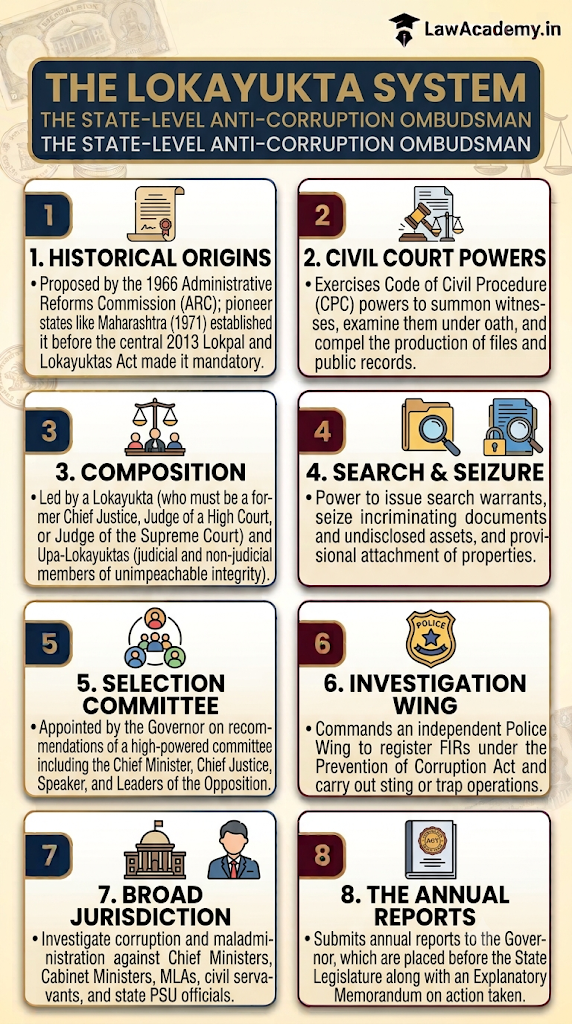
The Lokayukta is an independent anti-corruption ombudsman established at the state level in India to investigate allegations of corruption, maladministration, abuse of power, and favoritism against public servants and elected officials.
While the Lokpal operates at the national/central level, the Lokayukta functions as the apex anti-corruption watchdog within individual states.
I. Historical & Statutory Background
- Administrative Reforms Commission (ARC), 1966: The concept of an Indian Ombudsman was first formally recommended by the First ARC headed by Morarji Desai, proposing a two-tier mechanism: Lokpal at the Centre and Lokayukta in the States.
- Pioneer States: Long before central legislation was enacted, states created their own ombudsman bodies through state statutes:
- Maharashtra was the first state to establish the Lokayukta system via the Maharashtra Lokayukta and Upa-Lokayuktas Act, 1971.
- Odisha passed the first Act in 1970, though it came into force later.
- The Karnataka Lokayukta Act, 1984 established one of the most empowered Lokayukta institutions in the country, equipped with its own independent police and investigation wing.
- The Lokpal and Lokayuktas Act, 2013: Section 63 of this central statute made it legally mandatory for every Indian state to establish a Lokayukta through state legislature enactments (if not already established) within one year from the commencement of the Act.
II. Role of the Lokayukta
- Combating Political and Administrative Corruption: Acts as a specialized external monitor to investigate graft, illicit enrichment, kickbacks, and disproportionate assets.
- Redressal of Citizen Grievances (Maladministration): Addresses administrative delays, arbitrary refusals, nepotism, and harassment caused to ordinary citizens by public departments.
- Ensuring Accountability of Public Functionaries: Brings high-ranking constitutional figures—including Chief Ministers, Cabinet Ministers, Members of the Legislative Assembly (MLAs), and senior bureaucrats—under an objective, non-partisan investigatory lens.
- Independent Oversight: Operates independently of the executive hierarchy, preventing ruling political regimes from suppressing internal corruption inquiries.
III. Composition and Appointment
The exact composition varies across state enactments, but largely aligns with the structural framework of the Lokpal and Lokayuktas Act, 2013:
1. Composition
- Head (Lokayukta): A single chairperson who is or has been a Chief Justice or a Judge of a High Court, or a Judge of the Supreme Court of India, or an eminent jurist.
- Upa-Lokayuktas (Members): One or more Deputy Ombudsmen appointed to assist the Lokayukta. Typically, these include both:
- Judicial Members: Former High Court or District Judges.
- Non-Judicial / Technical Members: Persons of unimpeachable integrity with expertise in anti-corruption policy, public administration, vigilance, finance, or law.
2. Appointment Procedure
To ensure political neutrality, the Lokayukta and Upa-Lokayuktas are appointed by the Governor on the binding recommendation of a high-powered Selection Committee, generally consisting of:
- The Chief Minister (Chairperson)
- The Chief Justice of the High Court (or a nominated sitting judge)
- The Speaker of the Legislative Assembly
- The Leader of the Opposition in the Legislative Assembly
- The Chairman and Leader of the Opposition of the Legislative Council (in bicameral states)
3. Term of Office and Independence
- Tenure: Usually 5 years or until attaining the age of 70 years (or 65/68 years, depending on state enactment), whichever is earlier.
- Security of Tenure: Cannot be arbitrarily removed by the executive. Removal requires an inquiry on grounds of proved misbehavior or incapacity, following the same procedure prescribed for the removal of a High Court Judge (address by state legislature).
- Bar on Future Employment: Post-tenure, members are barred from holding any government office of profit or contesting elections for a specified statutory period.
IV. Jurisdiction
The jurisdictional reach is broad, subject to specific state adaptations:
- Elected Representatives: The Chief Minister (in most states, subject to special procedural safeguards), State Cabinet Ministers, and Members of the Legislative Assembly (MLAs / MLCs).
- Civil Servants: All Group A, B, C, and D state government employees, civil servants, and police officers.
- Local Authorities & PSUs: Chairpersons, managing directors, and employees of local municipalities, panchayats, state-run Public Sector Undertakings (PSUs), government boards, statutory corporations, and state-aided universities/societies.
V. Powers of the Lokayukta
- Powers of a Civil Court: While conducting any inquiry or investigation, the Lokayukta exercises the powers of a Civil Court under the Code of Civil Procedure, 1908 (CPC):
- Summoning and enforcing the attendance of witnesses and examining them under oath.
- Compelling the discovery, inspection, and production of official files and documents.
- Receiving evidence on affidavits.
- Requisitioning public records from any court or government office.
- Issuing commissions for examination of witnesses or documents.
- Search and Seizure: Power to issue search warrants and direct authorized investigating officers to enter and search premises, seize incriminating documents, hard drives, cash, and undisclosed assets.
- Dedicated Investigation Wing: Where empowered by state statutes (e.g., Karnataka, Madhya Pradesh), the Lokayukta commands its own independent Police Wing (headed by an officer not below the rank of ADGP/IGP), capable of registering FIRs under the Prevention of Corruption Act, 1988 and conducting trap operations directly without prior executive sanction.
- Power of Superintendence: Power to direct, supervise, and monitor state vigilance directorates or anti-corruption bureaus regarding cases assigned by the Lokayukta.
- Provisional Attachment of Assets: Power to recommend or order the provisional attachment of properties and bank accounts believed to have been acquired through corrupt means, preventing alienation during proceedings.
VI. Functions of the Lokayukta
- Preliminary Inquiries & Formal Investigations:
- Receives written complaints supported by affidavits from the public alleging corruption or abuse of official position.
- May also initiate suo motu investigations based on media reports or audit discrepancies (in states where suo motu power is statutorily conferred).
- Grievance Redressal (Maladministration Inquiries):
- Examines systemic administrative failures, delays in citizen-service delivery, arbitrary administrative acts, and illegal government actions.
- Trap Operations:
- Coordinates undercover anti-corruption traps where public officials are caught red-handed accepting illegal gratification (bribes).
- Recommending Disciplinary and Penal Action:
- Upon completing an investigation, submits an investigation report to the “Competent Authority” (the Governor or Chief Minister).
- Recommends initiation of departmental disciplinary proceedings, dismissal, or prosecution in a Special Court under the Prevention of Corruption Act, 1988.
- Annual Reports to the State Legislature:
- Submits an annual report to the Governor detailing cases handled, systemic loopholes identified, and compliance by the government. The Governor places this report before the State Legislature along with an Explanatory Memorandum explaining the government’s reasons for any non-acceptance of recommendations.
VII. Limitations & Challenges
- Recommendatory Nature in Several States: In many states, the Lokayukta’s final reports are merely advisory; the executive retains discretion on whether to accept recommendations, sanction prosecution, or initiate departmental inquiries.
- Lack of Independent Prosecutorial Machinery: Many state Lokayuktas must rely on the state government’s public prosecutors, diluting enforcement momentum.
- Budgetary and Staffing Deficits: Insufficient forensic capabilities, delayed appointments to vacant member posts, and limited operational budgets frequently constrain investigative capacity.