
Essentials and parties to a Cheque
Essentials and parties to a Cheque
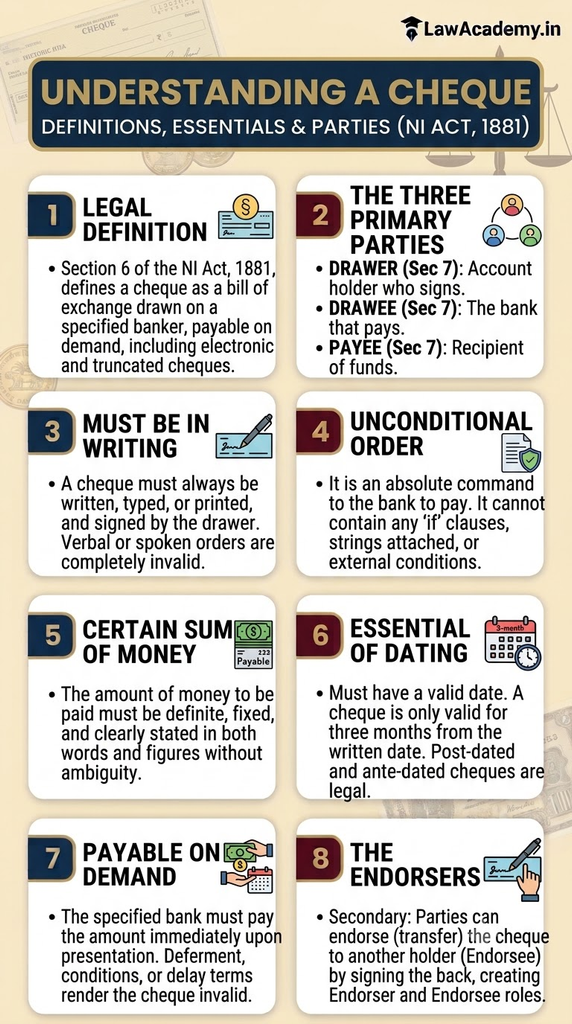
A cheque is a specialized, time-tested legal instrument that drives daily commerce and digital-era paper clearing. In India, it is governed by the Negotiable Instruments Act, 1881 (NI Act).
Below is a detailed legal analysis of its definition, essential characteristics, and the parties involved, according to the NI Act.
Definition of a Cheque (Section 6, NI Act, 1881)
Under Section 6 of the Negotiable Instruments Act, 1881, a “cheque” is defined as:
“A bill of exchange drawn on a specified banker and not expressed to be payable otherwise than on demand and it includes the electronic image of a truncated cheque and a cheque in the electronic form.”
Major Takeaways from the Legal Definition:
- Specialized Bill of Exchange: A cheque is a sub-species of a bill of exchange, meaning it must follow all the basic rules of a bill of exchange but with unique, restrictive criteria.
- Drawn on a Specified Banker: It is uniquely drawn on a specific bank where the drawer holds an account. (An ordinary bill of exchange can be drawn on any person/firm).
- Payable “On Demand” Only: The bank is obligated to pay the amount immediately upon presentation. It cannot be made payable after a fixed term or on a future contingency (unlike bills of exchange, which can be time-based).
- Modern Inclusions (Amendment):
- Cheque in Electronic Form: A digital cheque created and signed securely using digital signatures and biometrics.
- Truncated Cheque: A paper cheque that is scanned and digitised during the clearing process, sending its electronic image rather than transporting the physical paper, ensuring swift Clearing House settlements.
Essential Elements of a Cheque
To be legally valid and enforceable, a cheque must possess the following 10 essential features:
- In Writing: A cheque must be written. It can be typed or printed, but cannot be verbal.
- Unconditional Order: It is a command/order to pay. It must not contain conditions (e.g., “Pay only if my goods arrive safely” makes a cheque invalid).
- On a Specified Banker: Must be addressed to a specific bank branch where the drawer maintains their account.
- Signed by the Drawer: The drawer’s signature must match their bank specimen. A forged signature nullifies the cheque.
- Certain Sum of Money: The amount must be definite and express, stated clearly in both words and figures.
- Payable “On Demand”: Must be payable immediately when shown, with no delay or deferment terms.
- Three Specific Parties: There must be a Drawer (sender), Drawee (bank), and Payee (recipient).
- Certain Payee: The recipient must be clearly named or identifiable (e.g., “Pay to Rohan Sharma” or “Pay to Bearer”).
- Drawn Against Funds: Assumes the drawer has sufficient funds or an overdraft facility to cover the amount. (An NSF – Not Sufficient Funds – status triggers criminal liability under Section 138).
- Dating & Validity: Must be dated. A cheque is valid for exactly three months from its written date. Post-dated and ante-dated cheques are valid, but undated ones are not honored.
Parties to a Cheque
A cheque typically involves three primary parties, alongside certain secondary parties:
A. Primary Parties:
- The Drawer (Sec 7): The account holder who writes and signs the cheque, ordering their bank to make the payment.
- The Drawee (Sec 7): The specified bank on whom the cheque is drawn, obligated to pay the funds from the drawer’s account.
- The Payee (Sec 7): The person or entity to whom the cheque is made payable (i.e., the recipient of the funds). Note: The Drawer and Payee can be the same person (e.g., when a drawer writes a “Self” cheque).
B. Secondary Parties (During Circulation):
- The Endorser (Sec 51): The holder of the cheque who signs their name on the back to transfer its ownership/rights to someone else.
- The Endorsee (Sec 52): The person to whom the cheque is transferred via endorsement.
- The Holder (Sec 8): Any person legally entitled in their own name to the possession of the cheque and to receive its payment.