
Essential features of Promissory Note, Cheque and Bills of Exchange in Negotiable Instruments Act, 1881
Essential features of Promissory Note, Cheque and Bills of Exchange in Negotiable Instruments Act, 1881
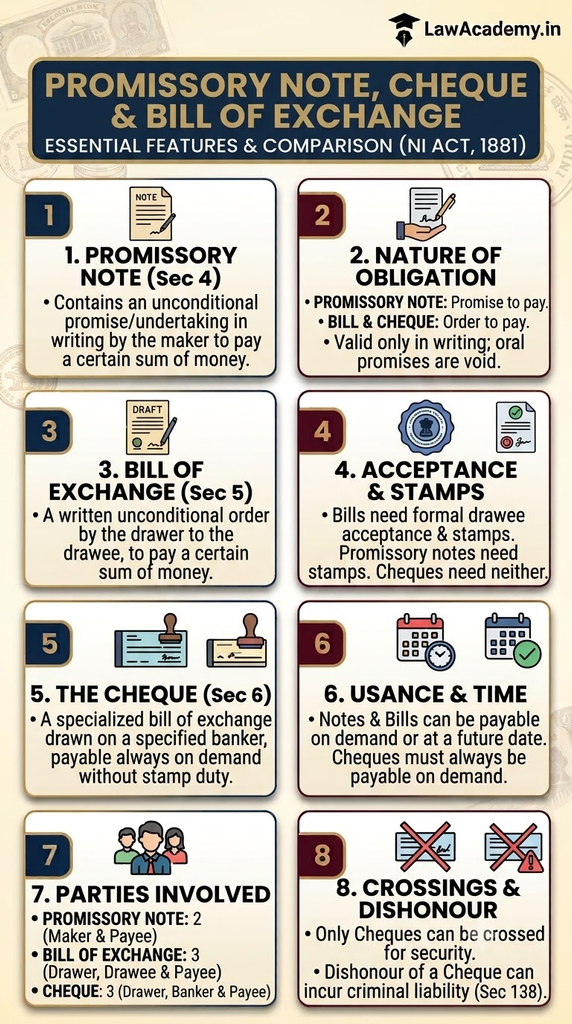
The Negotiable Instruments Act, 1881 recognizes three primary negotiable instruments: Promissory Notes (Section 4), Bills of Exchange (Section 5), and Cheques (Section 6).
1. Promissory Note (Section 4)
A Promissory Note is an instrument in writing (not being a bank-note or a currency-note) containing an unconditional undertaking, signed by the maker, to pay a certain sum of money only to, or to the order of, a certain person, or to the bearer of the instrument.
Essential Features:
- In Writing: Must be written, printed, or typed; a verbal promise to pay does not constitute a promissory note.
- Express Undertaking/Promise to Pay: Must contain an explicit, definitive promise to pay. A mere acknowledgment of indebtedness (such as an IOU: “I owe you ₹10,000”) is not a promissory note.
- Unconditional Undertaking: The promise to pay must not depend on any contingent event (e.g., “I promise to pay ₹5,000 after my marriage” is invalid). However, a promise to pay after the death of a person is valid, as death is certain.
- Signed by the Maker: Must be executed and signed by the debtor (maker).
- Certainty of Parties: Two primary parties are involved:
- Maker: The debtor who creates and signs the note.
- Payee: The creditor to whom the money is promised. Both parties must be certain and clearly identified.
- Certain Sum of Money: The amount promised must be fixed, precise, and payable in legal tender (money), not in goods, shares, or services.
- Stamping: Must be properly stamped as per the Indian Stamp Act, 1899. An unstamped promissory note is inadmissible as evidence in court.
- Prohibition on Bearer Demand Notes: Under Section 31(2) of the Reserve Bank of India Act, 1934, no person other than the RBI or Central Government can draw a promissory note payable to the bearer on demand.
2. Bill of Exchange (Section 5)
A Bill of Exchange is an instrument in writing containing an unconditional order, signed by the maker, directing a certain person to pay a certain sum of money only to, or to the order of, a certain person or to the bearer of the instrument.
Essential Features:
- In Writing: Must be a written instrument.
- Unconditional Order: It is an order/command to pay, not a request or prayer (using polite words like “Please pay” does not invalidate it if the language creates a mandatory direction).
- Three Primary Parties:
- Drawer: The creditor who creates the bill.
- Drawee: The debtor directed to pay.
- Payee: The person entitled to receive the money (Drawer and Payee can be the same person).
- Requirement of Acceptance: The drawee incurs liability only after signing and writing “Accepted” on the instrument. Prior to acceptance, the drawee is not liable.
- Certain Sum of Money: The amount ordered to be paid must be definite and denominated in legal currency.
- Payable on Demand or at a Fixed Future Date: Unlike cheques, a bill of exchange can be a demand bill or a time/usance bill (e.g., payable 90 days after sight).
- Stamping: Time bills must be stamped according to the relevant stamp laws; demand bills generally do not require stamp duty.
3. Cheque (Section 6)
A Cheque is a specialized bill of exchange drawn on a specified banker, payable always on demand, including truncated cheques and cheques in electronic form.
Essential Features:
- All Essentials of a Bill of Exchange: Must be in writing, signed by the drawer, contain an unconditional order, and specify a definite sum.
- Always Drawn on a Specified Banker: The drawee must always be a specific bank branch where the drawer maintains an account.
- Payable “On Demand” Only: A cheque can never be expressed as payable after a certain period or at a future date; it is legally payable immediately upon presentation.
- No Formal Acceptance Required: Unlike a regular bill of exchange, a cheque does not require acceptance by the bank before presentation for payment.
- No Stamping Required: Cheques are exempt from stamp duty in India.
- Validity Period: A cheque is valid for presentation for 3 months from the date written on its face.
- Electronic and Truncated Cheques: Expressly includes electronic images of truncated paper cheques generated during the Cheque Truncation System (CTS) clearing process, as well as digitally signed electronic cheques.
Comparative Matrix
| Feature | Promissory Note (Sec 4) | Bill of Exchange (Sec 5) | Cheque (Sec 6) |
| Nature of Obligation | Promise to pay | Order to pay | Order to pay |
| Primary Parties | 2 (Maker, Payee) | 3 (Drawer, Drawee, Payee) | 3 (Drawer, Drawee Bank, Payee) |
| Drawee Identity | None (Maker pays directly) | Any legal person/firm | Always a specified banker |
| Acceptance | Not required | Mandatory by Drawee | Not required |
| Payability | On demand or at a future date | On demand or at a future date | Always on demand |
| Stamp Duty | Mandatory (Indian Stamp Act) | Mandatory for time bills | Exempt from stamp duty |
| Notice of Dishonour | Not required to maker | Mandatory to drawer/endorsers | Cheque return memo/statutory notice (Sec 138) |
| Crossing | Cannot be crossed | Cannot be crossed | Can be crossed (General/Special) |