
Distinguish between Arbitration, Conciliation, Mediation and Negotiation.
Distinguish between Arbitration, Conciliation, Mediation and Negotiation.
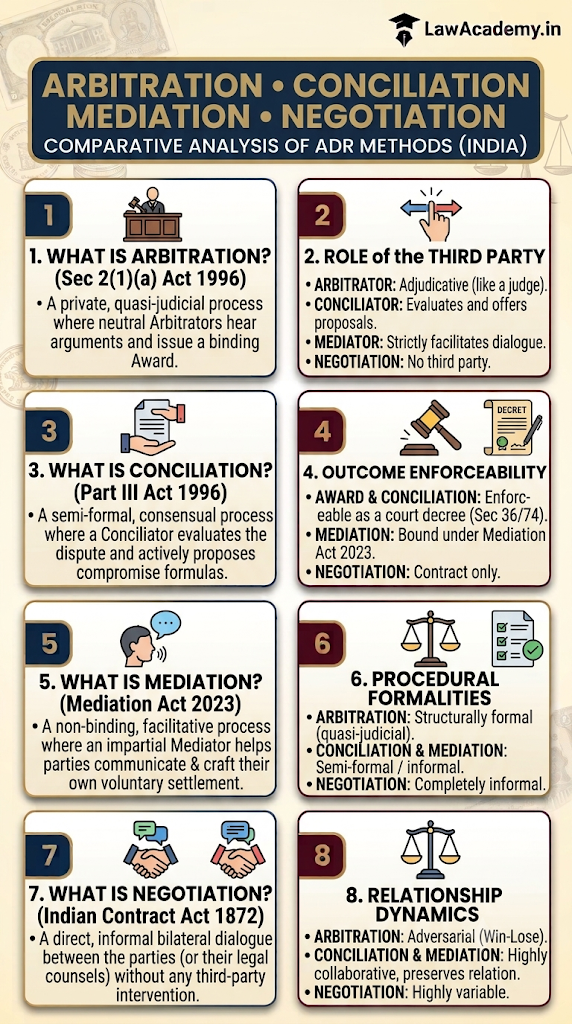
Alternative Dispute Resolution (ADR) provides mechanisms to resolve legal disputes outside the adversarial courtroom setting. The primary ADR methods under Indian law—governed largely by the Arbitration and Conciliation Act, 1996, the Mediation Act, 2023, and the Code of Civil Procedure, 1908 (Section 89)—are Arbitration, Conciliation, Mediation, and Negotiation.
Core Conceptual Definitions
- Arbitration: An adjudicatory process where disputing parties submit their conflict to an impartial third-party neutral (an arbitrator or arbitral tribunal) chosen by them or appointed by an institution/court. The arbitrator hears evidence, considers legal submissions, and delivers a final, binding determination called an Arbitral Award.
- Conciliation: A non-adjudicatory, consensus-driven process where a neutral third party (the conciliator) actively assists the parties in reaching an amicable settlement. Unlike a mediator, a conciliator can formulate terms of a possible settlement, provide proposals, and actively suggest compromise formulas. When signed, the outcome results in a Settlement Agreement.
- Mediation: A structured, voluntary negotiation process facilitated by an impartial third-party neutral (the mediator) who does not impose a solution or give opinions on legal merits. The mediator acts as a catalyst to bridge communication gaps, uncover underlying interests, and assist the parties in crafting their own mutually acceptable resolution (Mediated Settlement Agreement).
- Negotiation: A bilateral, non-facilitated dispute resolution method where the disputing parties communicate directly (or through their authorized legal representatives) without any third-party neutral to resolve differences, bargain, and reach an agreement.
Key Distinctions Across Parameters
1. Presence and Role of a Third Party
- Arbitration: A neutral third party (arbitrator) acts as a private judge. They hear arguments, examine witnesses/documents, and make an authoritative determination.
- Conciliation: A neutral third party (conciliator) acts as an active facilitator and advisor. Under Section 67 of the 1996 Act, the conciliator may offer proposals and formulate/reformulate settlement terms.
- Mediation: A neutral third party (mediator) acts strictly as a facilitator. The mediator does not suggest terms, evaluate guilt, or propose solutions; they manage communication dynamics.
- Negotiation: No third party is involved. The interaction is direct between the disputants or their respective counsel.
2. Decision-Making Authority
- Arbitration: Vested entirely in the Arbitrator. Parties relinquish control over the final outcome.
- Conciliation: Retained by the Parties. The conciliator suggests solutions, but the parties decide whether to accept them.
- Mediation: Retained entirely by the Parties. The parties design and consent to the settlement.
- Negotiation: Retained entirely by the Parties.
3. Nature and Enforceability of the Outcome
- Arbitration: Produces an Arbitral Award. Under Section 36 of the Arbitration and Conciliation Act, 1996, the award is final, binding, and executable as if it were a decree of a civil court. Grounds for challenge are strictly limited (Section 34).
- Conciliation: Produces a Settlement Agreement. Under Section 74 of the 1996 Act, it has the same status and effect as an arbitral award on agreed terms (Section 30), making it executable directly as a court decree.
- Mediation: Produces a Mediated Settlement Agreement. Under Section 27 of the Mediation Act, 2023, it is final, binding, and enforceable in the same manner as an arbitral award or civil court decree.
- Negotiation: Produces a settlement contract. It operates as an ordinary contract; breach requires filing a fresh civil suit for specific performance or damages unless recorded before a court/Lok Adalat.
4. Formality and Procedure
- Arbitration: Formal and quasi-judicial. While not bound by the strict rules of the CPC or the Indian Evidence Act (BSA), it follows structured pleadings (Statement of Claim and Defence), hearings, evidence presentation, and principles of natural justice.
- Conciliation: Semi-formal. Governed by statutory provisions (Part III of the 1996 Act) but conducted flexibly without formal evidentiary rules.
- Mediation: Informal and flexible. Focuses on private caucuses (separate meetings) and joint sessions guided by statutory ethics under the Mediation Act, 2023.
- Negotiation: Completely informal. Driven entirely by party convenience with no prescribed rules or procedural laws.
5. Relationship Dynamics
- Arbitration: Adversarial in nature (Win-Lose outcome). Often strains ongoing commercial or personal relationships.
- Conciliation: Collaborative and interest-based (Win-Win outcome). Focuses on restoring harmony.
- Mediation: Highly collaborative and transformative (Win-Win outcome). Designed specifically to preserve commercial partnerships, family ties, and future interactions.
- Negotiation: Variable; can range from competitive (hard bargaining) to cooperative (principled negotiation), depending entirely on the parties’ approach.
Comprehensive Comparative Matrix
| Parameter | Arbitration | Conciliation | Mediation | Negotiation |
| Governing Statute (India) | Arbitration & Conciliation Act, 1996 (Part I & II) | Arbitration & Conciliation Act, 1996 (Part III) | Mediation Act, 2023 / Section 89 CPC | Indian Contract Act, 1872 |
| Third-Party Neutral | Yes (Arbitrator / Tribunal) | Yes (Conciliator) | Yes (Mediator) | No (Direct party dialogue) |
| Role of Neutral | Adjudicative (Decides the dispute) | Evaluative / Facilitative (Can suggest terms) | Facilitative (Facilitates dialogue only) | Not applicable |
| Voluntary vs. Mandatory | Initiated via mutual agreement (clause), but proceedings and outcome are binding | Voluntary throughout | Voluntary (with statutory pre-litigation provisions) | Entirely voluntary |
| Nature of Proceedings | Quasi-judicial, formal | Semi-formal, collaborative | Informal, structured | Completely informal |
| Rules of Evidence / CPC | Not strictly applicable (Sec 19), but natural justice strictly enforced | Not applicable (Sec 66) | Not applicable | Not applicable |
| Final Outcome | Arbitral Award | Settlement Agreement | Mediated Settlement Agreement | Contract / Memorandum of Understanding |
| Legal Status of Outcome | Equivalent to a Civil Court Decree (Sec 36) | Equivalent to an Arbitral Award / Decree (Sec 74) | Enforceable as a Civil Court Decree (Sec 27) | Enforceable as an ordinary contract |
| Confidentiality | High (Sec 42A) | Strict statutory confidentiality (Sec 75) | Strict statutory confidentiality (Sec 22) | Subject to mutual party terms |
| Outcome Nature | Adversarial (Win–Lose) | Consensual (Win–Win) | Consensual (Win–Win) | Consensual (Win–Win or No Agreement) |