
Contents of Pleadings under CPC
Contents of Pleadings under CPC
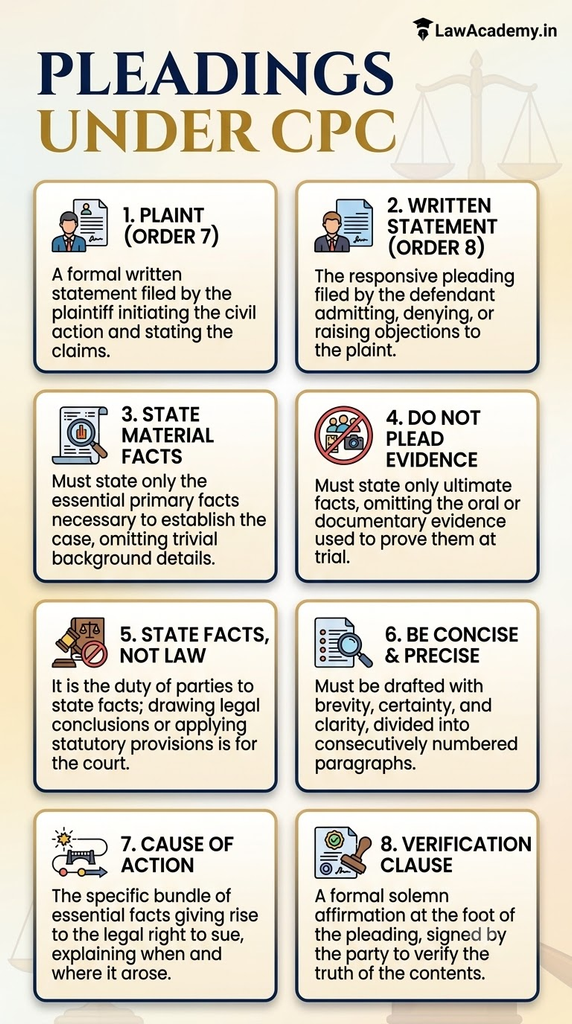
Pleading is defined under Order 6, Rule 1 of the Code of Civil Procedure, 1908, as a Plaint or a Written Statement. It represents the formal written statement of facts and claims submitted by each party to a civil suit to establish their respective case and disclose the precise matters in controversy before the court.
Core Components of Pleadings
Plaint (Order 7)
- Definition: The foundational pleading drafted and presented by the plaintiff to institute a civil action, outlining the cause of action, jurisdiction, valuation, and the specific judicial reliefs sought.
- Example: A written plaint filed by a landlord detailing the lease deed terms, monthly defaults, legal notice served, and praying for eviction and recovery of arrears of rent.
Written Statement (Order 8)
- Definition: The responsive pleading filed by the defendant admitting, denying, or raising preliminary objections against the allegations stated in the plaintiff’s plaint, or setting up a cross-claim/set-off.
- Example: A formal statement filed by a borrower denying the execution of a promissory note and pleading that the debt has been fully settled through documented bank transfers.
Contents and Golden Rules of Pleadings (Order 6, Rule 2)
State Material Facts Only (Facta Probanda)
- Definition: Pleadings must state only the essential primary facts necessary to establish the plaintiff’s cause of action or the defendant’s defense, omitting unnecessary trivial background details.
- Example: Pleading the exact date of execution of a contract, the specific term violated, and the loss incurred, rather than narrating social conversations leading up to the business meeting.
Do Not Plead Evidence (Facta Probantia)
- Definition: Pleadings must state the ultimate facts to be proved, but must not plead the oral or documentary evidence by which those facts are to be established at trial.
- Example: Stating that the defendant borrowed ₹2,00,000 on a specific date, without transcribing witness dialogues or reproducing the testimony of the bank cashier who witnessed the withdrawal.
State Facts, Not Law
- Definition: It is the duty of parties to state facts; drawing legal conclusions, statutory inferences, or applying statutory provisions is the function of the court.
- Example: Pleading that the defendant neglected to repair a retaining wall causing water damage to the plaintiff’s building, rather than pleading that the defendant is liable under the “Doctrine of Strict Liability” or “Law of Torts.”
State Facts in a Concise and Precise Form
- Definition: Facts must be pleaded with brevity, certainty, and clarity, divided into consecutively numbered paragraphs containing distinct allegations.
- Example: Drafting clear, separate numbered paragraphs—Paragraph 1 stating ownership of the suit plot, Paragraph 2 stating the date of unlawful trespass, and Paragraph 3 detailing the exact boundary encroached upon.
Essential Structural Contents of Pleadings
Name of the Court and Cause Title
- Definition: The heading identifying the specific judicial forum having jurisdiction, followed by the names, descriptions, and addresses of all plaintiffs and defendants.
- Example: Heading reading: “In the Court of the Principal Senior Civil Judge at Bengaluru,” followed by “Suit No. ___ of 2026: A (Plaintiff) vs. B (Defendant).”
Cause of Action and Jurisdiction
- Definition: The specific bundle of essential facts giving rise to the legal right to sue, along with statements explaining when the right arose and how the court possesses pecuniary and territorial jurisdiction.
- Example: Pleading that the breach of contract occurred on 15th January 2026 within the municipal limits of the court and the total claim amount falls within the pecuniary limit of ₹10,00,000.
Valuation and Court Fees
- Definition: The formal statement specifying the monetary value of the suit’s subject matter for the computation of court fees and determination of pecuniary jurisdiction.
- Example: Valuing a declaratory suit at ₹5,00,000 under the relevant Court Fees and Suits Valuation Act and paying the requisite ad-valorem court fee stamps.
Prayer Clause (Relief Sought)
- Definition: The concluding part of the plaint where the plaintiff explicitly states the exact remedies, damages, recovery amounts, or statutory declarations demanded against the defendant.
- Example: A specific prayer requesting: “Pass a decree directing the defendant to execute the registered sale deed in favor of the plaintiff, along with costs of the suit.”
Verification Clause (Order 6, Rule 15)
- Definition: A formal solemn affirmation appended at the foot of the pleading, signed by the party stating which paragraphs are true to their personal knowledge and which are believed to be true based on legal advice or records.
- Example: A standard verification declaring: “I, the plaintiff, do hereby verify that the contents of paragraphs 1 to 5 are true to my personal knowledge, and paragraphs 6 to 9 are based on legal advice believed to be true.”