
Brief note on the role of Legal Services Authorities Act, 1987 in the growth of ADR mechanism in India.
Brief note on the role of Legal Services Authorities Act, 1987 in the growth of ADR mechanism in India.
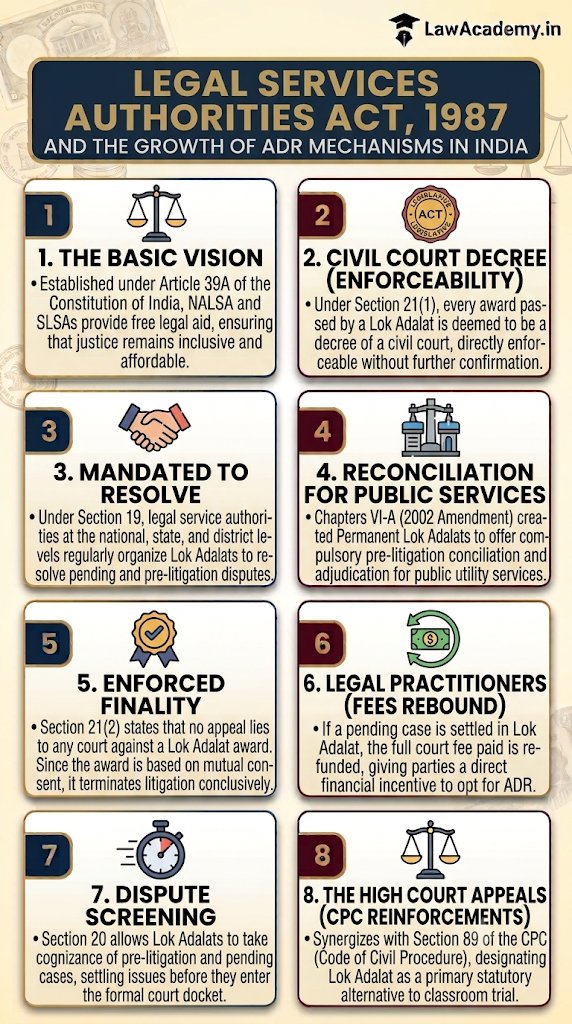
The Legal Services Authorities Act, 1987 (LSAA) is a foundational statutory pillar for the institutionalization, expansion, and democratization of Alternative Dispute Resolution (ADR) mechanisms across India. Enacted pursuant to Article 39A of the Constitution of India—which mandates the State to provide free legal aid and ensure that justice is not denied to any citizen due to economic or other disabilities—the Act transitioned ADR from a purely private, contract-driven choice into a state-sponsored, community-accessible public justice system.
1. Statutory Institutionalization of Lok Adalats (Chapter VI)
Prior to 1987, Lok Adalats (Peoples’ Courts) existed as informal, voluntary forums with no binding legal status. The LSAA codified and structured this forum into a potent ADR mechanism:
- Statutory Recognition (Section 19): Empowers the National Legal Services Authority (NALSA), State Legal Services Authorities (SLSA), District Legal Services Authorities (DLSA), and Taluk Legal Services Committees to organize Lok Adalats at regular intervals.
- Jurisdiction (Section 20): Lok Adalats can take cognizance of:
- Any case pending before any civil, criminal (compoundable), or revenue court, upon agreement of both parties or where the court is satisfied that there are chances of settlement.
- Any pre-litigation matter falling within the jurisdiction of regular courts, resolving conflicts before formal suits are instituted.
- Powers of a Civil Court (Section 22): Lok Adalats possess the powers of a Civil Court under the Code of Civil Procedure, 1908 (CPC) for summoning witnesses, requiring document production, and receiving evidence on affidavits.
2. Finality and Direct Enforceability of Awards (Section 21)
The most transformative contribution of the Act toward ADR is the statutory weight given to consensual settlements:
- Deemed Civil Court Decree: Under Section 21(1), every award passed by a Lok Adalat is deemed to be a decree of a civil court or an order of any other court.
- No Appeal (Absolute Finality): Under Section 21(2), no appeal lies to any court against an award made by a Lok Adalat. Because the award is founded on mutual consent, it terminates litigation conclusively, eliminating multi-tiered appellate delays.
- Refund of Court Fees: Under Section 21(1) read with the Court-Fees Act, 1870, if a pending suit is settled before a Lok Adalat, the full court fee paid by the plaintiff is refunded, providing a direct financial incentive for parties to choose ADR.
3. Institutionalization of Permanent Lok Adalats for Public Utility Services (Chapter VI-A)
Through the Legal Services Authorities (Amendment) Act, 2002, Parliament introduced Chapter VI-A (Sections 22A to 22E), creating Permanent Lok Adalats (PLA):
- Target Sectors (Section 22A): Compulsory pre-litigation conciliation and dispute resolution for “Public Utility Services” (e.g., postal, telegraph, telephone, power/electricity, water supply, public conservancy/sanitation, hospitals, and transport of passengers or goods).
- Compulsory Conciliation followed by Adjudication (Section 22C):
- Parties must first undergo conciliation assisted by the PLA.
- If the parties fail to reach an amicable agreement, the Permanent Lok Adalat is empowered to decide the dispute on merits, provided the dispute does not relate to an offence.
- Finality (Section 22E): The award of a PLA is final, binding, deemed to be a civil court decree, and cannot be questioned in any original suit, application, or execution proceeding.
4. Pan-India Infrastructure and National Lok Adalats
The Act created an unbroken institutional grid spanning the Supreme Court down to the Taluk level:
- National Lok Adalats: Held simultaneously across the entire nation on a single day every quarter, disposing of millions of pending and pre-litigation disputes (motor accident claims, cheque bounce cases under Section 138 NI Act, bank recovery suits, matrimonial discords, and labor disputes).
- Massive De-clogging of the Judiciary: By disposing of high volumes of petty and compoundable cases, the LSAA framework relieves conventional civil and criminal courts from docket explosion, allowing them to focus on complex trials.
5. Synergy with Section 89 of the Code of Civil Procedure (CPC)
When Section 89 of the CPC was revived and substituted in 2002 to mandate court-annexed ADR, it expressly designated Lok Adalat (to be conducted in accordance with the provisions of the Legal Services Authorities Act, 1987) as one of the four statutory alternatives to a courtroom trial (alongside Arbitration, Conciliation, and Judicial Settlement/Mediation).
Summary of Key Contributions
| Dimension | Role / Impact of Legal Services Authorities Act, 1987 |
| Legal Status of ADR | Elevated informal, traditional dispute resolution into a statutory framework. |
| Enforceability | Awards have the status of an executable Civil Court Decree without requiring separate confirmation suits. |
| Appellate Bar | Precludes further appeals against settlements, guaranteeing absolute dispute finality. |
| Access to Justice | Took ADR beyond elite corporate arbitration to rural, indigent, and marginalized citizens at zero cost. |
| Public Utilities | Created specialized Permanent Lok Adalats with adjudication powers when conciliation fails. |