
Brief note on Mediation as a tool for settlement of Family Disputes.
Brief note on Mediation as a tool for settlement of Family Disputes.
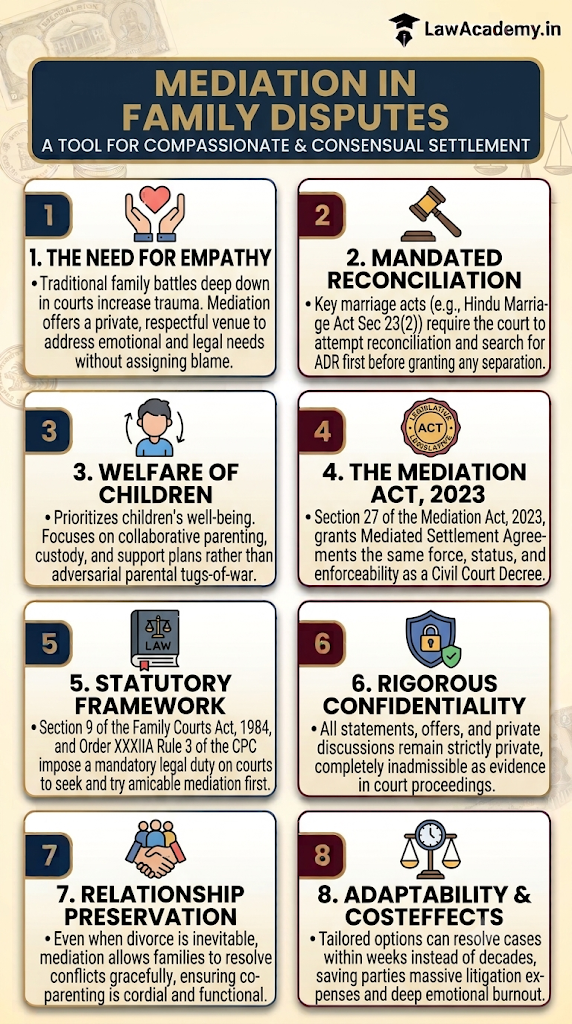
Mediation has emerged as one of the most effective, compassionate, and constructive dispute resolution tools for resolving family and matrimonial conflicts. Unlike conventional litigation, which operates on an adversarial “win-lose” approach, family mediation focuses on healing strained relationships, promoting open dialogue, and arriving at customized, mutually acceptable solutions.
I. Conceptual Basis in Family Conflicts
Family disputes—such as marital separation, divorce, child custody, visitation rights, maintenance/alimony, and division of ancestral property—are inherently sensitive, emotionally charged, and private.
- Why Adversarial Litigation Fails: Traditional courtroom litigation pits spouses and relatives against one another through bitter affidavits, public cross-examinations, and formal accusations. This often deepens hostility and causes severe psychological trauma to children.
- The Mediation Philosophy: In family mediation, an impartial, trained third-party neutral (the mediator) does not judge, assign blame, or pronounce a verdict. Instead, the mediator manages communication, diffuses hostility, helps parties identify their underlying emotional and financial needs, and assists them in formulating practical solutions that preserve personal dignity.
II. Statutory Framework in India
Indian law actively promotes, and in many instances mandates, an attempt at conciliation and mediation before a court proceeds to adjudicate family disputes:
- Family Courts Act, 1984:
- Section 9: Imposes a mandatory statutory duty on the Family Court to make every endeavor to persuade parties to arrive at a settlement before conducting a trial. Family Courts maintain institutional association with counselors and trained mediators.
- Code of Civil Procedure, 1908 (Section 89 & Order XXXIIA):
- Section 89: Directs courts to refer pending civil/matrimonial matters to alternative dispute resolution (ADR), including mediation.
- Order XXXIIA (Rule 3): Specifically mandates that in family suits, it is the duty of the court to assist the parties in arriving at an amicable settlement.
- Hindu Marriage Act, 1955 & Special Marriage Act, 1954:
- Section 23(2) of HMA and Section 34(3) of SMA require the court to attempt reconciliation between spouses in the first instance before granting divorce or judicial separation.
- The Mediation Act, 2023:
- Formally institutionalized community and court-annexed mediation in India.
- Recognizes family disputes as prime candidates for mediation.
- Under Section 27, a signed Mediated Settlement Agreement possesses the same legal force, status, and enforceability as a civil court decree.
III. Key Advantages in Family Disputes
- Protection of Children’s Best Interests:
- Child custody and visitation disputes often become bitter power struggles in court. Mediation shifts the focus away from parental conflict toward the welfare of the child, allowing parents to formulate workable shared parenting plans, holiday schedules, and educational support agreements.
- Strict Privacy and Confidentiality:
- Courtroom proceedings are public, and trial records can expose sensitive personal matters. Mediation sessions are conducted in private, and all statements, offers, and discussions remain strictly confidential and inadmissible in subsequent court proceedings.
- Preservation of Relationships:
- Even when marriage dissolution is unavoidable, mediation ensures that the breakdown is handled with dignity and civility. This is essential for long-term co-parenting and cordial extended-family ties.
- Customized and Flexible Solutions:
- Courts can only grant relief strictly provided by statute (e.g., granting or rejecting divorce, fixing fixed maintenance). In mediation, parties have the freedom to craft creative agreements—such as structured asset divisions, staggered maintenance payments, or personalized visitation terms.
- Speed and Cost-Effectiveness:
- Family litigation can drag on for decades across trial courts and appellate tiers. Mediation can conclude within weeks or a few sessions, avoiding high litigation expenses and emotional burnout.
IV. Landmark Judicial Perspectives
- K. Srinivas Rao v. D.A. Deepa (2013) 5 SCC 226: The Supreme Court emphasized that in matrimonial disputes, criminal cases (such as Section 498A IPC) and civil matrimonial cases should routinely be referred to mediation centers to see if an amicable reconciliation or mutual settlement can be reached, recognizing mediation as an effective antidote to prolonged marital litigation.
- Afcons Infrastructure Ltd. v. Cherian Varkey Construction Co. (P) Ltd. (2010) 8 SCC 24: The Supreme Court expressly categorized matrimonial and custody disputes, partition suits among family members, and inheritance claims as disputes that are suitable for ADR and mediation.
Core Summary
| Parameter | Adversarial Court Litigation | Family Mediation |
| Focus | Fault, guilt, and legal rights | Needs, interests, and future relationships |
| Atmosphere | Formal, public, and confrontational | Private, confidential, and empathetic |
| Decision-Maker | Judge (imposed decree) | Disputing parties (consensual agreement) |
| Child Welfare | Often secondary to legal battles | Central, prioritized through co-parenting plans |
| Outcome | Win–Lose (often leaves deep resentment) | Win–Win (restores mutual dignity) |