
Banker’s Lien and general precautions which a banker should take in granting Loans and Advances.
Banker’s Lien and general precautions which a banker should take in granting Loans and Advances.
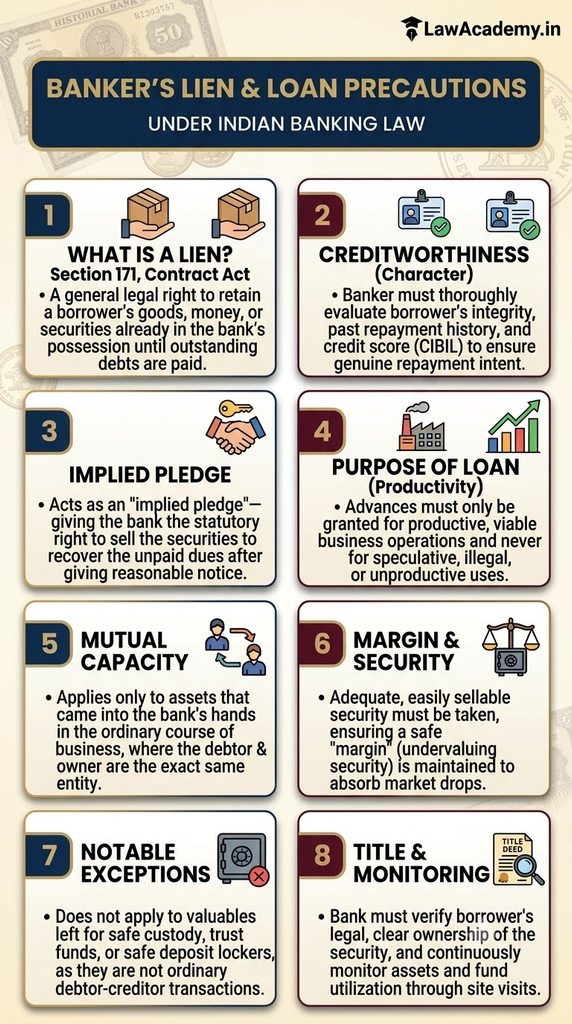
Banker’s Lien is a critical legal privilege that safeguards banking institutions against defaulting borrowers, functioning as a powerful tool for credit recovery under Indian contract law.
Below is a detailed legal analysis of the concept of Banker’s Lien, followed by the essential precautions a banker must exercise when extending credit (loans and advances).
Part 1: What is Banker’s Lien?
A Lien is the legal right of a creditor to retain possession of a debtor’s goods or securities until the outstanding debt is fully discharged.
- General Lien (Section 171, Indian Contract Act, 1872): Unlike a “particular lien” (which only allows a creditor to retain goods connected to a specific unpaid bill, like a tailor keeping a suit they made), a Banker’s Lien is a “General Lien.” Under Section 171, bankers (along with factors, wharfingers, attorneys, and policy brokers) have the statutory right to retain any goods, securities, or money belonging to a debtor that came into their possession during the ordinary course of business, as security for a general balance of account, even if that property is completely unrelated to the specific debt in question.
- “An Implied Pledge”: Legal precedent (e.g., Brandao v. Barnett) has established that a Banker’s Lien is more than just a right to hold; it is an implied pledge. This means that if the borrower defaults after reasonable notice, the bank does not just keep the securities—it has the right to sell them to recover the outstanding loan amount without going to court.
- When Banker’s Lien Applies:
- The property must come into the bank’s hands in the ordinary course of banking business (e.g., bills of exchange, cheques, or promissory notes deposited for collection).
- The goods/securities must belong to the customer in the same capacity in which they owe the debt (mutual identity of parties).
- There must be no contract or agreement (either express or implied) that conflicts with the right of lien.
- Crucial Exceptions (When Lien does NOT apply):
- Safe Custody: Goods, jewelry, or documents left specifically for safekeeping (Bailment).
- Trust Funds: Money deposited for a specific, earmarked purpose (e.g., to pay an insurance premium).
- Locked Boxes: Contents of safe deposit lockers (Lessor-Lessee relationship).
- Securities left accidentally or after a specific loan has been fully paid off.
Part 2: General Precautions in Granting Loans & Advances
When a banker decides to grant loans and advances, they are risking depositor funds. To prevent bad debts and non-performing assets (NPAs), bankers must follow seven fundamental, time-tested precautions (can be summarized as the “Ps and Cs of Credit”):
1. Assess Creditworthiness & Character (The “C” of Character)
The banker must evaluate the borrower’s integrity, past repayment history (via CIBIL/credit scores), and business reputation. A borrower with high capital but poor character is a high risk.
2. Analyze the Capacity & Capital (The “C” of Capacity)
Evaluate the borrower’s financial capacity to run the business and generate cash flows to repay the debt, alongside their capital (tangible net worth) invested in the venture to ensure they have “skin in the game.”
3. Evaluate the “Purpose” of the Loan (Safety & Productivity)
Loans should only be granted for productive, economically viable purposes (e.g., expanding a factory, purchasing inventory) and never for speculative, illegal, or unproductive purposes that carry high default risks.
4. diversification of Risk (Don’t Put All Eggs in One Basket)
A bank should never advance too much credit to a single borrower, group, or a specific industry (such as real estate or steel). Economic downturns in that sector can take down the bank.
5. Verify the “Margin” & Valuation of Security
When taking security (mortgages or pledges), the banker must ensure it is easily sellable and undervalue it slightly (maintain a “margin” of 15% to 50%) to absorb any future drops in market value.
6. Examine Title & Ownership of Assets
Before accepting a property, gold, or shares as security, the bank’s legal team must rigorously check original deeds and registers (via searching SARFAESI/CERSAI registers) to verify that the borrower is the true, undisputed owner with no existing legal claims on the assets.
7. Insure & Monitor/Supervise Assets
- Encumbered properties, plant machinery, and stocks must be heavily insured against fire, theft, and natural disasters, with the bank’s name noted as the mortgagee.
- Continual inspection and “site visits” of inventory and financial books must be conducted to ensure the funds are actually being used for the agreed purpose.