
Banker and a Customer Relationship
Banker and a Customer Relationship
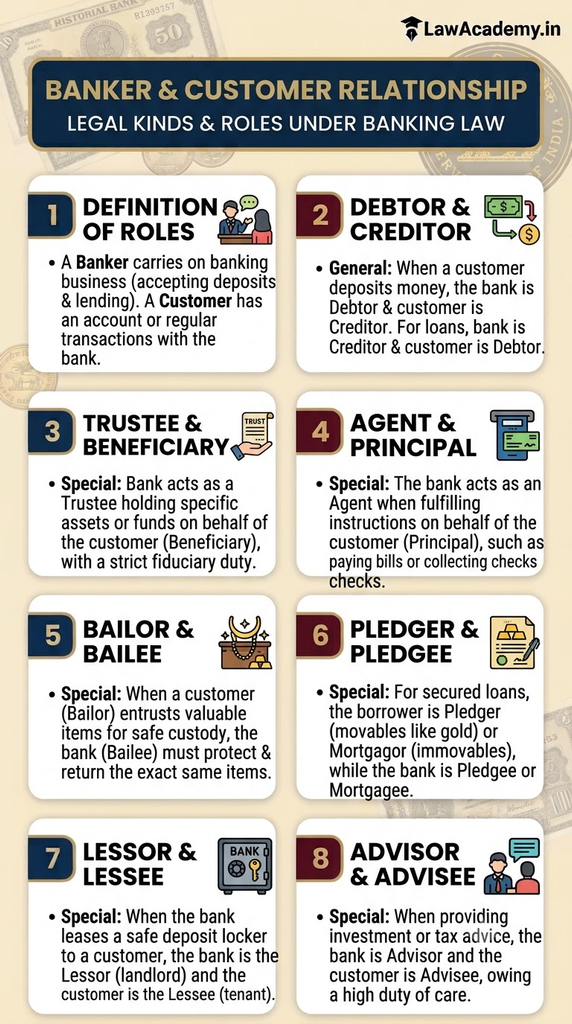
The relationship between a banker and a customer is the foundation of the banking business. Understanding who qualifies as a banker and a customer, along with the various legal and financial roles they assume, is essential.
Definition of “Banker” & “Customer”
1. Who is a “Banker”?
While the Banking Regulation Act, 1949 does not define the word “Banker” directly, Section 5(b) defines banking as “the accepting, for the purpose of lending or investment, of deposits of money from the public, repayable on demand or otherwise, and withdrawable by cheque, draft, order or otherwise.”
- Definition: A Banker is a person, firm, or company carrying on the business of banking—acting as a financial intermediary that takes deposits, pays out on cheques, and provides credit or financial services.
2. Who is a “Customer”?
The term “Customer” is not defined by any statute. Legal precedent has established its definition:
- Definition: A Customer is any person (or entity) who has an account (such as a savings, current, or loan account) with a bank, or for whom the bank habitually undertakes to provide banking services, establishing a regular relationship.
- Key requirement: Simply walking into a bank to cash a check or buy a one-time demand draft does not make someone a “customer” in the eyes of the law; there must be some ongoing transaction or account history.
Kinds of Relationship existing between Banker and Customer
The banker-customer relationship can be divided into General Relationship and Special Relationships.
A. General Relationship
1. Debtor and Creditor
- Definition: This is the most fundamental relationship. When a customer deposits money with a bank, the bank does not hold it as a physical safeguard or trustee. Instead, the bank becomes the Debtor (borrower) and the customer becomes the Creditor (lender). The bank “owes” this money to the customer, who has the right to demand it back according to agreed terms.
- Note: When the customer takes a loan or overdraft, the relationship reverses: the customer becomes the Debtor, and the bank becomes the Creditor.
- Example: A customer deposits ₹1,00,000 into their savings account. The bank uses that money to fund other operations, but is obligated to pay back ₹1,00,000 whenever the customer withdraws it via ATM or cheque.
B. Special Relationships
2. Trustee and Beneficiary
- Definition: A bank acts as a Trustee when it holds a specific asset, document, or fund for a customer (the Beneficiary) for a designated purpose, rather than absorbing it as general deposits. The bank does not own this property; it holds it with a fiduciary responsibility.
- Example: A customer deposits funds specifically dedicated for their daughter’s trust or leaves securities with the bank’s trust division with strict instructions to hold them until the daughter turns 18. The bank cannot use this money for its own lending; it is a trustee.
3. Agent and Principal
- Definition: When a bank performs ancillary tasks on behalf of the customer—like paying bills, collecting checks, or buying/selling securities—it acts as an Agent, while the customer is the Principal. The bank must follow the principal’s specific mandates.
- Example: A customer sets up a standing instruction for the bank to automatically pay their monthly insurance premium of ₹5,000 and electricity bill. The bank acts as the customer’s agent in transferring these funds.
4. Bailor and Bailee (Safe Custody)
- Definition: When a customer entrusts valuable physical goods (like jewelry or title deeds) to the bank for safekeeping, the customer is the Bailor and the bank is the Bailee. The bank has an obligation to return the exact same physical items in the same condition. (Contrast this with general deposits, where the bank just owes the “value”).
- Example: A customer puts jewelry and property papers into a bank locker or hands over a sealed packet for safe custody. The bank is liable as a bailee to guard and return those exact items.
5. Mortgagor and Mortgagee / Pledger and Pledgee (Secured Lending)
- Definition: When a bank lends money against security, a special relationship arises:
- Mortgagor & Mortgagee: Relates to immovable property (like land or a house) as security.
- Pledger & Pledgee: Relates to movable property (like gold or stock) given as physical security.
- Example (Pledge): A customer hands over gold jewelry to the bank to secure a gold loan. The customer is the pledger, and the bank is the pledgee.
- Example (Mortgage): A customer secures a home loan by mortgaging their property deeds to the bank. The customer is the mortgagor, and the bank is the mortgagee.
6. Advisor and Advisee
- Definition: Historically, banks only transacted money. Today, they offer financial, investment, and tax advice. When a customer relies on the bank’s specialized expertise, the relationship is Advisor and Advisee. The bank owes a duty of care, and can be held liable for negligent advice.
- Example: A wealth management executive at a bank advises a customer to invest their retirement corpus of ₹50,00,000 into specific high-risk mutual funds, promising they are “completely safe.” The bank acts as an advisor.
7. Lessor and Lessee
- Definition: When a bank rents out safe deposit lockers to customers, the bank is the Lessor (the landlord) and the customer is the Lessee (the tenant). The bank provides space and retains overall security, but the customer controls the locker’s contents.
- Example: A customer pays an annual rent of ₹3,000 for a bank locker to store confidential deeds. The bank has no knowledge of what is inside and acts purely as a lessor of that secure physical space.