
Appeal, Reference, Review and Revision under CPC
Appeal, Reference, Review and Revision under CPC
Appeal
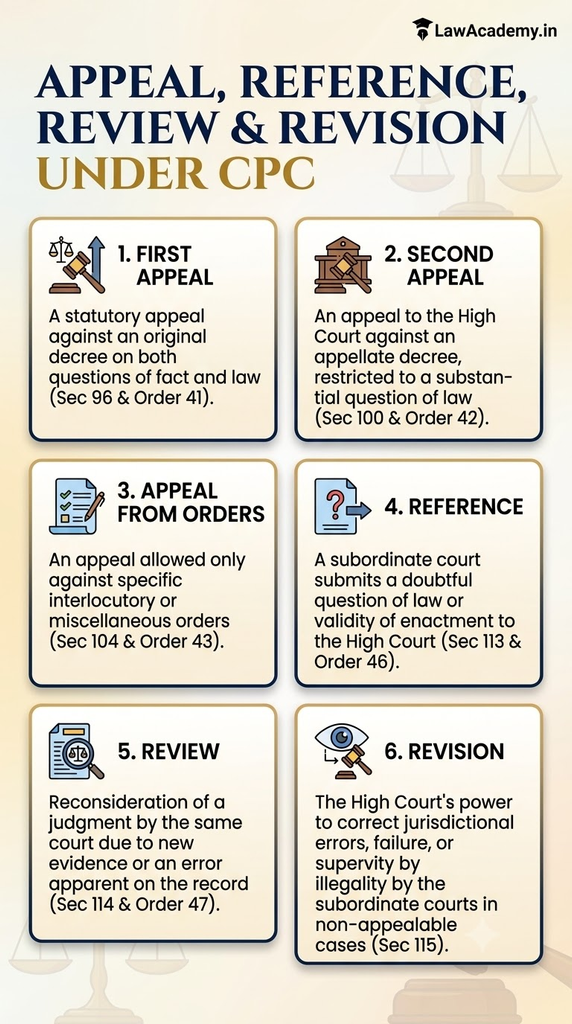
An Appeal is a statutory judicial proceeding by which a litigant removes a case from an inferior court to a superior court to test the soundness, legality, and validity of a decree or an appealable order.
First Appeal from Original Decree (Section 96 & Order 41)
- Definition: A statutory appeal available as a matter of right against an original decree passed by a court exercising original jurisdiction, allowing the appellate court to re-hear both questions of fact and questions of law.
- Example: Appealing to the District Court against a judgment and decree of a Senior Civil Judge dismissing a suit for specific performance of an agreement of sale.
Second Appeal (Section 100 & Order 42)
- Definition: An appeal lying exclusively to the High Court against an appellate decree passed by a subordinate court, restricted solely to cases involving a “substantial question of law.”
- Example: Filing a second appeal before the High Court where the lower appellate court reversed a decree on title by misinterpreting a registered gift deed and ignoring established statutory rules of succession.
Appeals from Orders (Section 104 & Order 43)
- Definition: A limited, non-substantive appeal allowed only against specific interlocutory or miscellaneous orders explicitly enumerated under Section 104 and Order 43 Rule 1.
- Example: Filing a Miscellaneous First Appeal (MFA) against a trial court’s order rejecting an application for temporary injunction under Order 39, Rule 1.
Reference (Section 113 & Order 46)
A Reference is a consultative procedure whereby a subordinate trial court, entertained by a reasonable doubt on a question of law or the validity of an enactment, solicits the binding opinion and decision of the High Court.
- Definition: A reference made by a court trying a suit or executing a decree to the High Court for an authoritative opinion on a question of law, an Act, an Ordinance, or a Regulation whose validity is challenged and doubtful, where no appeal lies against the eventual decree.
- Example: A Junior Civil Judge making a reference to the High Court regarding whether a newly amended municipal property tax notification violates a state statutory enactment, where the court’s final decision in the suit would be non-appealable.
Review (Section 114 & Order 47)
A Review is an equitable and statutory re-examination of a judgment, decree, or order by the very same judge or court that pronounced it, intended to rectify grave patent errors.
- Definition: An application made by an aggrieved person to the court that passed the decree or order for reconsidering its decision upon discovering new, material evidence that could not be produced earlier despite due diligence, or on account of an error apparent on the face of the record, or any other sufficient reason.
- Example: Applying to the same Civil Judge to rectify an eviction decree because the court had erroneously noted the tenant’s deposit as ₹50,000 instead of ₹5,00,000 due to a clerical omission evident directly from the marked exhibit.
Revision (Section 115)
A Revision is the supervisory jurisdiction exercised by the High Court to keep subordinate courts strictly within the bounds of their legal authority and jurisdiction.
- Definition: The discretionary power of the High Court to call for and examine the record of any case decided by a subordinate court (from which no appeal lies) to ensure the court has not exercised a jurisdiction not vested in it, failed to exercise jurisdiction so vested, or acted illegally or with material irregularity.
- Example: Filing a Civil Revision Petition (CRP) before the High Court challenging an order of a trial court that dismissed an application under Order 7 Rule 11 (rejection of plaint) despite the plaint clearly showing on its face that the suit was barred by limitation.