
Procedural Roadmaps, Savings Clauses, and Digital Evidence Under BNS, BNSS, and BSA
Procedural Roadmaps, Savings Clauses, and Digital Evidence Under BNS, BNSS, and BSA
Navigating the Shift: Procedural Roadmaps, Savings Clauses, and Digital Evidence Under BNS, BNSS, and BSA
By [LawAcademy Editorial Team]
Published on [15-09-2026]
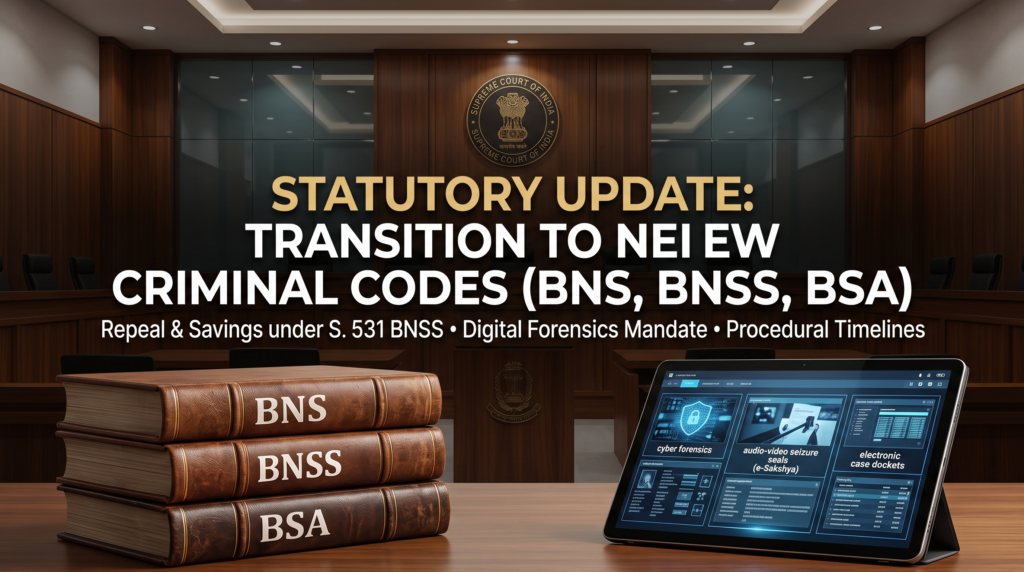
The replacement of India’s colonial-era criminal statutes by the Bharatiya Nyaya Sanhita, 2023 (BNS), the Bharatiya Nagarik Suraksha Sanhita, 2023 (BNSS), and the Bharatiya Sakshya Adhiniyam, 2023 (BSA) initiated a structural transition across police stations, forensic laboratories, and courts nationwide.
As judicial and enforcement agencies operationalize the tri-code architecture, recent administrative circulars and judicial pronouncements have clarified transitional procedures, digital evidentiary standards, and strict statutory timelines.
The Transition Rule & Section 531 BNSS (Repeal & Savings)
A recurring point of litigation during the transition has been determining whether old procedural laws continue to apply after the enactment date. Judicial interpretations around Section 531(2)(a) BNSS and constitutional protections under Article 20(1) have crystallized the following rules:
- Substantive Offence Date Dictates Penal Law: The date of the alleged commission governs substantive offences. Acts committed prior to the commencement date are registered and charged under the Indian Penal Code (IPC), 1860, not the BNS.
- Pending Proceedings Preserved: If an FIR, preliminary enquiry, trial, appeal, or revision was already pending before the enforcement date, Section 531 of the BNSS mandates that it continues to be governed by the Code of Criminal Procedure (CrPC), 1973.
- Fresh Proceedings Post-Enforcement: Any fresh application, complaint, or FIR registered regarding an older offence must utilize the procedural mechanisms and numbering of the BNSS (such as Section 173 BNSS for FIR registration instead of Section 154 CrPC).
Digital Forensics & The Electronic Evidentiary Standard (BSA)
The evidentiary framework has moved away from treating digital materials as inherently secondary:
- Primary Status for Digital Records (Section 61 BSA): Electronic records, semiconductor memory chips, server logs, mobile communications, and cloud-hosted data now carry parity with traditional paper documentation.
- Mandatory Audio-Video Capture: Under Section 176(3) BNSS and related investigation rules, forensic visits and videography of searches, seizures, and witness statements (via systems like e-Sakshya) have become compulsory for offences punishable with imprisonment of seven years or more.
- Zero FIR & e-FIR Framework: The statutory codification of Zero FIR ensures jurisdictional disputes between police stations can no longer impede immediate crime reporting, complemented by e-FIR channels for specified non-heinous offences.
Enforcing Procedural Time Limits
To eliminate protracted pre-trial delays, the BNSS imposes strict statutory timelines on investigative agencies and the bench:
| Stage of Proceeding | Earlier Position (CrPC) | New Mandate (BNSS) |
| Investigation Progress | No structured requirement | Mandatory status update to the informant within 90 days |
| Framing of Charges | Open-ended schedule | Must be completed within 60 days of the first hearing |
| Pronouncement of Judgment | Ambiguous guidelines | Judgment delivered within 45 days of concluding arguments |
Practice Takeaway for Lawyers and Law Students
The operational reality of Indian criminal litigation now requires dual-statute proficiency: managing ongoing legacy trials strictly under the CrPC and Evidence Act while structuring all new investigations, applications, and forensic evidence under the procedural mechanisms of the BNSS and BSA.
Reference & Statutory Citations
- Enactments: Bharatiya Nyaya Sanhita, 2023 (BNS); Bharatiya Nagarik Suraksha Sanhita, 2023 (BNSS); Bharatiya Sakshya Adhiniyam, 2023 (BSA).
- Core Transition Provisions: Section 531, BNSS (Repeal and Savings); Section 61, BSA (Electronic Evidence); Section 176(3), BNSS (Forensics).
- Constitutional Reference: Article 20(1) (Protection against ex post facto penal laws), Constitution of India.