
Supreme Court Directs Equal Yardstick for OBC Creamy Layer in Rohith Nathan Ruling
Supreme Court Directs Equal Yardstick for OBC Creamy Layer in Rohith Nathan Ruling
Beyond Paychecks: Supreme Court Directs Equal Yardstick for OBC Creamy Layer in Rohith Nathan Ruling
By [LawAcademy Editorial Team]
Published on [14-09-2026]
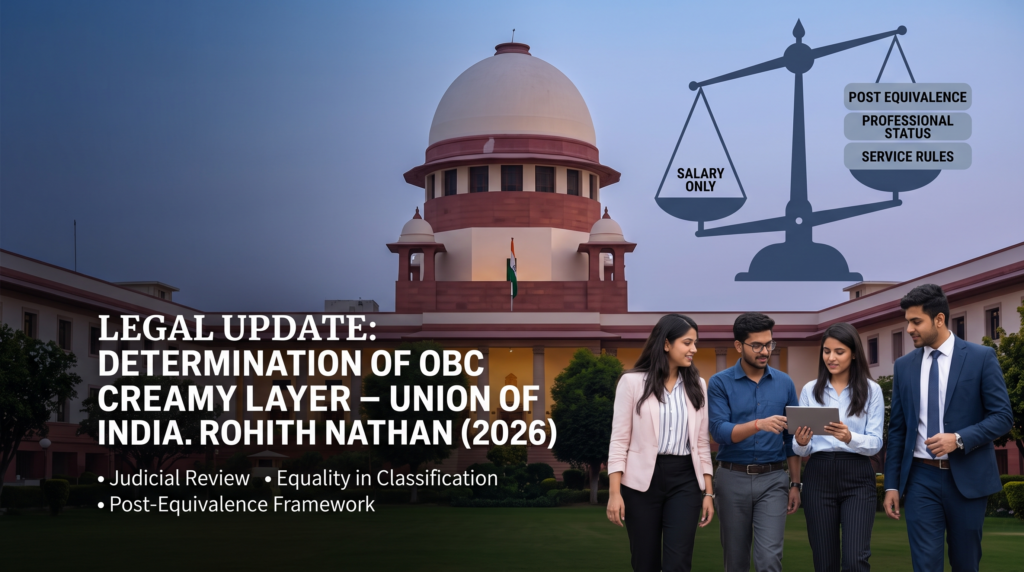
The Supreme Court delivered a decisive verdict resolving decades of administrative ambiguity over how Other Backward Classes (OBC) creamy-layer exclusions are computed for wards of Public Sector Undertaking (PSU) and private-sector employees.
In Union of India v. Rohith Nathan & Others, the apex court held that parental salary income cannot serve as the sole criterion to deny OBC non-creamy layer (NCL) benefits, mandating that social status and service equivalence must guide reservations under the Constitution.
Context and the Legal Controversy
Under the landmark Indra Sawhney (1992) framework and the subsequent Department of Personnel and Training (DoPT) Office Memorandum (OM) dated September 8, 1993, creamy-layer exclusion was structured primarily around occupational status (Category I & II) rather than gross paychecks:
- Government Employees: Direct entry into Group ‘A’ / Class I posts puts wards in the creamy layer. Crucially, parental salary and agricultural income are specifically excluded when computing the monetary income ceiling (Category VI).
- PSU and Autonomous Bodies: Category II-C of the 1993 OM directed that government equivalence be evaluated for posts in PSUs, public sector banks, and universities.
- The Bureaucratic Gridlock: For over three decades, executive bodies failed to formally map post-equivalence between PSU managerial scales and civil posts. Consequently, following a 2004 DoPT clarification, recruiting authorities subjected PSU and private-sector employees solely to Category VI’s gross income test—treating parental salary as general income while continuing to exempt government salaries.
This created an unfair disparity: children of Group ‘B’ government officers earning higher overall salaries remained eligible for OBC reservations, whereas candidates whose parents held modest non-equivalent posts in PSUs or nationalized banks were disqualified simply because their parent’s gross salary crossed the monetary threshold.
Core Findings of the Supreme Court
- Rejection of Purely Income-Based Disqualification: The bench held that treating gross salary as the determinant for PSU employees—while excluding salary for direct civil servants—violates the spirit of Article 14 and Article 16.
- State Inaction Cannot Prejudice Candidates: The government’s failure to establish post-equivalence across three decades cannot become a ground to disenfranchise deserving OBC candidates who cleared high-stakes national examinations.
- Harmonizing the 1993 Framework: The Court underscored that creamy-layer determination is rooted in social advancement and status, not transient monthly compensation. The original 1993 mandate must be applied without using arbitrary administrative clarifications to target salary figures.
- Relief and Accommodation: The bench instructed authorities to re-evaluate the candidatures of excluded aspirants within six months and, where necessary, create supernumerary posts so that qualified candidates do not forfeit their service allocations.
Legal Significance
The judgment establishes long-overdue parity in national competitive examinations like the UPSC Civil Services Examination. By reaffirming that administrative lethargy cannot truncate constitutional affirmative action, Rohith Nathan establishes that parental social status, rather than market-driven cost-to-company (CTC) metrics, remains the constitutional touchstone for creamy-layer determination.
Reference & Citation
- Case Name: Union of India v. Rohith Nathan & Others
- Bench / Authority: Supreme Court of India
- Core Precedent Considered: Indra Sawhney v. Union of India (1992); DoPT Office Memorandum No. 36012/22/93-Estt.(SCT) dated September 8, 1993.