
Lok Adalat? Procedure and functioning of a Lok Adalat and the difference between a matter decided under it and regular courts.
Lok Adalat? Procedure and functioning of a Lok Adalat and the difference between a matter decided under it and regular courts.
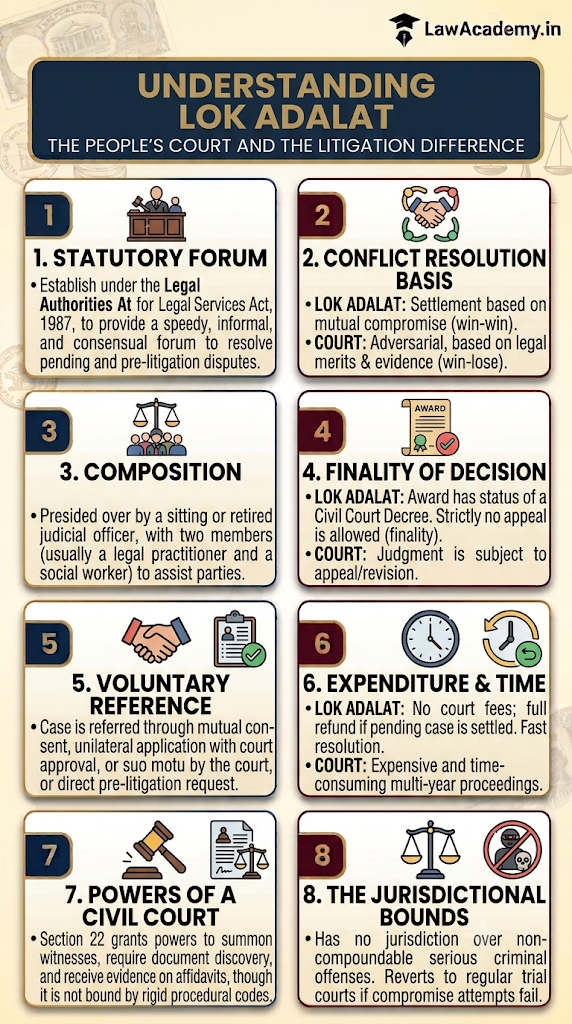
Lok Adalat (People’s Court) is a statutory forum for Alternative Dispute Resolution (ADR) established under the Legal Services Authorities Act, 1987 (LSAA). Rooted in ancient Indian dispute-resolution traditions (such as the Panchayat system), it was codified to give effect to Article 39A of the Constitution of India, which mandates equal justice and free legal aid.
A Lok Adalat operates as a non-adversarial body where pending court cases or pre-litigation disputes are settled amicably through negotiation, conciliation, and mutual compromise.
I. Organization and Composition of Lok Adalat (Section 19)
Under Section 19 of the Act, Lok Adalats are organized by:
- The Supreme Court Legal Services Committee (SCLSC)
- The High Court Legal Services Committee (HCLSC)
- State Legal Services Authorities (SLSA)
- District Legal Services Authorities (DLSA)
- Taluk Legal Services Committees (TLSC)
Composition of Benches:
A Lok Adalat bench typically consists of:
- A sitting or retired judicial officer (serving as the Presiding Officer).
- Two members, usually:
- An advocate / legal practitioner.
- A social worker or expert engaged in the welfare of women and children.
II. Jurisdiction and Subject Matter (Section 19(5))
A Lok Adalat exercises jurisdiction over:
- Pending Cases: Any case pending before any civil court, criminal court, or tribunal.
- Pre-Litigation Disputes: Any matter falling within the jurisdiction of a court but not yet filed.
Eligible Disputes:
- Matrimonial and family disputes (custody, maintenance, divorce by mutual consent).
- Motor Accident Claims (MACT cases).
- Cheque bounce disputes under Section 138 of the Negotiable Instruments Act, 1881.
- Bank recovery and loan default matters.
- Land acquisition compensation disputes.
- Labor and industrial employment disputes.
- Electricity, water, and municipal tax bill arrears.
- Compoundable criminal offenses.
Statutory Bar: Under the proviso to Section 19(5), a Lok Adalat has no jurisdiction over any matter relating to an offense that is not compoundable under any law (e.g., non-compoundable serious criminal offenses under BNS/IPC).
III. Procedure and Functioning of Lok Adalat
The operational mechanism follows a structured, consent-based procedure outlined under Sections 20, 21, and 22 of the Act:
1. Reference of Cases (Section 20)
A case is referred to a Lok Adalat through any of the following avenues:
- Mutual Consent: Both parties make a joint application to the court where the case is pending.
- Unilateral Application: One party applies, and the court, after giving a reasonable opportunity of being heard to the opposing party, is satisfied that there is a possibility of settlement.
- Court’s Discretion (Suo Motu): The court itself is satisfied that the matter is appropriate for settlement before a Lok Adalat.
- Pre-Litigation Reference: Either party to a dispute applies directly to the DLSA/TLSC before initiating litigation.
2. Conciliatory Functioning
- Informal & Direct Communication: The members of the Lok Adalat interact directly with the parties and their counsel in a relaxed, informal setting.
- Facilitating Compromise: Guided by principles of natural justice, equity, objectivity, and fair play, the bench assists the parties in narrowing their differences.
- No Imposition: Under Section 19(6), the Lok Adalat’s sole function is to arrive at a compromise or settlement. It cannot impose any decision, fine, or penalty against the will of any party.
3. Powers of a Civil Court (Section 22)
For procedural inquiries, the Lok Adalat has the same powers as a Civil Court under the Code of Civil Procedure, 1908 (CPC) regarding:
- Summoning and enforcing witness attendance and examining them on oath.
- Discovery and production of documents.
- Receiving evidence on affidavits.
- Requisitioning public records.
4. The Passing of the Award (Section 21)
- When a compromise is reached, the terms are reduced to writing, signed by both parties and their advocates, and endorsed by the bench.
- The bench passes an Award in terms of the agreed compromise.
- If no compromise is arrived at, the record is returned to the regular court from which it was referred, and the suit proceeds from the stage where it was interrupted. In pre-litigation cases, parties are advised to approach a competent court.
5. Financial Incentive (Refund of Court Fees)
Under Section 21(1) read with the Court-Fees Act, 1870, if a pending matter is settled in a Lok Adalat, the entire court fee paid by the plaintiff is refunded, encouraging litigants to explore settlements.
IV. Differences Between Lok Adalat and Regular Courts
| Parameter | Lok Adalat | Regular Civil / Criminal Court |
| Primary Philosophy | Conciliatory, consensual, and restorative | Adversarial, adjudicatory, and fault-finding |
| Basis of Decision | Mutual consent and compromise between parties | Statutory merits, evidence, and strict legal application |
| Final Decision / Order | Lok Adalat Award (Sec 21) | Judgment and Decree / Sentence |
| Nature of Outcome | Win–Win (preserves future relationships) | Win–Lose (leaves lingering bitterness) |
| Appellate Remedies | No appeal lies to any court (Sec 21(2)); absolute finality | Subject to first appeals, second appeals, and SLPs |
| Challenging an Award | Only through a Writ Petition under Articles 226/227 of the Constitution on grounds of fraud | Through regular statutory appeals, revisions, and reviews |
| Procedural Codes | Not bound by the CPC (1908) or Evidence Act / BSA (2023) | Strictly bound by the CPC, BNSS, and BSA |
| Court Fees | Nil; full refund of court fees if pending case is settled | Mandatory court fees payable by the plaintiff/petitioner |
| Time & Cost | Resolved swiftly (often in a single day) at virtually zero cost | Multi-year proceedings accompanied by heavy litigation costs |
| Role of Presiding Officer | Acts as an active conciliator/mediator | Acts as an authoritative judge/umpire |