
Explain the grounds of setting aside of an Arbitral award and the conditions for the removal of an arbitrator
Explain the grounds of setting aside of an Arbitral award and the conditions for the removal of an arbitrator
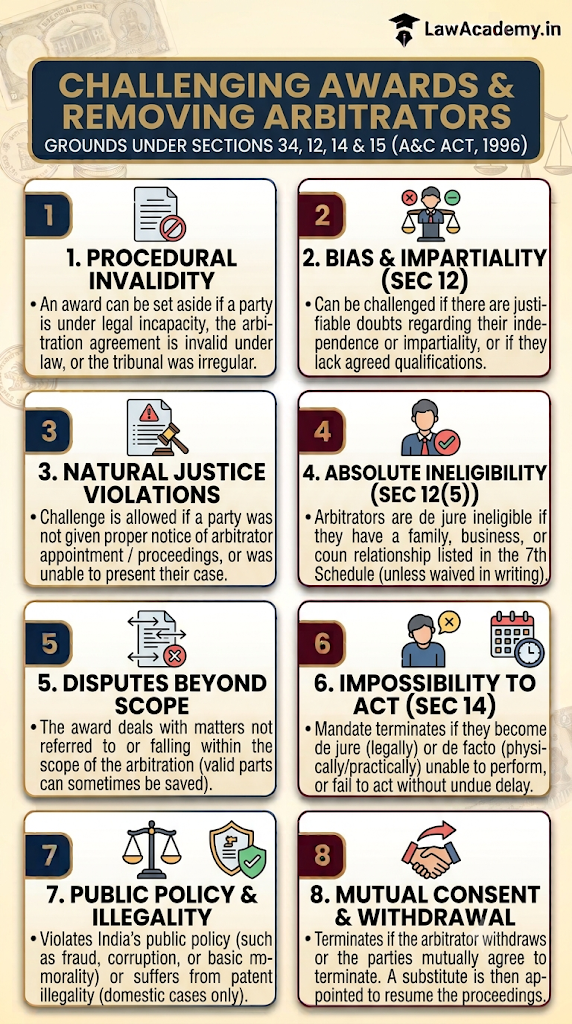
In India, the Arbitration and Conciliation Act, 1996 balances the principle of party autonomy with necessary judicial safeguards. To protect the integrity of the process, the Act provides strict and limited grounds for setting aside an arbitral award (Section 34) and specific conditions for the removal or termination of an arbitrator (Sections 12, 13, 14, and 15).
PART I: Grounds for Setting Aside an Arbitral Award (Section 34)
Under Section 34 of the Act, a court cannot review an arbitral award on its merits (like an appellate court). An award can only be set aside if the challenging party proves specific procedural, jurisdictional, or legal defects.
These grounds are divided into two categories: grounds to be proved by the party based on the record of the tribunal (Section 34(2)(a)), and grounds the court can find on its own (Section 34(2)(b)), plus the ground of patent illegality (Section 34(2A)).
A. Grounds to be Established by the Challenging Party (Section 34(2)(a))
- Incapacity of a Party: A party to the arbitration agreement was under some legal incapacity (e.g., minor or person of unsound mind) at the time of making the agreement.
- Invalid Arbitration Agreement: The arbitration agreement is invalid under the law to which the parties subjected it, or under the law in force (such as Indian law).
- Lack of Proper Notice (Violation of Natural Justice): The challenging party was not given proper notice of the appointment of an arbitrator or of the arbitral proceedings, or was otherwise unable to present their case (Audi Alteram Partem).
- Dispute Outside the Scope of Reference: The award deals with a dispute not contemplated by, or not falling within, the terms of the submission to arbitration, or contains decisions on matters beyond the scope of the arbitration. (If the valid parts can be separated, only the unauthorized parts will be set aside).
- Irregular Composition or Procedure: The composition of the arbitral tribunal or the arbitral procedure was not in accordance with the agreement of the parties (unless the agreement was in conflict with a non-waivable provision of the Act), or failed to follow the Act.
B. Grounds the Court Can Find on Its Own (Section 34(2)(b))
- Non-Arbitrable Subject Matter: The subject matter of the dispute is not capable of settlement by arbitration under Indian law (e.g., criminal offenses, matrimonial disputes, guardianship, or insolvency).
- Conflict with the Public Policy of India: The award is in conflict with the “public policy of India”. According to Explanations to the section, an award violates public policy only if:
- It was induced or affected by fraud or corruption (or violated confidentiality/evidence rules).
- It is in contravention with the fundamental policy of Indian law (though this does not allow the court to re-assess the merits of the case).
- It is in conflict with the most basic notions of morality or justice.
C. Patent Illegality (Section 34(2A))
- Patent Illegality (For Domestic Arbitrations Only): Introduced by amendments, a domestic arbitral award (not an international commercial arbitration) can be set aside if it is “patently illegal” on the face of the award. However, this cannot be used for a mere erroneous application of the law or by re-appreciating evidence.
Strict Timelines (Section 34(3)):
An application for setting aside must be made within 3 months from the date the party received the award. A court can condone a delay of only up to 30 additional days if “sufficient cause” is shown—absolutely no extension can be granted after 120 days.
PART II: Conditions for the Removal of an Arbitrator
An arbitrator’s mandate can be terminated, and the arbitrator removed, under three primary statutory routes: Challenge Procedure (Sections 12 & 13), Failure or Impossibility to Act (Section 14), and Withdrawal or Agreement (Section 15).
A. Grounds for Challenge (Section 12)
An arbitrator is required to disclose in writing any circumstances that could affect their independence or impartiality. A party may challenge them under the following conditions:
- Justifiable Doubts on Impartiality: Circumstances exist (such as family, business, or financial ties with a party or the dispute) that give rise to justifiable doubts about their independence or impartiality (guided by the Fifth Schedule of the Act).
- Lack of Agreed Qualifications: The arbitrator does not possess the natural or expert qualifications agreed to by the parties.
- Absolute Ineligibility (Section 12(5)): Any person who has a relationship with the parties, counsel, or the dispute that falls within the Seventh Schedule (such as being an employee, consultant, regular advisor, or having a direct financial interest) is de jure ineligible to be appointed. (This can only be waived by an express written agreement after the dispute has arisen).
Procedure for Challenge (Section 13):
The challenging party must send a written statement of the reasons for the challenge to the arbitral tribunal within 15 days of becoming aware of the tribunal’s constitution or the grounds of challenge. If the challenged arbitrator does not withdraw, or the other party does not agree to the challenge, the arbitral tribunal itself decides on the challenge.
- Note: If the tribunal rejects the challenge, it continues the proceedings and makes an award. The challenging party can then use those grounds to try to set aside the final award under Section 34.
B. Failure or Impossibility to Act (Section 14)
The mandate of an arbitrator will terminate (leading to their removal and substitution) if:
- De Jure Impossibility: They become legally unable to perform their functions (such as falling under the Seventh Schedule ineligibilities, being declared bankrupt, or being disqualified by law).
- De Facto Impossibility: They become physically or practically unable to perform their functions (due to severe illness, prolonged absence, or death).
- Undue Delay: They fail to act without undue delay, causing a stall in the proceedings.
If a controversy remains regarding these grounds (for instance, if an arbitrator refuses to step down), a party can apply to the Court (under Section 14(2)) to decide on the termination of the mandate.
C. Agreement or Withdrawal (Section 15)
The mandate of an arbitrator is also terminated if:
- Withdrawal: The arbitrator voluntarily withdraws from office for any reason.
- Mutual Consent of the Parties: The parties mutually agree to terminate the arbitrator’s mandate, exercising their right of party autonomy.
Summary of Differences
| Feature | Setting Aside an Award (Sec 34) | Removal of an Arbitrator (Sec 12–15) |
| Object | Voiding a finished, faulty arbitral award. | Ending an arbitrator’s mandate during the proceedings. |
| Authority | The Court (Civil Court / High Court). | The Arbitral Tribunal first, or the Court (for Sec 14/15/Ineligibilities). |
| Key Grounds | Incapacity, invalid agreement, violation of natural justice, public policy, or patent illegality. | Bias/partiality, lack of qualification, legal/physical impossibility, or undue delay. |
| Timing | Must be filed strictly within 3 to 4 months of receiving the award. | Can be triggered at any stage of the ongoing arbitration. |
| Result | The award is annulled (or sent back for correction); a new dispute might be launched. | The arbitrator is substituted by a new arbitrator (Section 15), and proceedings typically resume. |