
Brief note on the Family Court system in India.
Brief note on the Family Court system in India.
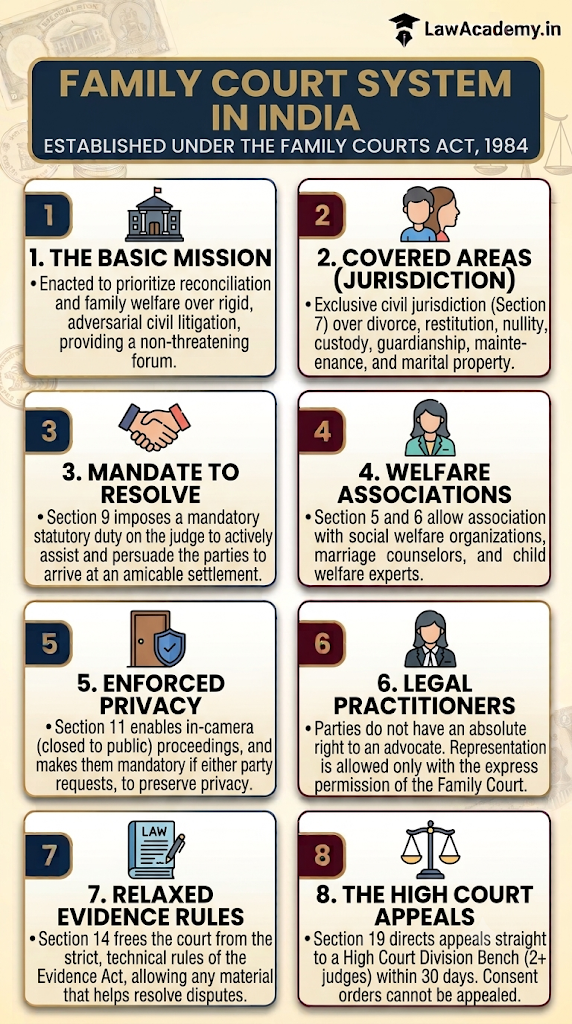
The Family Courts system in India was established under the Family Courts Act, 1984, enacted to promote conciliation and secure the speedy settlement of disputes relating to marriage and family affairs. Prior to this legislation, matrimonial and family disputes were adjudicated by ordinary civil courts, where rigid procedural rules and an adversarial atmosphere often exacerbated domestic friction rather than resolving it.
1. Objectives and Legislative Intent
- Shift from Adversarial to Conciliatory Justice: The primary goal is to prioritize reconciliation, mutual settlement, and family welfare over rigid, fault-finding judicial pronouncements.
- Speedy and Inexpensive Disposal: To shield family disputes from protracted civil litigation, procedural technicalities, and high legal costs.
- Specialized Environment: To provide a non-threatening, private forum where sensitive issues—such as child custody, restitution of conjugal rights, and maintenance—can be discussed candidly.
2. Establishment of Family Courts (Section 3)
- Under Section 3, the State Government, after consultation with the High Court, is mandated to establish a Family Court for every area comprising a city or town with a population exceeding 1 million (10 lakh).
- The State Government may also establish Family Courts in other areas as it deems necessary.
3. Jurisdiction of Family Courts (Section 7)
Section 7 confers exclusive civil jurisdiction on Family Courts over matrimonial and family matters, completely ousting the jurisdiction of ordinary civil courts and magistrates in those areas:
- Matrimonial Relief: Suits or proceedings for divorce, judicial separation, nullity of marriage, and restitution of conjugal rights.
- Validity of Marriage & Legitimacy: Declarations regarding the matrimonial status of any person or the legitimacy of a child.
- Property Disputes: Suits between spouses regarding property acquired during or before marriage.
- Injunctions in Marital Relationships: Injunctions arising out of circumstances connected to a marital relationship.
- Maintenance: Suits or claims for maintenance (including maintenance proceedings under statutory personal laws and criminal maintenance under Section 125 CrPC / Section 144 BNSS).
- Custody and Guardianship: Suits or proceedings relating to the guardianship, custody, or visitation access of minors or persons with disabilities.
4. Salient Features and Distinguishing Procedures
A. Mandatory Duty to Endeavour for Reconciliation (Section 9)
In every suit or proceeding, the Family Court has a statutory obligation to endeavor to assist and persuade the parties to arrive at an amicable settlement before proceeding with a formal trial. The court may adjourn proceedings to allow reconciliation efforts to take place.
B. Association with Social Welfare Entities and Experts (Sections 5 & 6)
The State Government, in consultation with the High Court, can determine the association of:
- Social welfare organizations, marriage counselors, child welfare agencies, and psychologists with the court.
- Institutional appointment of permanent Counselors to conduct pre-trial mediation and conciliation sessions.
C. In-Camera Proceedings (Section 11)
To preserve the dignity, privacy, and reputation of families, proceedings may be conducted in camera (closed to the public) at the discretion of the court, and must be held in-camera if either party desires.
D. Simplified Procedure & Exemption from Strict Evidence Rules (Sections 10 & 14)
- Section 10: While the Code of Civil Procedure (CPC) generally applies, the Family Court has the autonomy to lay down its own flexible procedure to facilitate settlement.
- Section 14: The court is not strictly bound by technical rules under the Indian Evidence Act (now Bharatiya Sakshya Adhiniyam). It may receive any report, statement, document, or matter that, in its opinion, assists in effectively resolving the dispute, regardless of technical admissibility.
E. Restriction on Legal Practitioners (Section 13)
To minimize hostility and technical legal maneuvering, parties do not have an absolute right to be represented by a legal practitioner (advocate) as of right. An advocate can only appear with the express leave/permission of the Family Court. The court may also appoint an amicus curiae to assist in the interest of justice.
5. Appeals (Section 19)
- An appeal against any judgment or order (not being an interlocutory order) of a Family Court lies directly to the High Court.
- Appeals must be heard by a bench consisting of two or more Judges (Division Bench).
- The period of limitation for filing an appeal is 30 days from the date of the judgment or order.
- No appeal lies from a decree or order passed by the Family Court with the consent of the parties.
Summary Table
| Feature | Ordinary Civil Court | Family Court System |
| Governing Statute | Code of Civil Procedure, 1908 | Family Courts Act, 1984 |
| Approach | Adversarial (Win–Lose) | Conciliatory and Remedial (Win–Win) |
| Pre-Trial Reconciliation | Discretionary (Sec 89 CPC) | Mandatory statutory duty (Sec 9) |
| Proceedings | Open court by default | In-camera (mandatory on request) |
| Rules of Evidence | Strict statutory admissibility | Flexible; assists justice (Sec 14) |
| Appeals | District Court / Single Judge HC | Directly to Division Bench of High Court |