
Historical Background and Objectives of the Arbitration and Conciliation Act, 1996.
Historical Background and Objectives of the Arbitration and Conciliation Act, 1996.
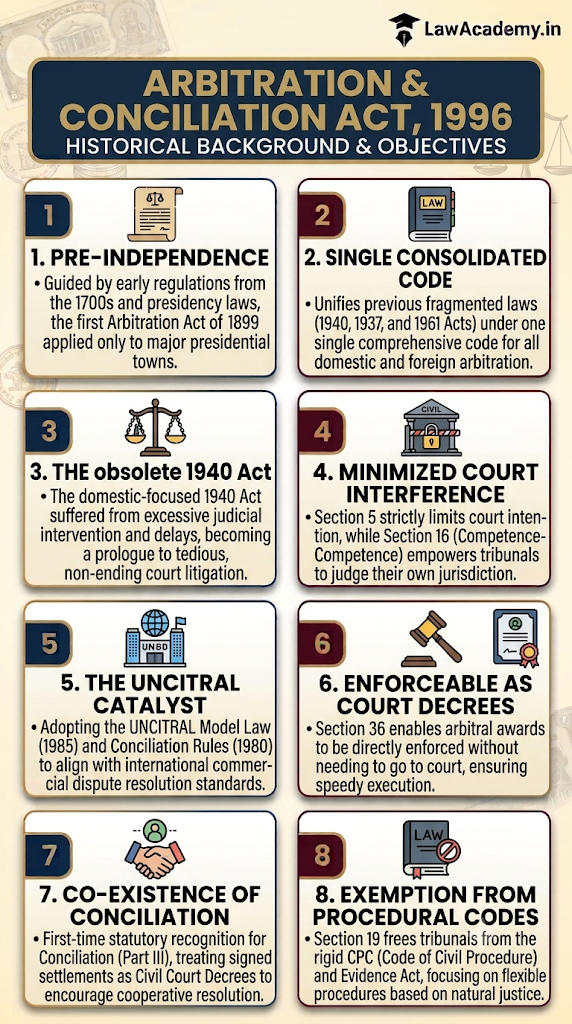
The Arbitration and Conciliation Act, 1996 stands as a watershed legislation in Indian commercial and procedural jurisprudence. It was enacted to consolidate, modernize, and unify the laws relating to domestic arbitration, international commercial arbitration, and the enforcement of foreign arbitral awards, as well as to formally recognize conciliation.
I. Historical Background
The legislative evolution of arbitration in India transitioned through distinct phases, moving from colonial-era statutory fragments to an internationally harmonized framework.
1. Pre-Independence Statutory Developments
- Early Regulations: Before codification, arbitration existed in customary indigenous forums (such as Panchayats). Formal legislative recognition began with Bengal Regulations of 1772, 1780, and 1781, providing for reference to arbitration upon mutual consent.
- The Indian Arbitration Act, 1899: Enacted based on the English Arbitration Act of 1889, this was India’s first specific arbitration statute. However, its territorial application was limited to Presidency Towns (Calcutta, Bombay, and Madras).
- The Second Schedule of CPC, 1908: For mofussil (non-presidency) jurisdictions, arbitration was governed by the Second Schedule of the Code of Civil Procedure, 1908.
- The Arbitration (Protocol and Convention) Act, 1937: Enacted to give effect to the Geneva Protocol on Arbitration Clauses (1923) and the Geneva Convention on the Execution of Foreign Arbitral Awards (1927).
2. The Arbitration Act of 1940
To consolidate domestic provisions, the British administration enacted the Arbitration Act, 1940 (repealing the 1899 Act and the Second Schedule of CPC). It dealt exclusively with domestic arbitration.
- Deficiencies of the 1940 Act:
- Excessive Judicial Intervention: Parties could easily access regular civil courts at every stage—prior to reference, during proceedings, and post-award.
- Protracted Delays: An arbitral award could not be executed on its own; it had to be filed in court to be made a “rule of the court” (decree). This resulted in protracted litigation that defeated the purpose of speedy resolution.
- Famous Judicial Criticism: The Supreme Court in Guru Nanak Foundation v. Rattan Singh & Sons (1981) famously observed that the 1940 Act had made arbitration proceedings a “mockery” and a “prelude to litigation”, causing the legal way of doing business to become tedious and indefinitely delayed.
3. Foreign Awards Acts
To enforce international commercial awards, separate statutes operated in silos:
- The Arbitration (Protocol and Convention) Act, 1937 (Geneva Convention).
- The Foreign Awards (Recognition and Enforcement) Act, 1961 (New York Convention of 1958).
4. The Catalyst for Reform (1991 Economic Reforms & UNCITRAL)
- Following the economic liberalization of 1991, India opened its markets to Foreign Direct Investment (FDI) and global commerce. International investors required a predictable, fast-track dispute resolution mechanism with minimal court interference.
- The United Nations Commission on International Trade Law adopted the UNCITRAL Model Law on International Commercial Arbitration (1985) and the UNCITRAL Conciliation Rules (1980). The UN General Assembly recommended that all nations adopt these models to ensure global uniformity.
- Recognizing that the 1940 Act was obsolete, the President promulgated the Arbitration and Conciliation Ordinance, 1996, which subsequently was enacted by Parliament as the Arbitration and Conciliation Act, 1996 (Act No. 26 of 1996), coming into force on August 22, 1996.
II. Objectives of the Arbitration and Conciliation Act, 1996
The Statement of Objects and Reasons accompanying the Act outlines key legislative objectives:
1. Consolidation and Harmonization of Arbitration Law
- To unify domestic arbitration, international commercial arbitration, and the enforcement of foreign awards under a single comprehensive code.
- Repealed the three fragmented previous statutes:
- The Arbitration Act, 1940
- The Arbitration (Protocol and Convention) Act, 1937
- The Foreign Awards (Recognition and Enforcement) Act, 1961
2. Adoption of the UNCITRAL Model Law
- To ensure that Indian arbitration law conforms to the UNCITRAL Model Law on International Commercial Arbitration (1985) and the UNCITRAL Conciliation Rules (1980), establishing global credibility for India’s legal ecosystem.
3. Curtailing Judicial Interference (Section 5)
- To strictly limit court intervention. Section 5 contains an express non-obstante clause barring judicial authorities from intervening in the arbitral process except where explicitly provided by Part I of the Act.
4. Autonomy and Flexibility of the Arbitral Tribunal
- Principle of Competence-Competence (Section 16): Empowering the arbitral tribunal to rule on its own jurisdiction, including deciding any objections concerning the existence or validity of the arbitration agreement.
- Freedom from Rigid Procedural Codes (Section 19): Freeing tribunals from the technical strictures of the Code of Civil Procedure, 1908 (CPC) and the Indian Evidence Act, 1872 (now Bharatiya Sakshya Adhiniyam, 2023), allowing procedural adaptability guided by natural justice.
5. Direct Enforceability of Arbitral Awards (Section 36)
- Eliminated the cumbersome requirement of applying to court to get an award made a “rule of the court.”
- Under Section 36, an arbitral award is directly enforceable and executable in the same manner as a decree of a civil court.
6. Formal Recognition of Conciliation (Part III)
- For the first time, provided a statutory framework for Conciliation as an alternative dispute resolution mechanism.
- Under Section 74, a conciliated settlement agreement is conferred the exact legal status and effect of an arbitral award on agreed terms.
7. Expeditious and Cost-Effective Dispute Resolution
- To relieve backlogged civil courts by diverting commercial disputes to specialized tribunals, ensuring timely conclusions, business confidentiality, and cost efficiency.
8. Seamless Enforcement of Foreign Awards (Part II)
- To establish a predictable, time-bound procedure for enforcing foreign arbitral awards under both the New York Convention (1958) and the Geneva Convention (1927).
Key Structural Framework of the 1996 Act
- Part I (Sections 2 to 43): Governs domestic arbitrations and international commercial arbitrations seated in India.
- Part II (Sections 44 to 60): Enforces foreign awards under the New York Convention (Chapter I) and Geneva Convention (Chapter II).
- Part III (Sections 61 to 81): Provides the statutory framework for Conciliation.
- Part IV (Sections 82 to 86): Supplementary provisions (High Court rule-making powers, removal of difficulties, repeals).