
Importance of Banking business in India and the impact of Technology on it
Importance of Banking business in India and the impact of Technology on it
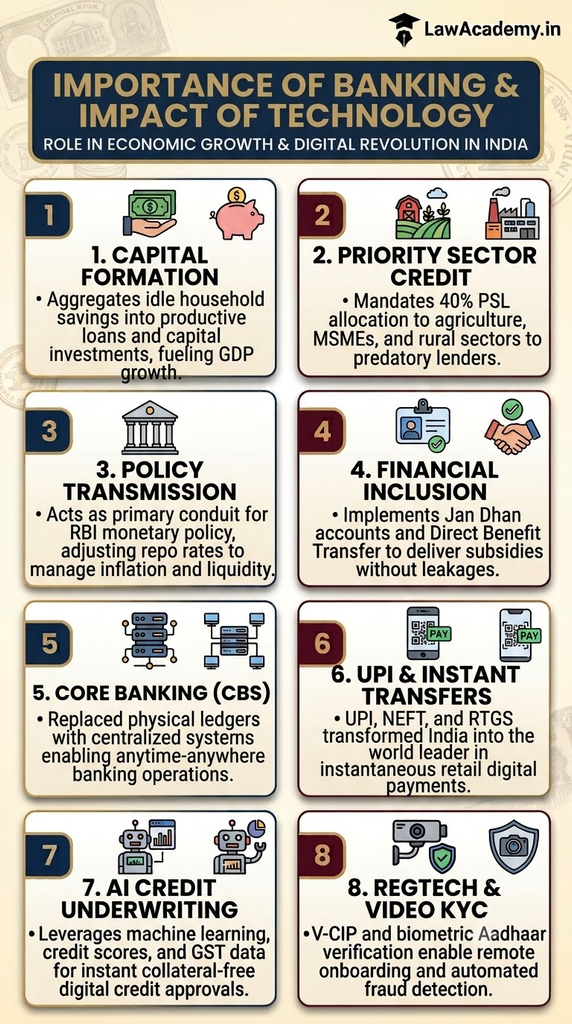
Importance of Banking Business in India
The banking sector serves as the circulatory system of the Indian economy. Its primary significance is reflected in several core functions:
1. Capital Formation and Mobilization of Savings
- Aggregates idle monetary savings from households across urban and rural demographics into institutional deposits.
- Channels these pooled resources into productive capital investments, infrastructure projects, and corporate credit, driving Gross Domestic Product (GDP) growth.
2. Credit Deployment to Priority Sectors
- Under RBI mandates, banks allocate a minimum of 40% of Adjusted Net Bank Credit (ANBC) to Priority Sector Lending (PSL).
- Ensures continuous institutional credit flow to agriculture, MSMEs, education, social infrastructure, and affordable housing, preventing reliance on unregulated, usurious money lenders.
3. Execution of Monetary Policy
- Acts as the primary transmission channel for the Reserve Bank of India’s (RBI) monetary decisions.
- Adjustments in benchmark policy rates (Repo Rate, Reverse Repo Rate) and statutory reserve ratios (CRR, SLR) are transmitted through commercial bank lending and deposit rates, regulating inflation and liquidity in the economy.
4. Financial Inclusion and Poverty Alleviation
- Implements direct-benefit state initiatives such as the Pradhan Mantri Jan Dhan Yojana (PMJDY).
- Provides unbanked and economically weaker sections with zero-balance savings facilities, institutional credit lines, and direct transfer of government subsidies, curtailing leakage and corruption.
5. Facilitation of Trade and Commerce
- Facilitates domestic and international commerce through documentary credits, letters of credit (LCs), bank guarantees, and bill discounting mechanisms.
- Lowers settlement risk for traders and secures trade finance compliance under international standards.
Impact of Technology on the Indian Banking Business
The adoption of technology has transformed Indian banking from a labor-intensive, branch-confined brick-and-mortar framework into an automated, real-time digital financial network.
1. Core Banking Solutions (CBS)
- Centralized relational database systems enabled “Anytime, Anywhere” banking across branch networks.
- Shifted banking records from localized branch ledgers to centralized, secure server environments, paving the way for synchronized retail banking operations.
2. Real-Time Retail Payments & UPI Revolution
- Introduction of National Electronic Funds Transfer (NEFT) and Real-Time Gross Settlement (RTGS) for high-value interbank clearing.
- The launch of the Unified Payments Interface (UPI) by the National Payments Corporation of India (NPCI) democratized instantaneous, zero-cost retail payments, establishing India as a global leader in real-time digital transaction volume.
3. Mobile Banking, Internet Banking, and Digital Wallets
- Transitioned routine transactional operations—fund transfers, bill payments, account statement downloads, and tax payments—directly into customer smartphones.
- Reduced overhead operational costs for commercial banks while eliminating branch congestion.
4. Algorithmic Credit Underwriting & AI/ML
- Transitioned credit evaluation from manual financial scrutiny to automated, data-driven scoring using Artificial Intelligence (AI) and Machine Learning (ML).
- Analyzes GST data, bank statements, transaction histories, and credit bureau scores (e.g., CIBIL) to disburse instant pre-approved personal and MSME loans.
5. RegTech, Video KYC, and Anti-Fraud Security
- Replaced physical, paper-based verification with Aadhaar-enabled e-KYC and Video-based Customer Identification Processes (V-CIP).
- Implements automated transaction monitoring systems, behavioral analytics, and AI-driven alerts to detect money laundering, unauthorized access, and suspicious transactions in real time.
6. Differentiated Digital Frameworks (Neo-Banks & Account Aggregator)
- Accelerated digital-only neo-banking partnerships offering streamlined APIs and specialized corporate expense management.
- The RBI-regulated Account Aggregator (AA) framework enables secure, consent-based digital sharing of financial records across institutions, expanding institutional credit access.
Comparison Summary: Traditional vs. Tech-Driven Banking
| Parameter | Traditional Indian Banking | Tech-Driven Modern Banking |
| Primary Channel | Physical branch counters & paper vouchers | Mobile applications, net banking & UPI |
| Transaction Processing | Manual ledger entries, batch-clearing | Real-time, straight-through automated processing |
| Fund Transfer Speed | Physical cheques / DDs taking 2–3 days | Instantaneous (IMPS, UPI, RTGS 24×7) |
| KYC & Onboarding | Physical document submission & branch visits | Aadhaar e-KYC, DigiLocker & Video KYC (V-CIP) |
| Credit Assessment | Collateral-heavy, slow manual underwriting | Data-driven, algorithmic instant loan approvals |