
Jurisdiction and powers of Debt Recovery Tribunal.
Jurisdiction and powers of Debt Recovery Tribunal.
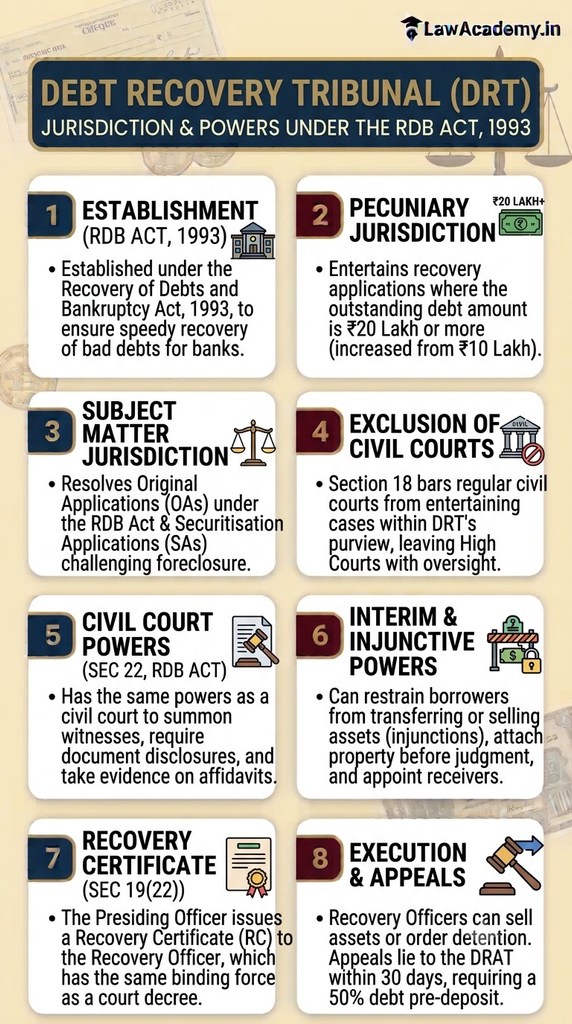
The Debt Recovery Tribunal (DRT) was established under the Recovery of Debts and Bankruptcy Act, 1993 (RDB Act) to provide a fast-track, specialized judicial mechanism for banks and financial institutions to recover their bad debts and non-performing assets (NPAs) without being bogged down by the lengthy procedures of regular civil courts.
Below is a detailed legal analysis of the jurisdiction, powers, and procedures of the DRT in India.
I. Jurisdiction of the Debt Recovery Tribunal (DRT)
The jurisdiction of a DRT is defined by geography, the type of case, the amount of money involved, and the specific laws it enforces.
1. Pecuniary (Monetary) Jurisdiction
- Minimum Threshold: The DRT has the jurisdiction to entertain debt recovery applications from banks and financial institutions where the debt amount is ₹20 lakh or more.
- Note: Prior to 2018, the threshold was ₹10 lakh, which was raised to ₹20 lakh by the Central Government to reduce the case burden on Tribunals.
- For debts below ₹20 lakh, banks must approach regular Civil Courts or use alternative recovery mechanisms.
2. Subject Matter & Statutory Jurisdiction
DRTs derive their authority from two primary legislations:
- Recovery of Debts and Bankruptcy Act, 1993 (RDB Act): Under Section 19, banks or financial institutions (including notified NBFCs) file an “Original Application” (OA) to recover outstanding dues from defaulting borrowers.
- SARFAESI Act, 2002: Under Section 17, any person (including a borrower, guarantor, or affected third party) aggrieved by the foreclosure or recovery actions taken by a bank (under Section 13(4)) can file a “Securitisation Application” (SA) to challenge those actions before the DRT.
- Insolvency and Bankruptcy Code (IBC), 2016: The DRT acts as the Adjudicating Authority for insolvency, bankruptcy, and debt resolution of Individuals and Partnership Firms (while the NCLT handles corporate debtors).
3. Territorial Jurisdiction
- Determined based on where the branch of the bank is located, where the defendant (borrower/guarantor) resides or carries on business, or where the cause of action (the default or loan agreement) arose.
4. Exclusion of Civil Court Jurisdiction (Section 18, RDB Act)
- No civil court has the jurisdiction to entertain any suit or proceeding in respect of matters falling within the purview of the DRT. Only High Courts (under Articles 226/227) and the Supreme Court retain constitutional oversight over DRT matters.
II. Powers of the Debt Recovery Tribunal (DRT)
The DRT is led by a Presiding Officer (PO) (qualified to be a District Judge) who possesses extensive powers to adjudicate disputes and enforce recovery. Under Section 22 of the RDB Act, the DRT is not bound by the strict, complex rules of the Code of Civil Procedure, 1908 (CPC), but is guided by the principles of natural justice, giving it the flexibility to act swiftly.
1. Powers of a Civil Court
The DRT has the same powers as a civil court under the CPC for the following tasks:
- Summoning and enforcing the attendance of any person and examining them on oath.
- Requiring the discovery and production of documents.
- Receiving evidence on affidavits.
- Issuing commissions for the examination of witnesses or documents.
- Reviewing its own decisions and dismissing an application for default or deciding it ex-parte.
2. Interim and Injunctive Powers
To prevent borrowers from shifting or hiding assets during a dispute, the DRT can issue the following orders:
- Interim Orders (Section 19(12), RDB Act): Can restrain a borrower from transferring, selling, or alienating their properties (injunction).
- Attachment of Property: Order the attachment of the borrower’s properties before a final judgment if there is a risk they will dispose of them.
- Disclosure of Assets: Direct the borrower/defendant to declare their assets under oath.
- Appointment of Receivers: Appoint a receiver to take possession, manage, or protect the secured assets.
3. Power to Issue Recovery Certificates (Section 19(22))
- Once the DRT decides in favor of the bank, the Presiding Officer issues a Recovery Certificate (RC).
- The RC is sent to the Recovery Officer (RO) of the Tribunal, which has the force of a court decree and initiates the actual recovery.
4. Execution Powers (via the Recovery Officer)
The Recovery Officer has extensive, direct powers to execute the Recovery Certificate, including:
- Attachment and sale of the debtor’s movable and immovable properties.
- Arrest and detention of the debtor in civil prison.
- Appointment of a receiver for the management or sale of properties.
- Attaching the debtor’s bank accounts or garnisheeing debts owed to them.
5. Power to Impose Fines and Penalties
- Can penalize parties for non-compliance with its orders, hiding assets, or filing false affidavits.
III. Appeal Process
- Any person aggrieved by an order of the DRT can file an appeal before the Debt Recovery Appellate Tribunal (DRAT) under Section 20 of the RDB Act or Section 18 of the SARFAESI Act.
- The appeal must be filed within 30 days of the DRT order.
- Pre-deposit Requirement: The borrower must deposit a minimum of 50% of the debt amount determined by the DRT (which the DRAT can reduce to 25%) before the appeal can be heard, preventing frivolous delays.