
Presumptions of a Negotiable Instrument under the Negotiable Instruments Act, 1881.
Presumptions of a Negotiable Instrument under the Negotiable Instruments Act, 1881.
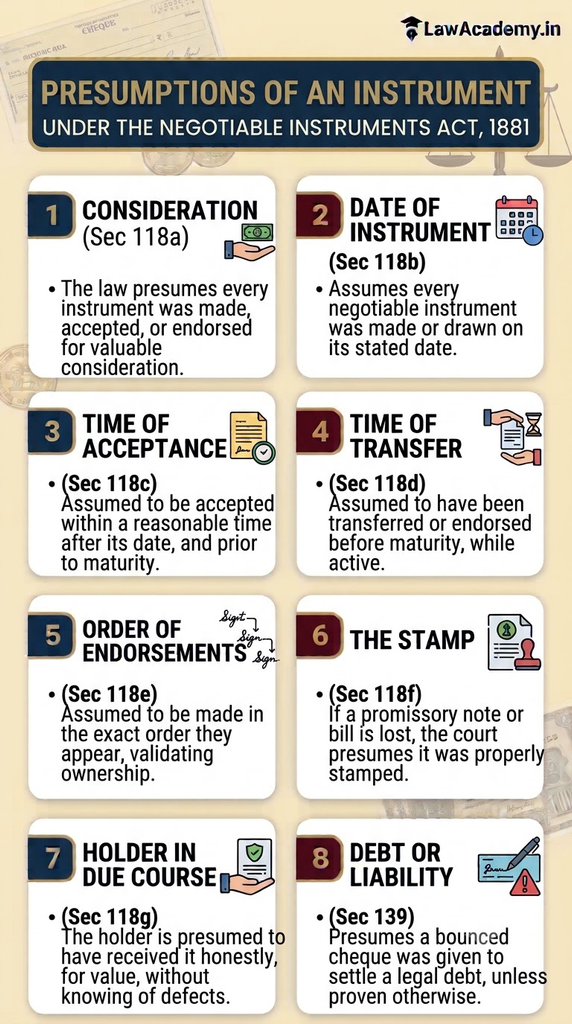
Under the Negotiable Instruments Act, 1881 (NI Act), negotiable instruments—such as promissory notes, bills of exchange, and cheques—carry special statutory privileges to ensure they can circulate freely in business. To prevent the holder from having to prove every single transaction detail in a dispute, the law establishes several powerful legal assumptions (presumptions) in their favor.
The primary rules governing these assumptions are found in Section 118 and Section 139 of the NI Act. Until the opposite is proven (rebutted) by the debtor, the court will take these facts for granted.
Special Presumptions under the NI Act, 1881
1. Consideration (Section 118(a))
- Presumption: Every negotiable instrument was made, drawn, accepted, endorsed, or transferred for valuable consideration (value or benefit), and not as a gift.
- Explanation: In a contract, the person demanding money must prove they gave something in return. Under the NI Act, the law already assumes the recipient provided valid service, goods, or value for the instrument. The debtor must prove otherwise.
- Example: If A signs a cheque for B, the court automatically assumes A owes B money or B gave some valuable service to A. B does not have to prove what he did to get that cheque unless A can show that no debt existed.
2. Date of Instrument (Section 118(b))
- Presumption: Every negotiable instrument bearing a date was made or drawn on that specific date.
- Explanation: Unless someone proves the date was back-dated, forged, or altered, the date written on the paper is considered the true date of its creation.
- Example: If a promissory note has “October 12, 2026” written on it, the court starts with the assumption that it was indeed signed on October 12, 2026.
3. Time of Acceptance (Section 118(c))
- Presumption: Every accepted bill of exchange was accepted within a reasonable time after its date, and before its maturity.
- Explanation: It is assumed the debtor accepted the bill of exchange promptly and prior to its expiration date, ensuring the transaction remains valid.
- Example: If B accepts A’s bill of exchange, the law presumes B did so responsibly during its active period, not long after it expired or was abandoned.
4. Time of Transfer (Section 118(d))
- Presumption: Every transfer or endorsement of a negotiable instrument was made before its maturity.
- Explanation: The transfer of the instrument is assumed to have occurred while it was still active and valuable, not after its deadline.
- Example: If B endorses a bill of exchange to C, it is presumed to have been handed over while the bill was still valid, and not after it expired.
5. Order of Endorsements (Section 118(e))
- Presumption: Endorsements appearing on a negotiable instrument were made in the exact order in which they appear on the paper.
- Explanation: This helps establish the chain of ownership. If multiple signatures appear on the back of a cheque (A, then B, then C), the law assumes A signed first, followed by B, and then C.
- Example: When B transfers to C, and C to D, it is assumed B’s transaction preceded C’s, verifying the continuity of the right to collect.
6. Stamp (Section 118(f))
- Presumption: A lost promissory note or bill of exchange was duly stamped.
- Explanation: In India, certain documents require government stamp duty. If the instrument is lost, the court assumes it had the correct stamps unless shown otherwise.
- Example: If A sues B on a lost promissory note, the court assumes it was properly stamped before loss, protecting the lawsuit from technical dismissals.
7. Holder in Due Course (Section 118(g))
- Presumption: The person holding the instrument (the holder) is a ‘Holder in Due Course’—meaning they got it in good faith, for value, and without knowing of any defects in title.
- Explanation: The law protects honest buyers. However, if it is proven the instrument was originally stolen, obtained by fraud, or through an offence, the holder must then prove they acquired it honestly.
- Example: If A is holding a cheque, the court assumes he is the rightful, honest owner who received it for value, and he doesn’t have to defend his possession until someone proves the cheque was stolen.
8. Debt or Liability (Section 139)
- Presumption: When a cheque is dishonored (Section 138), it is presumed the holder received the cheque for the discharge of a legally enforceable debt or liability.
- Explanation: This is a crucial rule for bounced cheque cases. When a cheque is returned unpaid, the court assumes the debtor gave it to settle an existing debt, rather than a personal favor or casual gift. The burden is entirely on the drawer to prove they did not owe anything.
- Example: If A’s cheque to B bounces, the court assumes A owed B that exact amount of money. A has to produce evidence to show that it was just a security cheque or there was no actual debt.