
Salient Features of the Banking Regulation Act, 1949
Salient Features of the Banking Regulation Act, 1949
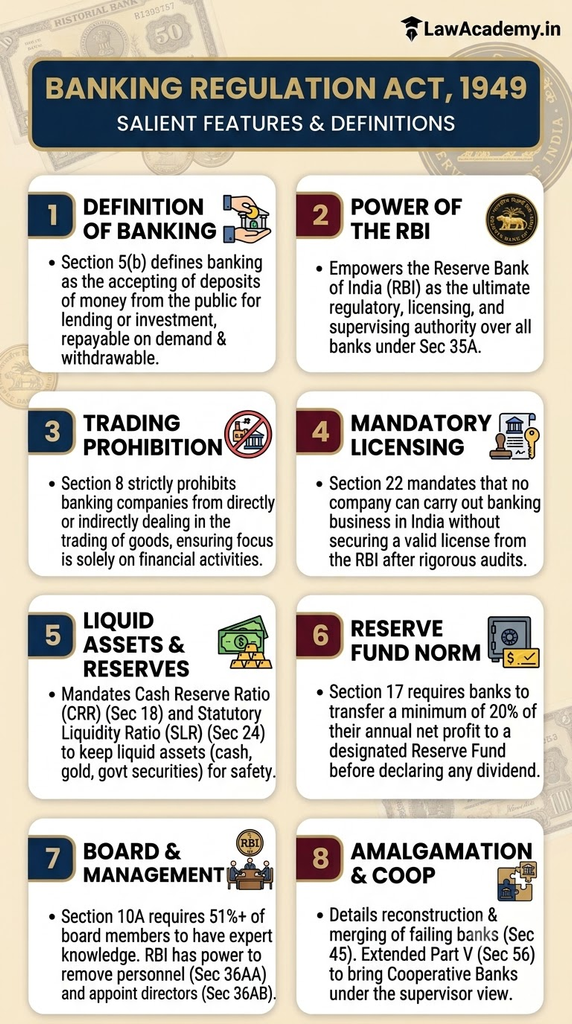
Definition of Banking
Under Section 5(b) of the Banking Regulation Act, 1949, “Banking” is defined as:
“The accepting, for the purpose of lending or investment, of deposits of money from the public, repayable on demand or otherwise, and withdrawable by cheque, draft, order or otherwise.”
From this statutory definition, four essential characteristics emerge:
- Acceptance of deposits from the general public.
- The deposits must be for the purpose of lending or investment.
- Deposits must be repayable on demand or at the expiry of a fixed tenure.
- Repayment must be withdrawable through recognized banking instruments (cheque, draft, electronic order, etc.).
Under Section 5(c), a “Banking Company” is defined as any company which transacts the business of banking in India.
Salient Features of the Banking Regulation Act, 1949
1. Comprehensive Regulatory Powers of the RBI
- The Act positions the Reserve Bank of India (RBI) as the supreme regulatory, supervisory, and licensing body over all commercial and cooperative banking institutions.
- Under Section 35A, the RBI has broad statutory powers to issue binding directions to banking companies in the public interest, in the interest of banking policy, or to prevent the affairs of any bank from being conducted in a detrimental manner.
2. Mandatory Licensing System (Section 22)
- No company can commence or carry on banking business in India without securing a valid statutory licence from the RBI.
- The RBI conducts strict due-diligence checks—evaluating capital adequacy, earning prospects, public interest, and the character of the management—before granting or cancelling a licence.
3. Prohibition of Non-Banking Trading Activities (Sections 6 & 8)
- Permitted Businesses (Section 6): Enumerates legitimate ancillary activities banks can engage in (such as borrowing, bill discounting, issuing letters of credit, foreign exchange, and safe deposit vaults).
- Prohibition of Trading (Section 8): Strictly prohibits banking companies from directly or indirectly dealing in the buying, selling, or bartering of goods (merchandise), except in connection with the realization of securities held against debts.
4. Disposal of Non-Banking Assets (Section 9)
- Banks are prohibited from holding any immovable property, however acquired (e.g., through default mortgage realization), for more than seven years, except property required for their own business use. The RBI may extend this period by up to five additional years.
5. Strict Capital Adequacy and Reserve Norms (Sections 11 & 17)
- Minimum Capital & Reserves (Section 11): Prescribes statutory requirements for minimum paid-up capital and reserves to ensure solvency.
- Reserve Fund (Section 17): Every banking company must transfer a minimum of 20% of its annual net profit to a designated Reserve Fund before any dividend can be declared.
6. Maintenance of Liquid Assets & Cash Reserves (Sections 18 & 24)
- Cash Reserve Ratio (CRR) / Cash Reserves (Section 18): Non-scheduled banking companies must maintain a designated percentage of their demand and time liabilities in cash or current accounts with the RBI.
- Statutory Liquidity Ratio (SLR) (Section 24): Banks must maintain a statutory percentage of their total demand and time liabilities in unencumbered liquid assets (cash, gold, or approved government securities) to ensure immediate liquidity.
7. Restrictions on Loans and Advances (Section 20 & 21)
- Prohibition on Own Shares (Section 20): A banking company cannot grant loans or advances against the security of its own shares, nor enter into commitments on behalf of any of its directors.
- Control Over Advances (Section 21): The RBI is empowered to control credit policy, fix lending rates, stipulate margins on secured advances, and restrict exposure to specific economic sectors.
8. Control Over Management and Board of Directors (Sections 10A, 36AA & 36AB)
- Professional Board (Section 10A): Not less than 51% of board members must possess specialized knowledge or practical experience in banking, accountancy, agriculture, rural economy, finance, or law.
- Removal of Personnel (Section 36AA): The RBI has the authority to remove any chairman, director, chief executive officer, or employee whose continuation is detrimental to the interests of depositors.
- Appointment of Additional Directors (Section 36AB): The RBI may appoint additional directors to safeguard depositor interests.
9. Inspection, Audit, and Account Disclosures (Sections 29, 30 & 35)
- Banks must prepare standardized annual financial balance sheets and profit & loss accounts (Form A & B under the Third Schedule) and submit them to audited scrutiny by qualified auditors.
- Under Section 35, the RBI has unhindered powers to inspect the books, registers, and operations of any banking institution.
10. Reconstruction, Moratorium, and Amalgamation (Sections 44A & 45)
- Voluntary Amalgamation (Section 44A): Outlines the procedure for merging banking companies upon approval by a two-thirds majority of shareholders and subsequent sanction by the RBI.
- Compulsory Reconstruction / Moratorium (Section 45): The Central Government, on the application of the RBI, can declare a moratorium suspending a failing bank’s operations to frame a scheme for reconstruction, revival, or compulsory amalgamation with another stable institution.
11. Extension to Cooperative Banks (Section 56)
- Through the addition of Part V (Section 56) in 1965, the provisions of the Act were extended to apply to State, District Central, and Primary Urban Co-operative Banks, subjecting them to the supervisory and prudential oversight of the RBI.