
Evolution of the Banking System in India
Evolution of the Banking System in India
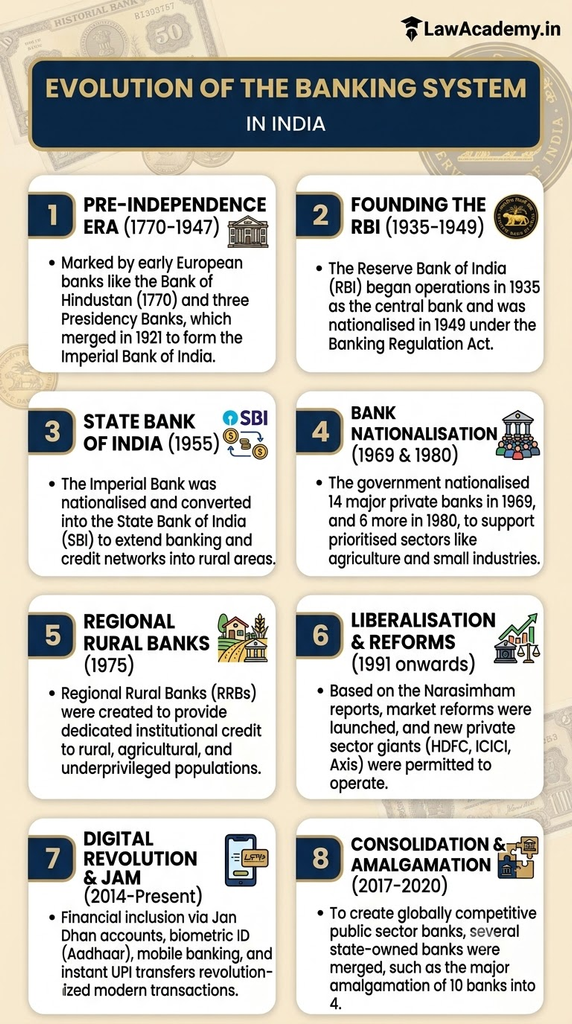
The evolution of the banking system in India has spanned over 250 years, transitioning from colonial-era agency houses to a robust, digitally driven global financial ecosystem. This journey can be categorized into three distinct historical phases.
Phase 1: The Pre-Independence Era (1770–1947)
During this period, banking was scattered, primarily privately owned, and heavily driven by colonial trade and the needs of British imperial finance.
- Earliest Modern Banks:
- Bank of Hindustan (1770): Established in Calcutta (Kolkata), this is considered the first modern bank in India (it failed in 1832).
- General Bank of India (1786–1791): The first joint-stock bank in the country.
- The Presidency Banks: Three major presidency banks were set up by the East India Company, which formed the bedrock of colonial finance:
- Bank of Calcutta (1806) (renamed the Bank of Bengal in 1809)
- Bank of Bombay (1840)
- Bank of Madras (1843)
- Imperial Bank of India (1921): These three Presidency Banks were amalgamated in 1921 to form the Imperial Bank of India, which functioned as a commercial giant and quasi-central bank.
- Establishment of the RBI (1935): Based on the recommendations of the Hilton Young Commission, the Reserve Bank of India (RBI) was established under the RBI Act, 1934, as the nation’s central bank and currency authority, commencing operations on April 1, 1935.
- Early Indigenous Banks: Nationalist sentiment led to the founding of several Indian-managed banks during the late 19th and early 20th centuries, such as Punjab National Bank (1894) and Bank of India (1906).
Phase 2: Post-Independence & The Nationalization Era (1947–1991)
Following independence, the banking sector was heavily fragmented, with hundreds of weak private banks. The state intervened to extend banking to rural regions, support agriculture, and secure national development.
- Regulation and Nationalization of RBI (1949): The RBI was nationalized on January 1, 1949. Crucially, the Banking Regulation Act, 1949 was enacted, empowering the RBI to regulate, supervise, and secure the operations of all Indian banks.
- Creation of the SBI (1955): In 1955, the government nationalized the Imperial Bank of India, converting it into the State Bank of India (SBI) to build a rural credit and treasury network.
- First Wave of Bank Nationalization (1969): Under Prime Minister Indira Gandhi, the government nationalized 14 major private commercial banks (with deposits exceeding ₹50 crore) to redirect credit toward the “priority sector” (agriculture, small-scale industries, and rural areas).
- Birth of Regional Rural Banks (1975): Regional Rural Banks (RRBs) were introduced on October 2, 1975, to provide dedicated institutional credit to rural and agricultural populations.
- Second Wave of Nationalization (1980): Six more private banks (with deposits exceeding ₹200 crore) were nationalized, placing nearly 90% of the country’s banking under state control.
Phase 3: Liberalization and the Modern Era (1991–Present)
By 1991, nationalization had expanded the banking network but had left many public sector banks inefficient, unprofitable, and plagued by non-performing assets. Economic crisis prompted structural reforms.
- Narasimham Committee Reforms (1991 & 1998): These benchmark reports recommended reducing reserve requirements (SLR and CRR), deregulating interest rates, and introducing international Basel prudential norms on capital adequacy and asset classification.
- Entry of New Private Sector Banks (1993): For the first time in decades, the RBI granted licenses to new-generation, tech-savvy private banks, leading to the rise of institutions like HDFC Bank, ICICI Bank, and Axis Bank.
- Securitisation Act (SARFAESI) (2002): This legislation allowed banks and financial institutions to auction residential or commercial properties of defaulting borrowers to recover bad loans without court intervention.
- The Jan Dhan-Aadhaar-Mobile (JAM) & Inclusion (2014 onwards): The Pradhan Mantri Jan Dhan Yojana (PMJDY) (launched in 2014) revolutionized financial inclusion by opening hundreds of millions of zero-balance bank accounts for the unbanked.
- Consolidation of Public Sector Banks (2017–2020): To create global-scale, financially viable public sector banks, the government amalgamated multiple state-owned banks, merging Associate Banks into SBI (2017) and consolidating 10 public sector banks into 4 large entities (2020).
- Technology & Digital Payments Revolution (2016 onwards): The launch of the Unified Payments Interface (UPI) in 2016 by the NPCI transformed India into a world leader in real-time retail digital transactions. Mobile apps, internet banking, and fintech collaborations became the industry norm.
- Differentiated Banking & Neo-Banks: To cater to targeted niches, the RBI introduced Payments Banks (e.g., Airtel Payments Bank) and Small Finance Banks (e.g., AU Small Finance Bank), alongside the rise of digital-only “neo-banking” partnerships.
- NPA Resolution & Legislative Modernization (2016–Present): The enactment of the Insolvency and Bankruptcy Code (IBC) in 2016 provided a time-bound, effective mechanism to recover stressed assets. Continued legislative support, including the Banking Laws (Amendment) Act, has continuously updated the regulatory framework to reflect evolving technological and security paradigms.