
Supreme Court Rules Section 17A PC Act Prior Approval Inapplicable to Illegal Bribe Demands
Supreme Court Rules Section 17A PC Act Prior Approval Inapplicable to Illegal Bribe Demands
No Shield for Bribery: Supreme Court Rules Section 17A PC Act Prior Approval Inapplicable to Illegal Bribe Demands
By LawAcademy Editorial Team
Published on October 23, 2026
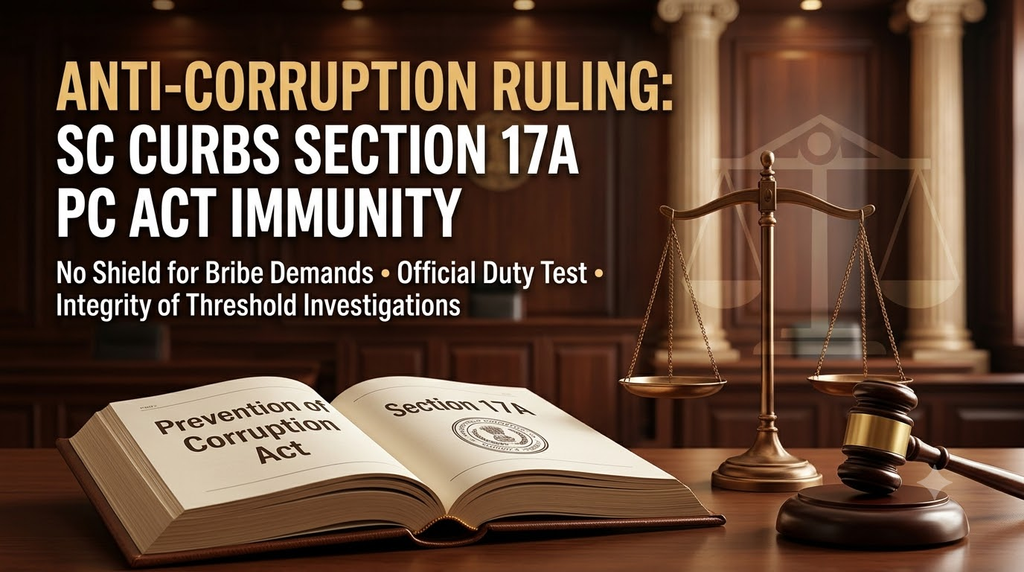
In a significant ruling sharpening the boundary between administrative immunity and anti-corruption enforcement, the Supreme Court of India held that prior approval under Section 17A of the Prevention of Corruption Act, 1988 (PC Act) is not mandatory to investigate a public servant accused of demanding or accepting illegal gratification.
A division bench comprising Justice S.V.N. Bhatti and Justice N.V. Anjaria dismissed the appeal in Tejaram v. State of Rajasthan (2026 INSC 1147), ruling that the mere status of an accused as a public servant does not automatically activate statutory protection. Section 17A was designed to insulate bona fide administrative decision-making from vexatious harassment, not to erect an evidentiary shield for standalone corrupt acts.
Factual Background
The appellant, a police constable with the Rajasthan Police, was booked by the Anti-Corruption Bureau (ACB) under Section 7 of the PC Act for allegedly demanding an illegal gratification of ₹1.5 lakh. The appellant challenged the initiation of the criminal proceedings and the framing of charges, contending that the investigating agency failed to secure prior approval from the competent authority under Section 17A before commencing the inquiry.
After the Rajasthan High Court dismissed his revision petition in March 2025, the appellant approached the Supreme Court, arguing that the absence of statutory pre-approval was a jurisdictional defect that rendered the entire prosecution void ab initio.
Core Legal Reasoning of the Supreme Court
Delivering the judgment for the bench, Justice N.V. Anjaria analyzed the precise legislative wording of Section 17A (inserted via the 2018 Amendment):
*”No police officer shall conduct any enquiry or inquiry or investigation into any offence alleged to have been committed by a public servant under# No Shield for Bribery: Supreme Court Clarifies That Prior Approval Under Section 17A PC Act Does Not Cover Illegal Bribe Demands
In a significant verdict defining the operational boundary of statutory protection for public servants, the Supreme Court of India held that Section 17A of the Prevention of Corruption Act, 1988 (PC Act) cannot be invoked to shield public officials accused of soliciting or demanding illegal gratification.
The Court clarified that the statutory requirement of prior administrative approval before initiating an inquiry, inquiry, or investigation applies exclusively to decisions taken or recommendations made in the discharge of official duties, and does not extend to corrupt acts such as demanding bribes.
Procedural Context and Statutory Ambience
Section 17A, introduced via the 2018 amendment to the PC Act, requires investigative agencies (such as the CBI or state anti-corruption bureaus) to secure prior approval from the competent authority before conducting any inquiry or investigation into an offense relatable to:
“any recommendation made or decision taken by such public servant in discharge of his official functions or duties.”
In the present case, a police constable facing trial for soliciting a bribe of ₹1.5 lakh challenged the initiation of criminal proceedings against him. He contended that the failure of the anti-corruption agency to obtain prior sanction under Section 17A before registering the First Information Report (FIR) vitiated the entire trial ab initio. The Rajasthan High Court dismissed his revision plea, after which the appellant approached the apex court.
Core Legal Reasoning of the Supreme Court
- Official Decisions vs. Extraneous Offenses: The bench of Justices S.V.N. Bhatti and N.V. Anjaria held that Section 17A was designed to insulate honest public servants against vexatious scrutiny for bona fide policy or administrative choices. Demanding an illegal gratification has no nexus to any legitimate administrative recommendation or official decision.
- Public Servant Status Alone Is Insufficient: The Court rejected the argument that merely occupying a public office attracts Section 17A. The threshold requirement demands a direct link between the alleged offense and an official function or duty.
- Preserving Investigative Efficacy in Bribery Cases: If Section 17A were stretched to cover trap cases, bribe solicitations, or corrupt demands, it would defeat the very purpose of anti-corruption statutes by forewarning delinquent officials before verification or covert operations could occur.
- Separation of Section 17A (Investigation Approval) and Section 19 (Prosecution Sanction): The Court reaffirmed that while statutory sanction under Section 19 of the PC Act (or Section 218 BNSS / Section 197 CrPC) applies at the stage of taking cognizance, Section 17A operates strictly at the threshold stage of investigation and cannot be weaponized to shut down preliminary probes into bribery.
Practical Takeaways for Criminal Practice & Legal Studies
- Trial Court Practice: Defense counsels cannot rely on a lack of Section 17A approval to seek discharge in cases where allegations directly disclose demand or acceptance of illegal gratification.
- Administrative Clarity: Investigating officers are not obligated to await bureaucratic approval prior to registering FIRs or laying traps when the gravamen of the complaint is an overt demand for bribe money.
Reference & Sources
- Case Title: Tejaram v. State of Rajasthan
- Neutral Citation: 2026 INSC 1147
- Date of Judgment: October 16, 2026
- Bench: Justice S.V.N. Bhatti and Justice N.V. Anjaria
- Official Judgment Source: Supreme Court of India Official Judgments Search (sci.gov.in)
- Statutory Reference: India Code: Section 17A of the Prevention of Corruption Act, 1988