
Suits by or Against Minors and Persons of Unsound Mind (Order 32, CPC)
Suits by or Against Minors and Persons of Unsound Mind (Order 32, CPC)
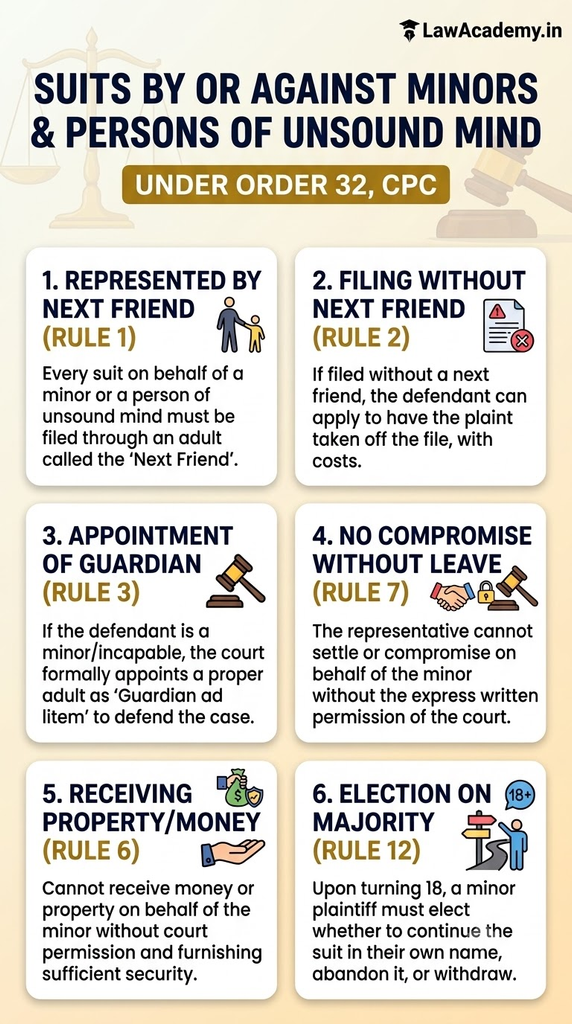
A Suit by or Against a Minor is a protective procedure ensuring that a person who has not attained majority (18 years under the Indian Majority Act, 1875, or 21 years if under a court guardian) or a person of unsound mind is properly represented by a legally capable adult to safeguard their substantive rights.
Representation of Minor Plaintiff by Next Friend (Order 32, Rule 1)
- Definition: Every suit instituted by or on behalf of a minor must be filed in the minor’s name through an adult person of sound mind known as the “Next Friend.”
- Example: A 12-year-old child suing through their maternal uncle as “Next Friend” to claim an insurance payout left by deceased parents.
Consequence of Filing Suit Without Next Friend (Order 32, Rule 2)
- Definition: If a plaint is presented on behalf of a minor without a next friend, the defendant may apply to have the plaint taken off the file, with costs awarded against the pleader or person who presented it.
- Example: A defendant demonstrating that the plaintiff is 16 years old and filed the recovery suit independently without any named adult representative, leading the court to take the plaint off the file.
Appointment of Guardian ad Litem for Minor Defendant (Order 32, Rule 3)
- Definition: Where the defendant is a minor, the court must formally appoint a proper adult with no adverse interest as the “Guardian for the suit” (Guardian ad litem) to defend the litigation.
- Example: In a partition suit naming a 14-year-old brother as a co-defendant, the court passes an order appointing the minor’s mother as his guardian ad litem after verifying her interests are not conflicting.
No Compromise Without Leave of Court (Order 32, Rule 7)
- Definition: A Next Friend or Guardian ad litem cannot enter into any agreement, settlement, or compromise on behalf of a minor without the express written leave of the court certifying that the compromise is for the minor’s benefit.
- Example: A father settling a damages claim for his injured 8-year-old son out of court for ₹1,00,000; the settlement is voidable against the child unless the trial judge examined the terms and granted formal leave under Rule 7.
Receipt of Property or Money under Decree (Order 32, Rule 6)
- Definition: A Next Friend or Guardian cannot receive any money, decree proceeds, or movable property on behalf of the minor without explicit permission of the court and furnishing sufficient security.
- Example: The court ordering that a ₹5,00,000 accident compensation decree awarded to a minor be deposited into a fixed deposit in a nationalized bank rather than disbursed directly in cash to the Next Friend.
Election on Attaining Majority (Order 32, Rules 12 & 13)
- Definition: When a minor plaintiff attains the age of majority during the pendency of the suit, they must elect whether to continue the litigation in their own name, abandon the claim, or repudiate it if filed as a co-plaintiff.
- Example: A minor turns 18 while a suit for declaration of title is pending; they file a memo discharging their Next Friend and elect to prosecute the action directly in their personal capacity.
Application to Persons of Unsound Mind (Order 32, Rule 15)
- Definition: All statutory rules under Order 32 regulating suits by and against minors apply equally to persons adjudged to be of unsound mind or found by the court upon inquiry to be mentally incapable of protecting their interests.
- Example: Appointing a court-approved guardian to defend an eviction suit instituted against an individual medically certified as suffering from severe dementia.