
Procedure of Execution under CPC
Procedure of Execution under CPC
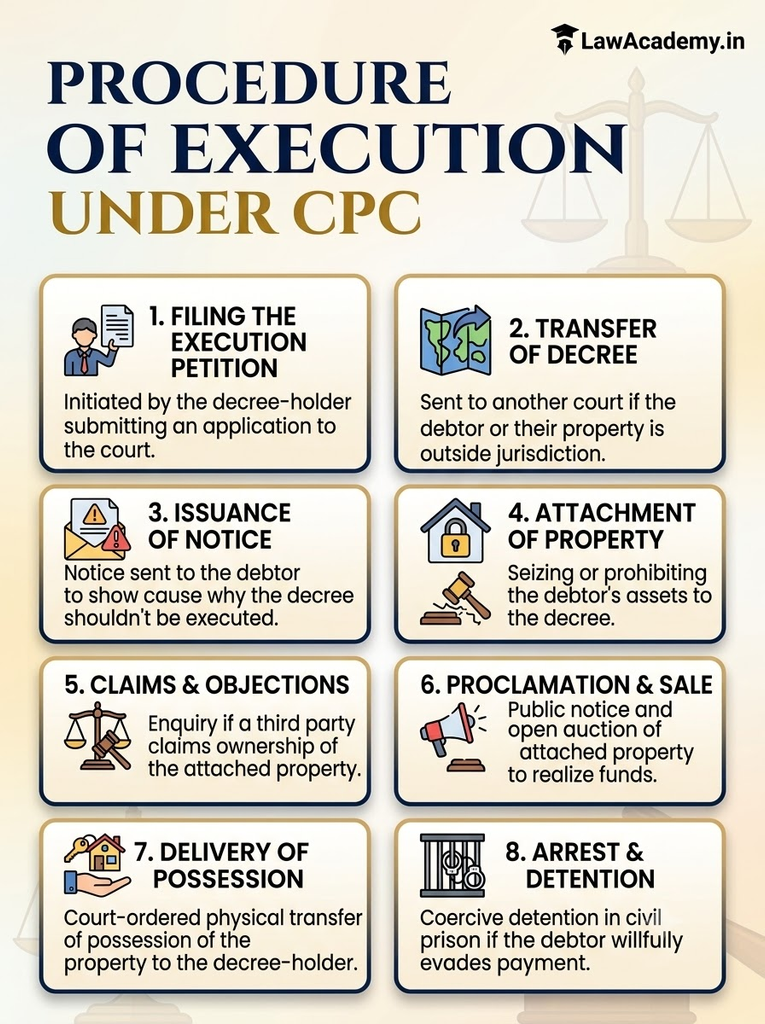
Procedure of Execution
1. Filing the Execution Petition (Order 21, Rules 10 & 11)
- Definition: The formal initiation of execution by the decree-holder submitting an application containing specified particulars (suit number, parties, date of decree, relief sought, and mode of execution) to the competent court.
- Example: Filing an Execution Petition (EP) within the 12-year limitation period before the trial court specifying that ₹5,00,000 remains unpaid under the money decree.
2. Transfer of Decree for Execution (Sections 38–39)
- Definition: The process whereby the court that passed the decree sends it to another court of competent jurisdiction because the judgment-debtor resides, works, or holds property outside the original court’s territorial limits.
- Example: A civil court in Bengaluru transferring a money decree along with a non-satisfaction certificate to a court in Chennai, where the judgment-debtor owns real estate.
3. Issuance of Notice to Show Cause (Order 21, Rule 22)
- Definition: A mandatory statutory notice issued to the judgment-debtor requiring them to show cause why the decree should not be executed (compulsory if the application is made more than two years after the decree or against legal representatives).
- Example: Issuing a notice to the legal heirs of a deceased judgment-debtor directing them to appear and explain why the inherited estate should not be seized to satisfy the decree.
4. Attachment of Property (Sections 60–64 & Order 21, Rules 41–54)
- Definition: The legal seizure or prohibition of the judgment-debtor’s movable or immovable assets, rendering any private transfer or alienation of such property void against execution claims.
- Example: Issuing a prohibitory order under Order 21, Rule 54 prohibiting a landowner from selling or mortgaging their agricultural land until the decretal debt is satisfied.
5. Adjudication of Claims and Objections (Order 21, Rules 58–103)
- Definition: The formal enquiry conducted by the executing court when a third party objects that the attached property belongs to them and not to the judgment-debtor.
- Example: A third party filing an objection under Order 21, Rule 58 showing a registered sale deed executed prior to the attachment, proving independent ownership of the seized property.
6. Proclamation and Court Auction Sale (Order 21, Rules 64–96)
- Definition: The public notification, publication, and subsequent open auction of attached property conducted under court supervision to realize proceeds for the decree-holder.
- Example: Publishing an auction notice in local newspapers stating the estimated value, encumbrances, and date of the public auction of the debtor’s commercial office space.
7. Delivery of Possession (Order 21, Rules 35 & 36)
- Definition: The physical or symbolic transfer of specific movable or immovable property from the judgment-debtor to the decree-holder through a court bailiff.
- Example: Deputing a court bailiff with police assistance to remove an unauthorized occupant, break locks if necessary, and hand over actual vacant possession of a residential flat to the owner.
8. Arrest and Detention in Civil Prison (Sections 51, 55–59 & Order 21, Rules 37–40)
- Definition: The coercive physical detention of a recalcitrant judgment-debtor in a civil prison after establishing that they possess the financial means to pay but are deliberately evading or refusing compliance.
- Example: Committing a dishonest debtor to civil prison for up to three months after the court finds that they transferred company funds into clandestine accounts to evade paying a commercial debt.