
General Principles of Execution under CPC
General Principles of Execution under CPC
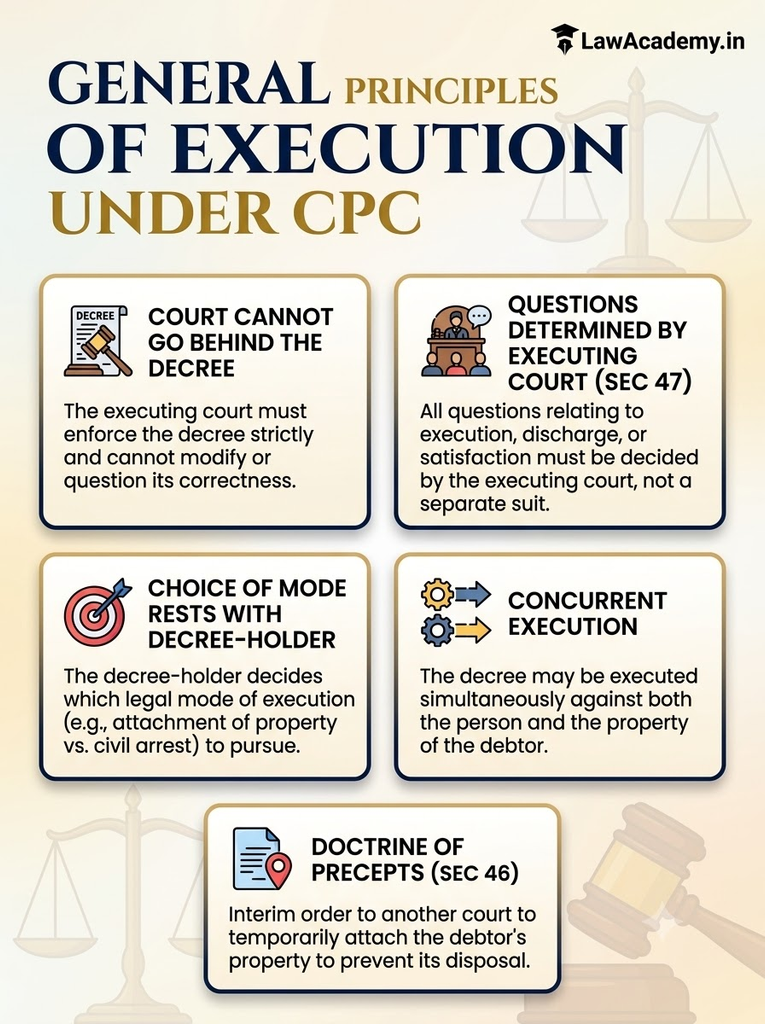
Execution is the enforcement, realization, or implementation of a decree or an order passed by a court of law, compelling the judgment-debtor to perform the obligation decreed against them so the decree-holder obtains the actual fruits of the litigation (governed by Sections 36 to 74 and Order 21 of the Code of Civil Procedure, 1908).
General Principles of Execution
Executing Court Cannot Go Behind the Decree
- Definition: The executing court must enforce the decree strictly as it stands and has no jurisdiction to question its correctness, legality, or modify its terms.
- Example: If a trial court erroneously decrees interest at 18% per annum, the executing court cannot reduce it to 6% during execution proceedings; it must execute the decree as drawn.
Questions to Be Determined by the Executing Court (Section 47)
- Definition: All questions arising between the parties relating to the execution, discharge, or satisfaction of a decree must be decided by the executing court itself, rather than by a separate, independent suit.
- Example: If a judgment-debtor claims that they already paid the decretal amount directly to the decree-holder out of court, this plea must be adjudicated by the executing court under Section 47, not through a fresh recovery suit.
Choice of Mode Rests with the Decree-Holder
- Definition: Subject to statutory limitations, the decree-holder has the primary prerogative to decide which prescribed legal mode of execution to pursue against the judgment-debtor.
- Example: In a money decree, the decree-holder may opt to execute the decree by attaching the debtor’s bank account rather than attaching their immovable residential plot.
Concurrent Execution
- Definition: A decree-holder may simultaneously seek execution of a decree against the person as well as the property of the judgment-debtor, subject to the court’s equitable discretion.
- Example: A creditor filing an application to attach the debtor’s commercial vehicle while simultaneously seeking a warrant for their civil imprisonment to prevent flight.
Doctrine of Precepts (Section 46)
- Definition: An interim order issued by the court that passed the decree to another competent court to temporarily attach the debtor’s property located within that other court’s jurisdiction to prevent its disposal.
- Example: A civil court in Karimnagar issuing a precept to a civil court in Hyderabad to immediately attach the judgment-debtor’s warehouse pending formal transfer of the decree for execution.