
Different kinds of Jurisdiction under CPC, 1908
Different kinds of Jurisdiction under CPC, 1908
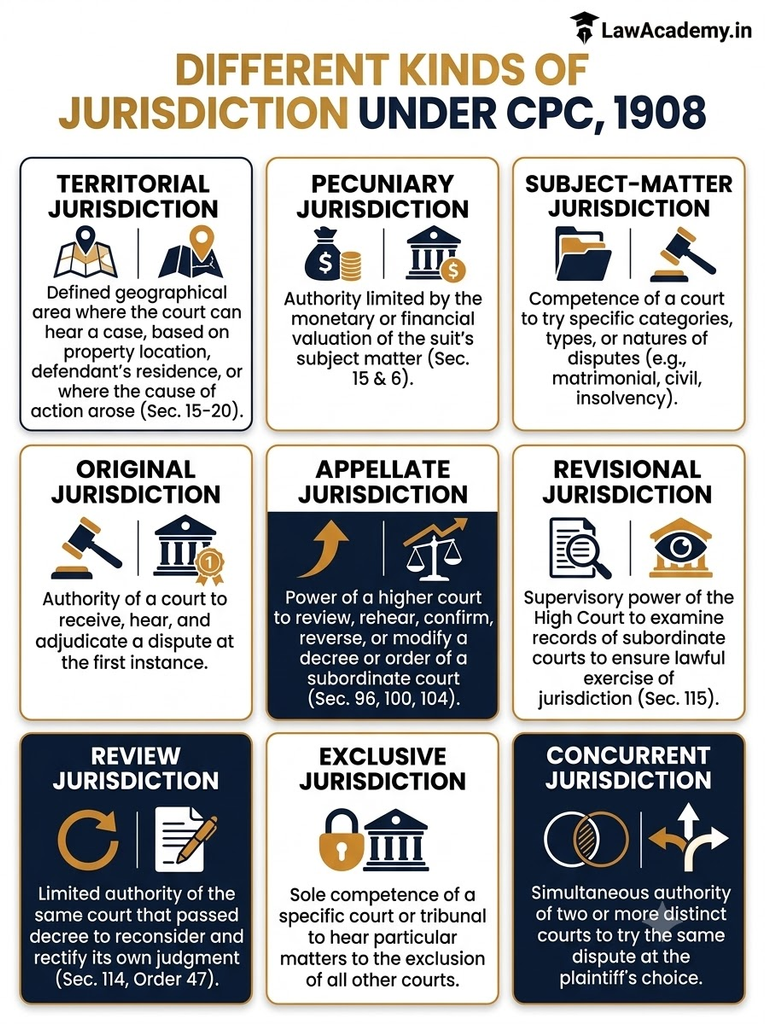
Jurisdiction is the legal authority, power, and competence of a court to hear, try, and determine a cause, action, or matter brought before it and to pass enforceable orders or decrees.
Territorial (Local) Jurisdiction
- Definition: The authority of a court confined to a defined geographical area, determined by the location of the subject property, the defendant’s residence or place of business, or where the cause of action arose (Sections 15–20).
- Example: A suit for partition of agricultural land situated in Karimnagar must be filed in the competent civil court within Karimnagar district, not in Bengaluru.
Pecuniary Jurisdiction
- Definition: The power of a court to try suits strictly within a specified monetary or financial valuation limit of the suit’s subject matter (Section 6 and Section 15).
- Example: If a Junior Civil Judge’s statutory limit is up to ₹20,00,000, a recovery suit valued at ₹50,00,000 cannot be entertained by that court and must be instituted before the Senior Civil Judge or District Court.
Subject-Matter Jurisdiction
- Definition: The competence of a court to entertain and decide disputes of a specific nature, class, or category.
- Example: A regular Civil Court lacks jurisdiction to entertain industrial disputes or consumer complaints, which are reserved specifically for Labour Courts/Industrial Tribunals or Consumer Fora.
Original Jurisdiction
- Definition: The authority of a court to receive, hear, try, and decide a dispute at the first instance, rather than in an appeal or revision.
- Example: A suit for recovery of money or permanent injunction filed initially before a Court of the Junior Civil Judge is heard under its original jurisdiction.
Appellate Jurisdiction
- Definition: The power of a superior court to rehear, review, reverse, modify, or uphold a decree or appealable order passed by a subordinate court (Sections 96, 100, and 104).
- Example: A District Court hearing a First Appeal under Section 96 against a decree passed by a Senior Civil Judge.
Revisional Jurisdiction
- Definition: The supervisory power of the High Court to examine subordinate court records in non-appealable decided cases to correct illegal, irregular, or excess exercise of jurisdiction (Section 115).
- Example: The High Court entertaining a revision petition against an order of a Trial Court refusing to reject a plaint under Order 7 Rule 11 where no statutory appeal lies.
Review Jurisdiction
- Definition: The statutory power of the very court that pronounced a judgment or order to re-examine and correct it on grounds of discovery of new vital evidence or an error apparent on the face of the record (Section 114 and Order 47).
- Example: A Civil Judge reconsidering an eviction decree because an arithmetic calculation error in calculating rent arrears was evident on the face of the judgment.
Exclusive Jurisdiction
- Definition: The sole and uninterrupted power conferred on a specific court or tribunal to try a particular class of cases to the complete exclusion of all other judicial bodies.
- Example: The National Company Law Tribunal (NCLT) possesses exclusive jurisdiction over corporate insolvency and winding-up proceedings under the Insolvency and Bankruptcy Code (IBC).
Concurrent (Coordinate) Jurisdiction
- Definition: The co-existing, parallel power of two or more distinct courts to entertain and decide the same matter, giving the plaintiff or petitioner the option to approach either forum.
- Example: Where a breach of contract occurs in City A but the defendant resides in City B, both the Civil Court at City A and the Civil Court at City B have concurrent territorial jurisdiction to entertain the suit.