
BCI Mandates Strict Disability Accommodations and Scribe Guidelines for AIBE
BCI Mandates Strict Disability Accommodations and Scribe Guidelines for AIBE
Ensuring Equal Access: BCI Mandates Strict Disability Accommodations and Scribe Guidelines for AIBE
By LawAcademy Editorial Team
Published on October 5, 2026
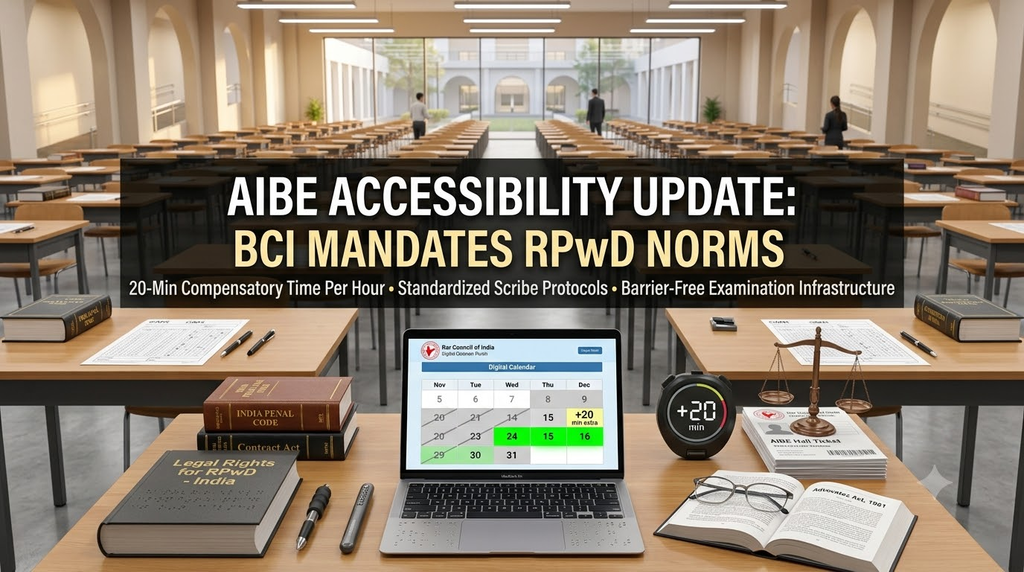
To enforce barrier-free testing across national examination centres, the Bar Council of India (BCI) issued a comprehensive compliance advisory governing reasonable accommodations for candidates with disabilities appearing for the All India Bar Examination (AIBE).
The advisory enforces uniform adherence to the Rights of Persons with Disabilities (RPwD) Act, 2016 and Ministry of Social Justice and Empowerment guidelines, ensuring that test centres do not arbitrarily deny compensatory time or scribe facilities to eligible law graduates.
Core Accessibility Directives
- Compensatory Extra Time: Candidates with benchmark disabilities (disability of 40% or more) are entitled to compensatory time of 20 minutes per hour of examination. For the standard 3-hour AIBE paper, this guarantees an additional 60 minutes, extending the testing duration to four hours.
- Independent Entitlement to Compensatory Time: The Council reiterated that compensatory time must be granted to all eligible candidates with benchmark disabilities regardless of whether they avail themselves of a scribe.
- Streamlined Scribe Deployment:
- Candidates are permitted to either bring their own scribe or request the examination center superintendent to allocate an authorized scribe.
- To prevent center-level harassment, invigilators cannot disqualify a candidate’s scribe on arbitrary criteria on exam morning, provided the scribe complies with statutory qualification norms (must not possess a degree in law or be a candidate for the same exam cycle).
- Physical Infrastructure & Ground-Floor Seating: Center superintendents must ensure wheelchair accessibility, accessible ramps, tactile signage, and designated ground-floor seating for candidates with locomotor challenges and visual impairments.
- Digital Accommodations & Braille Support: Specialized formats, including enlarged print question papers, screen-reader-compatible terminals, or assistive Braille inputs, must be provided for candidates who pre-registered under the respective visual impairment categories.
Curbing Administrative Discrepancies at Centers
During past exam cycles, multiple candidates with disabilities encountered discrepancies where individual testing centres refused scribes, withheld extra time, or demanded unnotified affidavits on the day of the exam.
The BCI clarified that a valid Disability Certificate or Unique Disability ID (UDID) card issued by a competent government medical authority submitted during online verification is conclusive proof of eligibility. Center superintendents face disciplinary and regulatory penalties if they alter these accommodations locally.
Reference & Source
- Issuing Authority: Bar Council of India (BCI) / Directorate of Legal Education.
- Statutory Compliance: Rights of Persons with Disabilities (RPwD) Act, 2016 (Sections 3, 16, 21); Ministry of Social Justice and Empowerment O.M. on Conduct of Written Exams for PwBDs.
- Judicial Reference: Vikash Kumar v. UPSC (Supreme Court directives on reasonable accommodation in public examinations).