
Halting ‘Bulldozer Justice’
Halting 'Bulldozer Justice'
Halting ‘Bulldozer Justice’: Supreme Court Imposes Pan-India Freeze on Extrajudicial Demolitions
By LawAcademy Editorial Team
Published on October 4, 2026
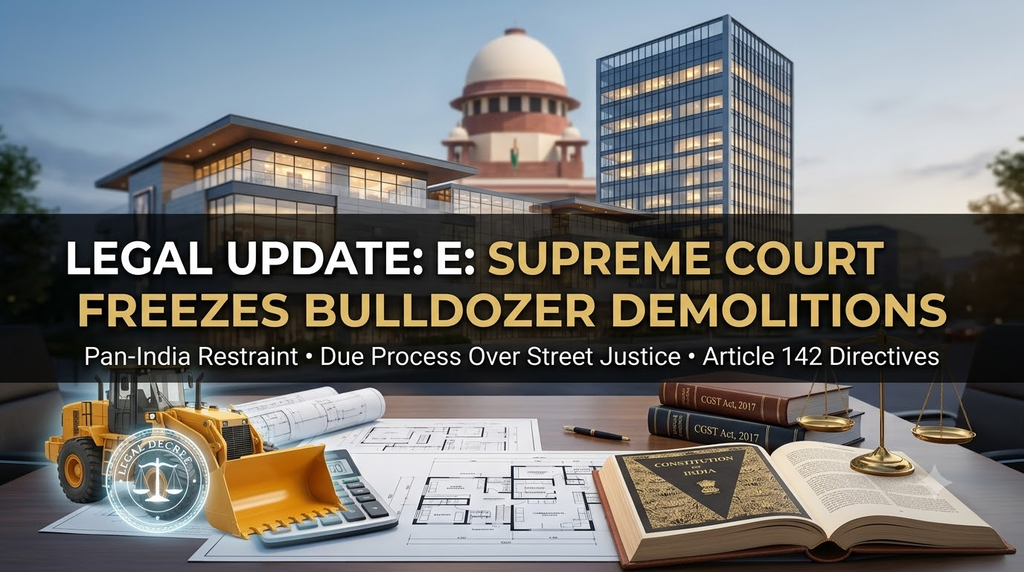
In a decisive move to protect the rule of law and the separation of powers, the Supreme Court of India stepped in against the practice of punitive property destructions. The bench ordered that no demolition of properties across the country shall take place without seeking prior leave of the Court.
Invoking its constitutional powers under Article 142, a division bench comprising Justices B.R. Gavai and K.V. Viswanathan observed that an executive authority cannot act as judge, jury, and executioner by razing the properties of persons merely because they are accused or convicted of a criminal offence.
Key Takeaways of the Order
- Pan-India Restraint: The Court directed that no municipal or state authority shall demolish the home, commercial establishment, or property of any citizen nationwide without obtaining explicit permission from the Supreme Court.
- Rejection of Collective Punishment: The bench observed that the law does not permit demolishing a family’s dwelling simply because one resident is implicated in an FIR. Such acts undermine the presumption of innocence and violate Article 21 (Right to Shelter & Dignity).
- Strict Accountability for Erring Officers: The Court warned that officials carrying out unauthorized demolitions in defiance of due process or out of malice will face contempt proceedings, disciplinary action, and personal financial liability for compensation.
- Limited Statutory Exceptions: The interim stay does not shield encroachments situated on public spaces, such as public roads, pedestrian footpaths, water bodies, or active railway lines, nor does it override formal demolition decrees already passed by a competent court of law.
Upholding Due Process Over Retributive Governance
The Supreme Court’s order directly addressed situations where civic bodies bypassed statutory notice timelines to target alleged offenders shortly after a crime was reported.
Justice Viswanathan highlighted that the executive’s role is restricted to investigating crimes and prosecuting offenders before independent judicial forums. Demolitions conducted as instant street justice bypass statutory safeguards such as the mandatory 15-day show-cause notice, appellate review, and opportunities for compounding or regularizing building infractions.
Reference & Source
- Matter: In Re: Directions in the Matter of Demolition of Structures (Writ Petition (Civil) No. 295 of 2022 and connected applications)
- Bench: Justices B.R. Gavai and K.V. Viswanathan
- Date of Interim Order: September 17
- Constitutional Provisions: Article 21, Article 142, and Article 300A of the Constitution of India.